

The Classroom of Choice: 100+ Strategies to Reach and Teach Every Learner, 2nd edition
By Jonathan C. Erwin
(ASCD, 2025 – Learn more)
Reviewed by Angela Lee
 The second edition of Jonathan Erwin’s The Classroom of Choice first appealed to me based on my strong belief in student choice in the classroom. I was amazed, however, in what was included as “student choice” in this book, including their own behavior!
This book is for teachers, new and experienced, looking for ways to “lay the foundation” or strengthen their classrooms/curriculum using Choice Theory so that students may thrive as learners and humans.
Each chapter has specific, ready to use, research based strategies that you may choose from based on the grade you teach and your students’ needs. While many of the strategies are well known among educators, (journal writing and mind maps, for example) there are many unique strategies in the book as well.
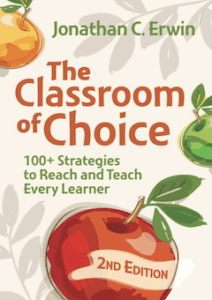 The nearly 300-page book begins with a rationale which explains what it means to lay the foundation for a classroom of choice, the components of a classroom based on choice, and the chapters in the book that correlate with each component. This organizational format is helpful and used throughout the book to guide the reader to other chapters that connect to information presented.
Chapter 2, ”Survival in the Classroom,” touches on basic human needs as well as the need for a sense of safety, security and order, which includes classroom procedures and routines. Chapter 3 discusses the need for students to feel love and belonging in the classroom. This chapter includes ways to connect with your students and develop positive relationships with them.
These two chapters provide multiple strategies to help teachers meet the basic needs of students (procedures for quieting a class and procedures for students seeking help, for example) and to help students feel love and belonging in the classroom (examples: human scavenger hunt and people bingo).
Chapter 4, “Creating an Empowering Environment,” includes ways to empower students which can help them take ownership of their own learning while intrinsically motivating them to learn. Strategies in this chapter include ways to celebrate student success (and when) and writing a class constitution with students.
Chapter 5, the longest chapter in the book, looks at other ways that teachers can empower students socially, emotionally, and academically. The ‘“car” metaphor for total behavior and teaching this concept to students really resonated with me. When given the tools needed to “choose” appropriate classroom behavior, students are more likely to make a positive choice.
The author provides examples of ways to teach this to students such as identifying when they have felt a particular emotion and what they have control over when they feel those emotions (their thoughts and actions). I thought about times when I have expected students to know how to act after feeling an emotion; this is difficult when they have not been taught how to handle these challenging situations. Empowering students by teaching them that they have control over their thoughts and actions when they feel a specific emotion is a critical tool when creating a positive classroom environment.
In Chapter 6, “Freedom in the Classroom,” Erwin writes about students having the ‘freedom to” when it comes to choices, as well as the “freedom from” routine and the threat of failing grades. Erwin also discusses his belief in mastery learning, which he uses in his own classroom. Mastery learning requires students who do not meet the standard with a passing grade to receive feedback and reteaching along with enrichment activities which allow them to meet the standard they are striving for.
The last chapter, “Fun in the Classroom,” provides strategies and rationale for students having fun while learning. The author provides examples of physical games, mind games, and “just plain fun and games” for teachers to choose from and/or adapt in their classroom.
I highly recommend this book for any teacher who is looking to build strong relationships with students while giving them choices to help them learn as they grow.
Angela Lee has taught English Language Arts in the School District of Oconee County in upstate South Carolina for 30 years. She obtained her Masters plus 30 and is a certified National Board teacher. She started teaching at the high school level where she taught for 17 years and then moved to the middle school level, teaching 6th and 8th grade language arts for 13 years. In addition to her brick and mortar teaching position, she teaches part time with South Carolina’s virtual school, VirtualSC. In her spare time, she enjoys Jazzercising, reading, needlepointing, and watching the Clemson Tigers play.

