I was riding a stuffy, creaking, green VW bus from the center of Kathmandu to Dhamma Shringa when it began to hail.
Having arrived in Nepal three days earlier, I was getting familiar with monsoon season’s weather pattern: each oppressively humid day gave way to a fleeting but intense afternoon shower, so timing-wise, this storm was typical.
The frozen pellets pounding down from the sky, however, were not.
I was on the last bus to Dhamma Shringa, a Vipassana Meditation Center on the northern edge of the Kathmandu Valley, where I’d soon be participating in a silent, ten-day meditation course. In good weather, the campus is about a half an hour ride from the City Offices, where I’d arrived that morning for course registration, but as hail clattered the bus and transformed into a whipping rain, the hillside paths turned to mud, and our bus began to slow.
Then it stalled.
Then it stopped.
No one I knew meditated, I didn’t grow up around yogis, and if my grandfather was aware of the amount of time I’ve spent barefoot in public, he’d probably want to die all over again.
Word came down from those ahead that the roads were too muddy and dangerous to drive, so a few miles downhill, we were instructed to gather our bags and hike the rest of the way.
Someone smarter than me might have taken this as a sign.
I kept trudging onwards.
Beginner’s Mind
Looking back, I’m still not sure where the idea to meditate came from.
I’m descended from a long line of repressed Irish-Catholics from Springfield, Massachusetts. Growing up, I never saw my grandfather in a pair of shorts: he exclusively wore sweaters, button-ups, and pressed slacks, only ever compromising with a golf shirt at my sister’s August birthday parties.
To this day, there is no evidence that he actually had knees.
No one I knew meditated, I didn’t grow up around yogis, and if my grandfather was aware of the amount of time I’ve spent barefoot in public, he’d probably want to die all over again.
In my mid-20’s, however, I began facing bouts of anxiety and depression that had previously been unfamiliar to me. Until that point, I’d never had any difficulty being happy, but as those feelings became more elusive, I knew I needed to do something different.
For some reason that still eludes me, I thought meditation might help, and one afternoon, I downloaded Headspace and began practicing for ten minutes before work each morning.
And even though I could tell early on in the process that meditation was working, I still didn’t plan on telling anyone I meditated.
I also didn’t plan on teaching meditation, or teaching teachers to teach meditation—but in hindsight, the path seems to take you where it takes you.
Three or four days into this new morning routine, I was on the phone with my dad and told him, “I’m going to try this meditation thing, but I don’t want it to change who I am.”
Two years later, he was driving me to JFK for a flight to Nepal, so I could take part in a silent meditation retreat.
I thought of that conversation, and from deep inside, I smiled.
Going Public
After graduating college in 2010, I was hired as a boarding faculty member at Wilbraham & Monson Academy, where I taught English for fourteen years.
In 2018, two of the school’s young alumni died by suicide, one of whom had previously been my advisee.
Shortly thereafter, a student named Evan lost a friend from his hometown, also to suicide, and in the wake of this, decided to speak about mental health at the next All-School Meeting.
I was about a year into my practice at the time and had no plans of coming out as a meditator.
I was about a year into my practice at the time and had no plans of coming out as a meditator. Evan, however, was not much of a public speaker, so I offered to speak alongside him: he would offer resources for anyone struggling with mental health, and I would present Headspace as a tool for managing stress and anxiety.
After Evan’s few minutes on stage that afternoon, I walked to the podium, cycled through a few slides, and played a video of Andy Puddicombe leading a two-minute meditation on The Tonight Show with Jimmy Fallon, which all seemed warmly received within the auditorium.
When I walked outside, however, the Head of School—Brian Easler, a former Army Ranger that still has an air of Special Forces about him—was waiting for me.
I assumed one of my clumsy attempts at humor had gone sideways, my nerves leading me to say something I probably shouldn’t have.
Luckily, though, the conversation went something like this:
BRIAN: “We need to bring meditation to campus.”
BILLY: “I couldn’t agree more.”
BRIAN: “Yeah, we could really use someone to teach meditation on campus.”
BILLY: “Yeah, we should find someone to teach meditation on campus.”
BRIAN (exasperated): “…I want it to be you, dummy.”
Or at least that’s my memory of it.
The Boston Buddha
Brian told me to find a meditation teacher training. The school would pay for it, and when finished, I would, in fact, be the one to bring meditation to campus.
I returned with the Boston Buddha.
“I started meditating to fall asleep,” Andy Kelley often says. “Now, I meditate to fall awake.”
More familiarly, the Boston Buddha is Andy Kelley, a fellow working-class, Irish-Catholic, who arrived to meditation to manage stress and help with sleep, never anticipating that he’d someday leave his career as a TV news producer to teach meditation.
“I started meditating to fall asleep,” he often says. “Now, I meditate to fall awake.”
I first met Andy at Stil Studio in Dedham, Massachusetts on a Friday in November: it was the opening night of his 100-Hour “Meditation for Everyone” Teacher Training, and given the fact that I’d never actually meditated with another person before, I arrived with no small amount of apprehension.
Whatever anxiety I felt, however, was immediately assuaged by how regular Andy was. Most weekends, he sat in the front of the room in a Celtics zip-up and a navy baseball hat, and once during a Patriots playoff game, he draped himself in a team-branded snuggie for good luck, which I found strangely comforting.
He was also funny—not just teacher funny, more “your-buddy-at-the-end-of-the-bar” kind of funny—and of all of his lines, the one that’s been most helpful is, “Go into every room assuming half the people are going to love you and half the people are going to think you’re full of shit.”
Andy was proof that personality doesn’t need to be washed away by practice. You actually get to keep it, you just hold it more lightly.
I graduated from the program in the spring of 2019, but had never led a “real” meditation outside of Andy’s program. A sense of Imposter Syndrome was beginning to simmer.
In a few months, I’d be the person at the front of the room expected to have the answers, and l still felt like I didn’t know enough, hadn’t practiced enough, wasn’t prepared enough to take on that role.
I was just sitting on the floor, breathing, trying to be a better person.
Whatever cool shit is supposed to happen before you become a real meditation teacher hadn’t happened to me.
I was just sitting on the floor, breathing, trying to be a better person.
I decided to go to Nepal.
Vipassana
At the arrival gate of Tribhuvan International Airport, a Customs Officer asked me the purpose of my visit to Nepal. I told him I was there for a Vipassana Course at Dhamma Shringa Meditation Center.
He laughed.
“Vipassana is very harsh. I tried it once and only made it seven days,” he said. “All your sins will be revealed.”
It was May 29th—two days before my 31st birthday—and by that point, I had been traveling for well over twenty-four hours. Truth be told, I was hoping for a warmer welcome than “all your sins will be revealed,” but as my mom always told us, “You get what you get and you don’t get upset.”
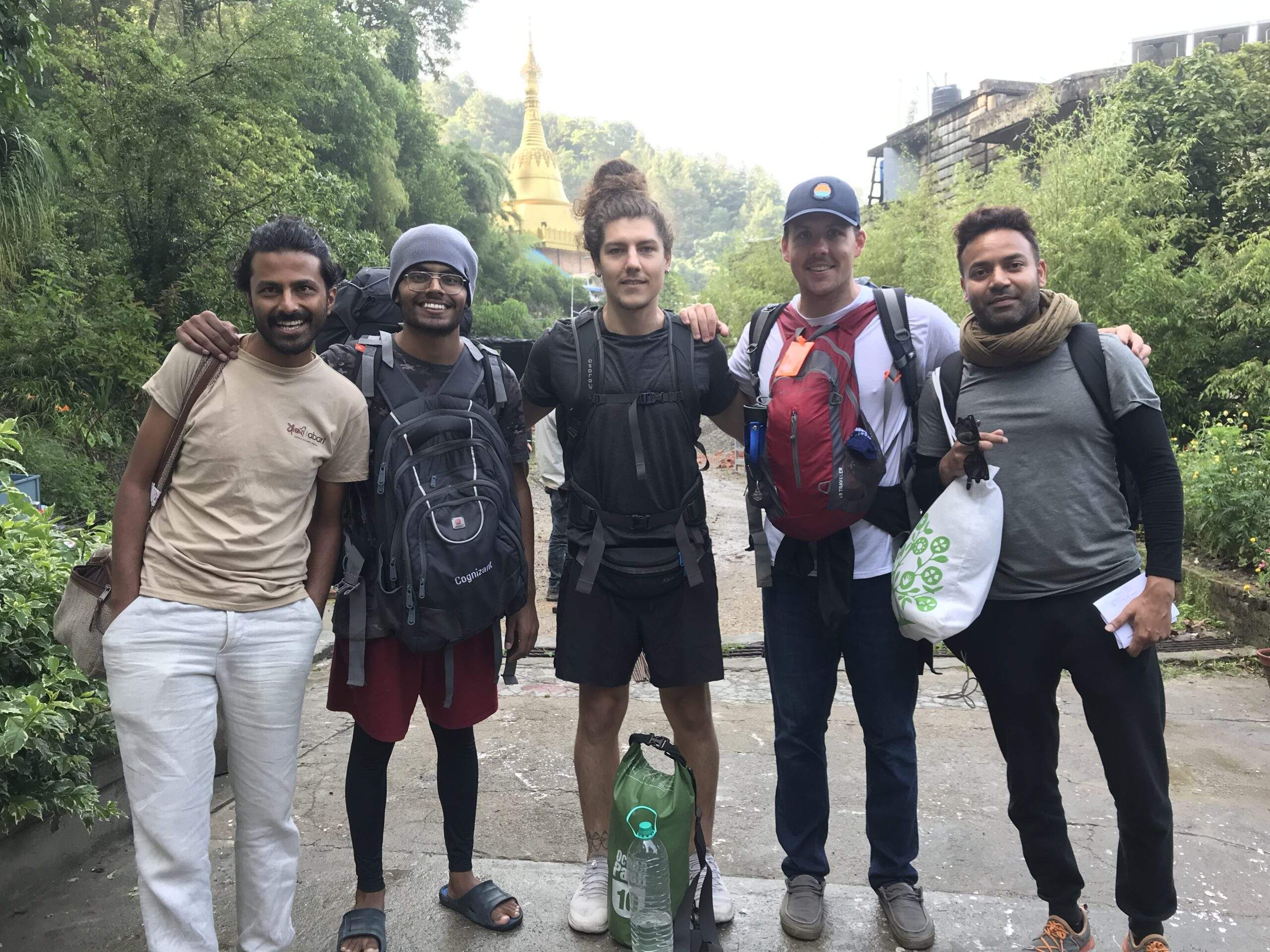
On the morning of June 1st, I registered for the course at the City Offices, grabbed a seat on the last available bus for the ride to the campus, and within the hour, was hiking against the violent afternoon rain, traversing the loosening earth of the Himalayan foothills, which felt a bit like trying to go up the down escalator.
The evidence that I’d made a mistake was mounting.
Luckily, I found myself next to a New Zealander named Ryan, one of the few other Westerners in the course, and as we walked against the spitting rain, he joked that this was “our initiation into a really friendly cult.”
Ryan seemed well-equipped to handle the next ten days: he had a surfer’s vibe, wore a shock of blonde hair and Rainbow sandals, and was reading Thich Nhat Hanh when I met him at registration.
On the afternoon of Day 5, however, his meditation cushion—three back to the left of my own—was removed by the volunteers and placed back in storage.
Over the next five days, more cushions were removed, and I’d often arrive to meditation with someone I’d never seen before now sitting on my left or right.
I can’t fault Ryan or anyone else for not making it, though.
Vipassana is hard.
Really hard.
Without a doubt, the hardest thing I’ve ever done…and I still didn’t get to see the colors.
But I was starting to learn that maybe that wasn’t the point.
Teaching the Practice
On the first day of my Meditations in Literature class at Wilbraham & Monson, I expected side eyes.
This was Massachusetts mindfulness.
This was the Dunkin’ dharma of which the sages spoke.
The students in front of me were seventeen-years-old, just starting their senior years, and since there’s no one smarter than a seventeen-year-old that’s just starting their senior year, I knew I’d have some detractors.
But by the second week, the practice was no longer an obligation.
Much to my surprise, they seemed psyched about it, and one morning a few weeks into the semester, a student named Christian came into the room and said, “Mr. Rosenbeck, I know meditation is working.”
I asked him how.
“I was going through the Dunkin’ Donuts Drive-Thru this morning, and the girl spilled my entire iced coffee on me,” he said. “But I didn’t even get mad. I just took a deep breath, thought, ‘Things happen, it’s out of my control,’ and I went home to change. I knew I was going to be late, but I didn’t stress.”
This was Massachusetts mindfulness.
This was the Dunkin’ dharma of which the sages spoke.
But patience at the Drive-Through wasn’t the only benefit, and over the first two years of the course, students said things like:
“Meditation has helped me stop panic attacks and anxiety.”
“I can now sleep through the night.”
“My mental health has significantly improved, and I stopped self-harming four months ago.”
“I became less judgmental of myself and the world.”
“Meditation made me want to be the best person I could be.”
Based on this success, I met with Brian about bringing more meditation into the curriculum.
Then, a global pandemic hit.
Within Prison Walls
On a first date at the Drunken Rabbit Brewery, I said, “Someday, I’d love to teach meditation in a prison.”
That was on a Tuesday.
By Friday, I got a call asking if I’d be willing to teach meditation in a prison.
This seemed like a lesson in being careful what you put out in the universe, especially on first dates.
I’d never stepped foot inside a prison before. The closest I’d come was using the gym at the juvenile hall where my dad worked growing up. But in spite of a total lack of experience with this demographic, I knew meditation could work for them.
It worked for me, after all.
Then, it worked for the skeptical teens in my class, my co-workers during the worst days of the pandemic, and the people that showed up to my classes at the yoga studio where I was teaching.
Given the chance, meditation seemed like it would work anywhere.
Why would that stop inside of barbed wire fences?
The first morning of class, I sat at the front of the room in an armless plastic chair, looked out at a sea of orange and blue jumpsuits, and thought that I’d never taught anyone with a face tattoo before.
Of course, the first time you walk into a jail—when you check-in at the front desk, go through the metal detectors, see the fences overhead, feel the doors lock behind you, pass armed guards, and hear the howl of inmates—it’s intimidating.
But it was also a moment of relief.
As much as I loved teaching at a prep school and a yoga studio, I couldn’t shake the feeling that there was an impact to be made beyond prep schools and yoga studios, and the first morning of class, I sat at the front of the room in an armless plastic chair, looked out at a sea of orange and blue jumpsuits, and thought that I’d never taught anyone with a face tattoo before.
I instructed the men to sit tall, loosen their shoulders, let their hands fall easy, and if it felt comfortable, to close their eyes.
Almost everyone did.
And as ever before, the practice didn’t discriminate.
The Meditation Biz
Among plenty of other body art, Julio had an eyeball tattoo in the middle of his forehead.
One afternoon when we came out of practice, someone across the table said, “That was great, but next time, could you ask Julio to close his third eye?”
Among plenty of other body art, Julio had an eyeball tattoo in the middle of his forehead. One afternoon when we came out of practice, someone across the table said, “That was great, but next time, could you ask Julio to close his third eye?”
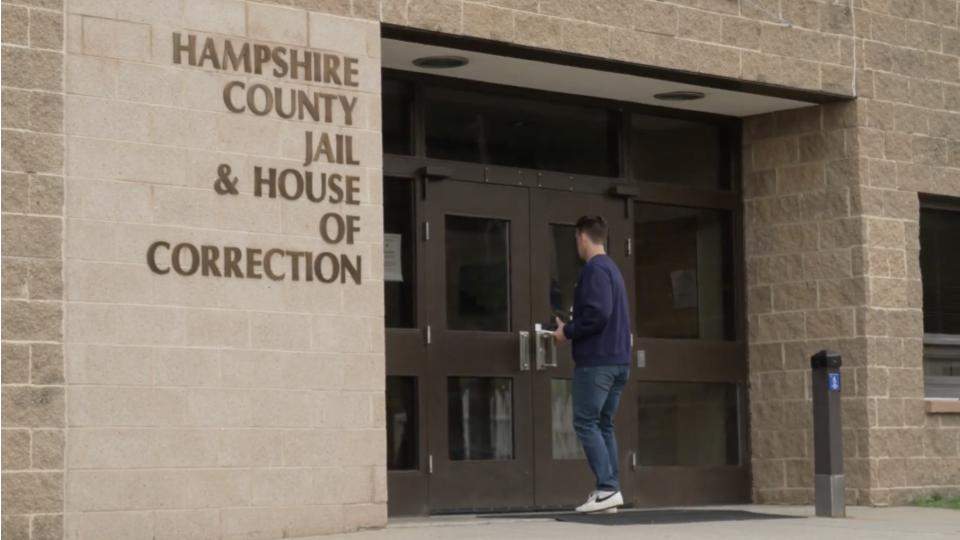
This was during my third four-week program at Hampshire County Jail & House of Corrections. What had started in the summer now extended into the fall and winter, and I found myself organizing my schedule to sneak away from the privilege of prep school to lead meditation behind barbed wire.
Of course, it wasn’t all laughs, and one afternoon that fall, I checked-in while an inmate was getting carried out on a stretcher after a fight.
I led the class while pepper spray seeped in from the hallway, our eyes watering and throats burning throughout the practice.
Some men came just to nap, a few pushed back just to push back, and sometimes, good students would arrive to class totally different than the week before. Someone would find out their release was delayed, or they’d lost parental rights, or a friend from home had died—and you could feel the way that news from the outside weighed down spirits on the inside.
This was the exception, though, and at the end of each program, I got responses like:
“The most useful class in the curriculum.”
“The only con is that it ended.”
“I want to follow a similar path in my own life.”
“No changes! If it ain’t broke, don’t fix it.”
“Count me in for the next round.”
It was about this time that I filed an official LLC for The Mellow Elephant, which, in the moment, was still more idea than plan.
At the end of the 2022-2023 school year, I decided to leave Wilbraham & Monson to pursue meditation full-time, and since then, I’d like to think that the risk has paid off: I’ve co-presented with the Boston Red Sox Hitting Coach at the World Baseball Coaches Convention, been featured on the front page of the newspaper for my work with law enforcement, and created programming for both the State of Massachusetts and Connecticut’s Department of Children and Families.
I’ve led practices on wrestling mats, at coffee shops, in lecture halls, and at a high-rise in TD Garden, guiding a meditation with a panorama of Boston stretched in front of me.
And amid all this success, most of my income last year came from stocking shelves at a package store.
My accountant received six W-2’s for 2025: one from a yoga studio, one from a treatment center, two from adjuncting at different colleges, and two more from different liquor stores, where I worked simultaneously.
This, it turns out, is life in the meditation biz.
The Meditation Road Trip
During a morning meditation before a Saturday liquor store shift, I thought about the Mellow Elephant, and what I might do to grow this dollar-a-day existence into something more.
When I was supposed to be focusing on my breath, my mind took off without me, and by the time the sit was over, I’d done no actual practice.
I did have an idea, though.
A one-day meditation barnstorm, filmed for a documentary, to prove that the practice really can work anywhere.
Still sitting on my cushion, I Googled, “When is World Meditation Day?”
May 21, 2025.
I had four months.
A few days later, I called a videographer to see if it was even possible to pull this off (Yes, it was possible), and more importantly, if I could afford it. (Not really, but we were going to do it anyway.)
For the next four months, I sat on liquor store counters and emailed clients, contacts, friends, friends of friends, strangers, and generic corporate inboxes that have probably never been checked. Eventually, I got enough yes’s to confirm that the World Meditation Day Road Trip could actually happen, I just needed to find a route to lead ten practices in ten different locations for ten different audiences operating on ten different schedules—and do it in ten hours.
Even in the era of AI, MapQuest remains a very useful tool.
Just a few days before take off, the schedule was fully solidified, and I was able to move to the final step of the process: blindly hoping that people would show up.
Luckily, there is one universal truth that applies to all of human incarnation—people love free shit—and thanks to the kindness of NOSOLO, a mental health apparel company, I had plenty of that, as their co-founder John Toracinta sent boxes of hats to give out along the route.
While I advertised the benefits of meditation, the uniqueness of this journey, and the chance to be in a documentary, “free hats” seemed to do most of the heavy lifting, attendance-wise.
The Meditation Day Road Trip was a mix of experiment, celebration, and proof of concept, wrapped up in a love letter to Western Massachusetts.
The end result was MELLOW: A Meditation Road Trip—a 45-minute documentary shot, directed, and edited by Kayla Ebner and Aiden McDonald—which captures roughly 130 miles and 150 meditators across ten different locations:
- Hampshire County Jail & House of Corrections
- Easthampton Fire Department
- Amherst Police Department
- Hampden County Sheriff’s Department
- Springfield Department of Children and Families
- Connecticut Department of Corrections
- Pleasant View Senior Center
- Kiley Middle School
- Minnechaug Regional High School
- The Urban Food Brood at Gasoline Alley
Before it was nearly packaged and ready for public consumption, however, the day was something else entirely: a mix of experiment, celebration, and proof of concept, wrapped up in a love letter to Western Massachusetts; it was the internal landscape of meditation set against the external journey of a roadtrip, and the hope that the two might work in unison to touch something I already knew to be true.
Around 2:30 that afternoon, I sat in an armless metal chair at the front of Pleasant View Senior Center, looking out at a sea of graying hair and floral prints.
It came into sharp focus that whatever space the practice brings us to exists the same for young and old, student and teacher, jailed and jailor.
And there was no difference from jumpsuits and face tattoos.
What I led in a prison, I led in a senior center.
What I led in a senior center, I led in a police station, a firehouse, a school, an office.
Under the yellow lights of Pleasant View, it came into sharp focus that whatever space the practice brings us to exists the same for young and old, student and teacher, jailed and jailor.
There was no place or person with dominion over what this was, what was here.
Hearts beating.
Lungs breathing.
Fully present.
Surrendering to what is.
And for all the miles travelled, we hadn’t gone anywhere at all.
MELLOW: A Meditation Road Trip was recently named a Merit of Awareness Winner for the upcoming 2026 Awareness Film Festival. Watch the entire documentary above.
About The Author