

The future city will not be sustainable simply because it contains more nature. It will become sustainable when nature helps determine what the city becomes.
What if nature was not something we added to cities, but something we designed cities around?
The question seems simple, but it unsettles many of the assumptions that have shaped modern urban development. For decades, nature has often been treated as one component of the city: a park within a neighbourhood, trees along a street, a green roof on a new building, or a restored river at the edge of an urban district. These interventions matter. Yet they can also reinforce the idea that nature exists in specific, bounded places, while the rest of the city continues to operate according to a different logic.
But the city is already a living ecosystem.
Water moves through urban soils, pipes, and rivers. Plants colonise walls, pavements, gardens, and abandoned land. Birds, insects and other animals navigate buildings, roads and fragmented habitats. Food, energy, materials, waste, and people circulate through interconnected systems. Human health depends on air quality, shade, water regulation, soil functions, access to green spaces and opportunities for social life. Even the most densely built urban environment remains embedded in ecological processes.
Nature’s backbone, i.e., biodiversity, therefore, is not an environmental “extra”. It is part of how the city functions, how it responds to heat and flooding, how it supports health, and how it creates identity and meaning. Biodiversity is not positioned as one more criterion to be checked at the end of a project. It becomes a cross-cutting dimension through which urban transformation is conceived, designed, financed, and governed.
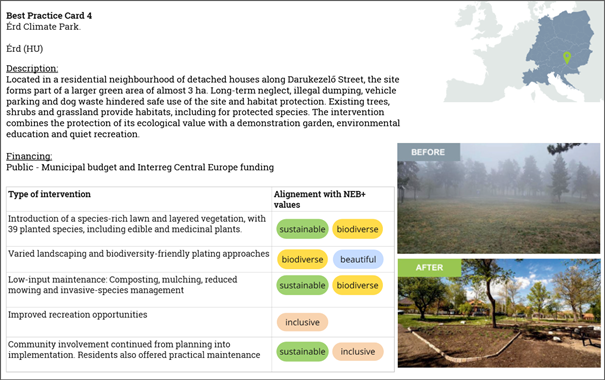
The URBIO BAUHAUS project promoted a “NEB+” approach that brings biodiversity explicitly alongside the three core values of the New European Bauhaus: sustainability, inclusion, and beauty. The Central Europe Strategy for a New European Bauhaus-based Urban Biodiverse Transition developed within the project sets out this vision and translates it into strategic priorities for bringing about urban transformation.
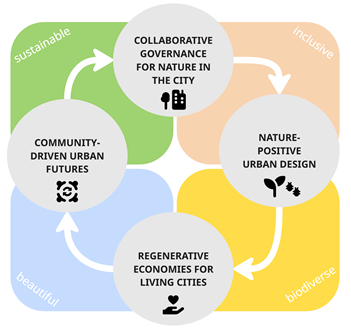
Changing how decisions are taken
Many of the physical solutions required to support urban biodiversity are already known. Cities can restore waterways, reduce and reverse soil sealing, adopt biodiversity-friendly maintenance practices, plant diverse urban forests, protect species, and reconnect fragmented habitats. The deeper challenge is that institutions, budgets, professions, and decision-making systems remain organised around fragmented models.
A department responsible for biodiversity conservation may seek to strengthen ecological networks while transport infrastructure fragments them. A climate adaptation plan may call for more trees, while technical standards leave insufficient space and soil for those trees to mature. Residents may be invited to comment on a project only after its principal objectives, design, and budget have already been determined.
Designing the city as a living system requires integrated governance and investment approaches, incorporating ecological priorities into everyday decisions concerning planning, housing, mobility, public space, procurement, and infrastructure. Urban plans can protect habitat continuity and healthy soils. Transport projects can strengthen rather than obstruct ecological connections. Housing policies can address access to nature, heat vulnerability, and the risk of green gentrification. Public procurement can support regenerative materials and biodiversity-sensitive maintenance.
Such integration requires more than coordination among sectors. It calls for environmental scientists, planners, architects, engineers, economists, public health experts, artists, and community organisations to recognise and combine different ways of understanding the city. Transdisciplinary collaboration begins before solutions are proposed: it allows scientific evidence, professional expertise, creative practice, and lived experience to shape how the challenge is understood in the first place.
Investment decisions must reflect this broader perspective. Urban biodiversity projects generate benefits over long periods and for many different actors. A municipality may finance a rain garden, while its benefits are distributed among residents, water utilities, health services, biodiversity, and future generations. A developer may bear the cost of retaining mature trees, while an entire neighbourhood benefits from cooler temperatures and better public space.
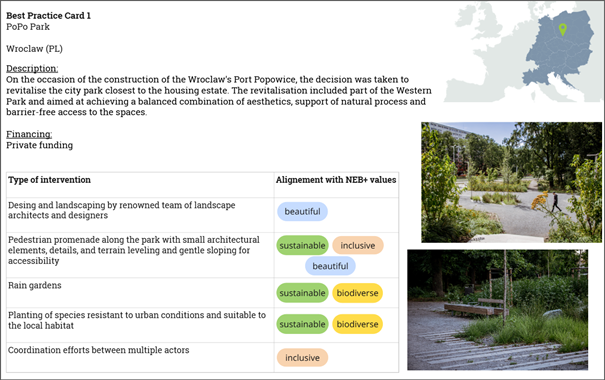
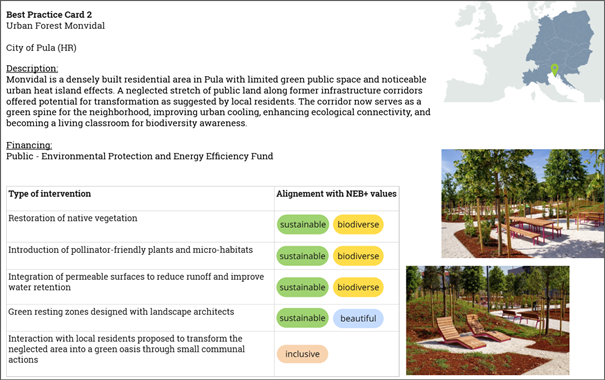
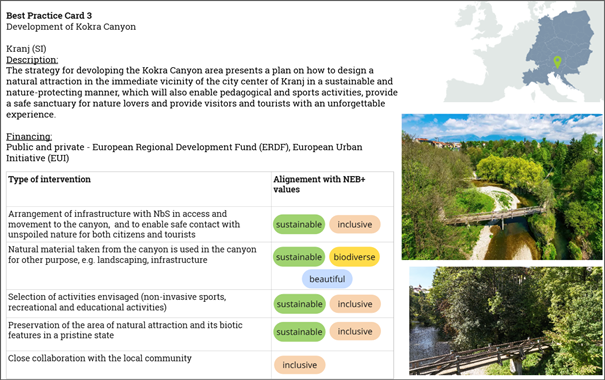
Designing with ecological processes
Conventional urban and landscape design often attempts to control nature by allocating vegetation to predetermined areas and maintaining landscapes in a stable visual condition. Ecological processes, however, involve seasonality, succession, movement, adaptation, growth, and decay, as living systems change.
Alternative design approaches embrace nature-positivity and regeneration, inviting cities to work with these processes rather than attempting to suppress them. This does not mean abandoning design but rather designing the conditions in which ecological relationships can develop over time. A rain garden, for example, is not simply an attractive planted area. It collects and filters stormwater, reduces pressure on drainage infrastructure, creates habitat, and makes the urban water cycle visible. An urban meadow is not simply grass that has been left unmown. When appropriately designed and managed, it can support pollinators, reduce irrigation, and allow residents to experience seasonal change. A network of street trees is not merely a beautification measure. Its species diversity, soil volume, canopy continuity, and relationship with walking and cycling routes influence cooling, resilience, accessibility, and habitat connectivity.
Nature-positive design combines minimisation of environmental harm with generating positive ecological value. A housing development can retain mature vegetation, regenerate soils, and create connected habitats. A mobility project can combine low-carbon transport with shade, water management and ecological corridors. A school ground can become a place for play, learning, climate adaptation, and biodiversity.
Beauty remains essential to this approach, but beauty cannot be reduced to a fixed appearance or visual style. In the New European Bauhaus perspective, it also concerns sensory experience, cultural meaning, identity, and belonging. Biodiverse landscapes may include spontaneous vegetation, visible water, dead wood, or less intensively managed areas. Their appearance may evolve across seasons and years. Ecological quality may sometimes conflict with established expectations of tidiness and control. The transition therefore requires not only new design practices, but also new cultural languages through which people can recognise, appreciate, and care for living urban environments.
Creating economies that support living systems
A regenerative perspective on economy seeks to reduce extraction while restoring ecological systems and creating lasting value for communities. This can take many forms. Buildings can be designed for adaptability and disassembly, allowing construction materials to be recovered and reused. Organic waste can become compost for urban agriculture and community gardens. Rainwater can be retained and reused rather than rapidly channelled away. Local, circular and bio-based materials can reduce environmental impacts while supporting regional skills and enterprises.
Biodiverse cities also require different forms of work and expertise. Ecological monitoring, seed collection, soil restoration, habitat creation, water-sensitive design, and biodiversity-friendly maintenance all depend on specialised knowledge. Urban farming initiatives, repair networks, cooperatives, and enterprises working with nature-based solutions can link ecological regeneration with employment, innovation, and local identity.
As urban nature affects health, resilience, social relations, and quality of life, the benefits it generates are numerous. Some of these benefits can be measured economically, while others resist or exceed monetary and short-term valuation. Recognising multiple forms of value implies thinking beyond a price on every ecological relationship. It means ensuring that biodiversity, health, cultural identity, and long-term resilience are not excluded from a decision simply because conventional accounting does not represent them adequately.
From consultation to stewardship
Residents, community organisations, schools, businesses, gardeners, and maintenance workers possess knowledge about how places are used and how they change over time. Their observations can reveal ecological and social relationships that may remain invisible in technical assessments. Therefore, an urban transition also depends on how people participate in shaping and caring for the urban environments they live in. Yet, participation is often limited to consultation. People are asked to comment on predefined proposals or select among a narrow range of options after the main decisions have already been taken. Such processes may improve a project, but they rarely allow communities to influence how the problem is framed.
Community-driven urban futures propose a substantial shift: from consultation to co-creation and, ultimately, stewardship. This is particularly important because a living system cannot be delivered once and considered complete. Urban ecosystems require observation, maintenance, learning, and adaptation. Citizen science programmes can help monitor species and habitats. Schools can connect biodiversity education with direct experiences of local places. Neighbourhood associations and community organisations can participate in the design and care of gardens, streets, waterways, and open spaces. Such involvement will not always produce consensus, nor should it be expected to. Choices concerning access, lighting, recreation, safety, maintenance, and habitat protection can reflect different and sometimes conflicting needs. Inclusion and ultimately stewardship therefore mean creating spaces where multiple perspectives can be expressed and negotiated, while remaining connected to ecological knowledge.
Stewardship, however, should not become a way for public authorities to transfer their responsibilities to unpaid volunteers. Meaningful stewardship requires stable resources, inclusive facilitation, clear roles, and continued institutional support. It must recognise that not everyone has the same time, capacity, or confidence to participate. Participation then becomes more than a way to gain public acceptance for a project. It becomes a process through which people develop relationships of knowledge, responsibility, and care towards the places they inhabit.
A shared logic, not a single model
There is no universal model for a biodiverse city.
A municipality facing river flooding will require different measures from a dense neighbourhood lacking shade. A former industrial area affected by soil degradation presents different possibilities from a small city seeking to reconnect urban and peri-urban habitats. Climate, land ownership, governance capacity, social inequalities, cultural practices, and existing ecosystems all influence what can be achieved.
Different cities can nevertheless share the same underlying logic: protect existing ecosystems before replacing them, connect habitats instead of creating isolated green features, regenerate rather than merely mitigate, involve communities from the beginning and evaluate success across ecological, social, cultural, and economic dimensions.
The relevant question is therefore not only, “What does this project cost?” It is also, “What forms of ecological, social, cultural, and economic value can this investment create?”
We begin to see biodiversity not only in parks and protected areas but also in housing decisions, procurement rules, school grounds, business models, drainage systems, and mobility networks. We begin to ask not where nature can be fitted into the city, but how urban life can contribute to ecological regeneration.
The future city will not be sustainable simply because it contains more nature. It will become sustainable when nature helps determine what the city becomes.
Claudia Romelli, Ágnes Fodor, and Mónika Németh
Brescia, Budapest, and Budapest
The complete framework, including the recommended actions, governance approaches, investment mechanisms, and examples developed by the URBIO BAUHAUS partnership, can be explored in the project’s outputs and most specifically in the Central Europe Strategy for a New European Bauhaus-based Urban Biodiverse Transition.
All documents can be found here: https://www.interreg-central.eu/projects/urbio-bauhaus/?tab=outputs