

October 27, 2026
Thomas J. F. Goreau, PhD
President, Global Coral Reef Alliance
October 27 2026 14:00 EST
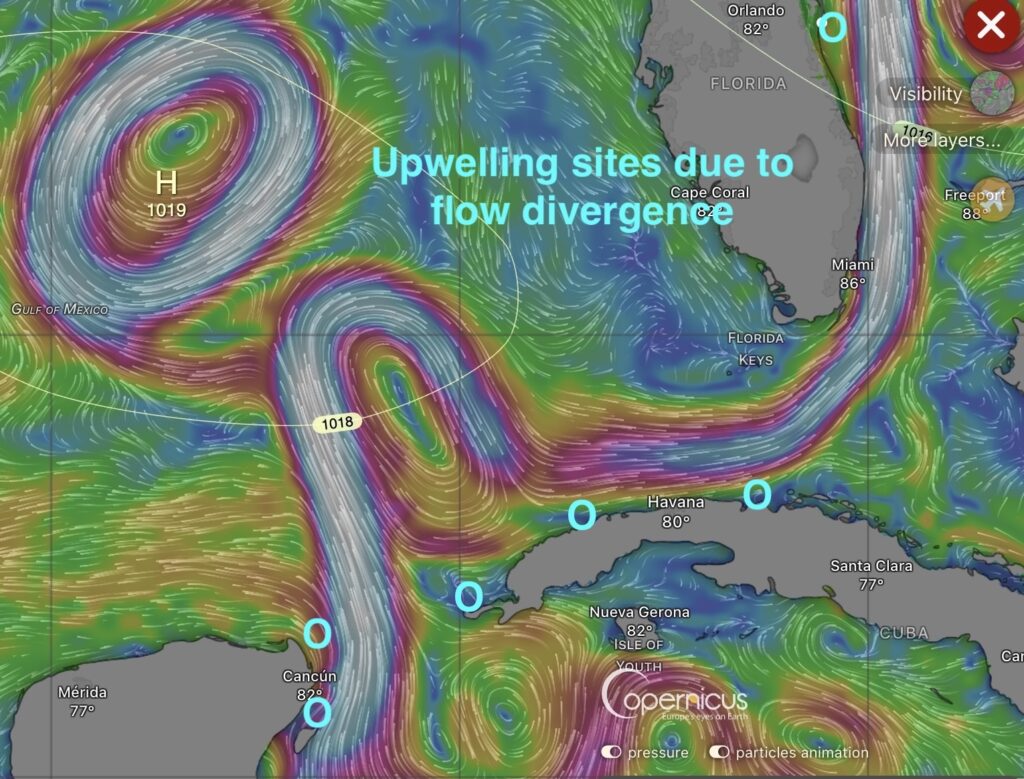
Today the Florida Current, the part of the Gulf Stream running most strongly south to north through the New Bahama Chanel between the Bahamas Banks on the East and Miami, Fort Lauderdale, and Palm Beach on the West, stopped flowing (below). This is extraordinary, and comes on top of the worst high tide sea flooding in South Florida history.
Above you can see the surface current flow lines from Windy for today, October 27 2026 at 2PM. A typical situation for August 18th 2026 is below for comparison. I’ve never seen this happen before, and wouldn’t expect to see it unless a Category 5 hurricane were crossing the Channel. Today has no hurricanes, but it the highest tide of the month. Nevertheless, nobody has ever seen sea flooding up drains so deep, the depths are records.
Below, August 18 2026, Normal flow of Florida Current.
While the Gulf Stream pulses and wiggles as it flows, especially when Loop currents are thrown off into the Gulf of Mexico. Because it sits in front of oceanographic laboratories, there is a vast data base and literature. There is normally only minor wiggling in the core of the Florida Current. Direct measurements of ocean flow between Bimini, Bahamas, and Miami, show only minor fluctuations Deep Sea Research Part I: Oceanographic Research Papers, July 2010, Volume: Volume 57, Issue 7, P835-846, Florida Current transport variability: An analysis of annual and longer-period signals, C.S. Meinen, M. O. Baringer, & R. F. Garcia, 10.1016/j.dsr.2010.04.001
Analysis of 40 years of data concluded that “The mean Florida Current flow transport estimates at 27°N is 32.1 Sv, the standard deviation was about 3.3 Sv” and made no mention of shutdowns.
What might this exceptional event without any extraordinary cause indicate? At the time of the slow down most of the loop current was recirculating west along the coast of Cuba back into the Gulf of Mexico, and the normally strong eastward flow from was suppressed, part of a reverse gyre rather than a steady flow.
Is this a one-of-a-kind event, or can it recur? If such conditions recur, they could result in more rapid heating of the Gulf of Mexico, and corresponding cooling in the axis of the Florida Current and the Gulf Stream, so that could be a matter of concern.

