

By Mona Iehl
 Fractions are divisive. You either love them or hate them, but people rarely feel like they truly understand them.
My husband and I were renovating our house when he said, “We need a board that’s 48 ⅔ feet, and we’ll need to screw it every 1 ¼ feet.” My brain immediately fizzled.
But then I grabbed a tape measure, and suddenly… it started to make sense. And I paused. Because that moment felt exactly like what many of our students experience in math class.
In our classrooms, we’ve often trained students to look for what to do instead of making sense of what the problem is actually saying. So when they see fractions, they search for a rule.
But what if the goal isn’t to decode the operation? What if the goal is to understand the situation?
3 ways we can help them make sense
There are three moves that can help students make sense of fraction situations in a way that makes solving meaningful and leads to lasting understanding.
1. Visualize the context of the problem
Students are often given problems that look like this:
½ ÷ ¾ = ? No story. No context. Just symbols and an operation.
Now imagine being an 11-year-old asked to “solve and show your work.” If you teach this grade, you might be thinking, “Well, they just use Keep, Change, Flip.” Yes, that procedure works, but it doesn’t help students understand.
Instead, we can give students something to think with. We can give them a situation.
Consider these problems, using the same fractions:
- There was ½ of my wedding cake left. The next day, we ate ¾ of it. How much is left?
or
- The 5th graders get to play on ½ of the soccer field at recess. However, ¾ of the field is covered in mud. How much of the soccer field is usable?
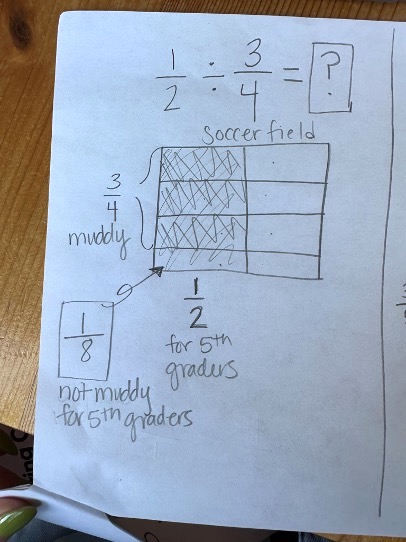
The diagram helps the student see the soccer field and how it is ½ theirs (split vertically) and then divided into fourths horizontally.
Same numbers. Same structure. Completely different experience. Now students can see what’s happening. And here’s the powerful part: We can teach students to create these stories themselves.
When they encounter a “naked number” problem (½ ÷ ¾ = ?), they can pause and ask:
“What could this look like?”
Thinking about a soccer field or a piece of cake is far more accessible than trying to make sense of abstract symbols alone.
2. Model the relationships
The next layer is modeling.
Too often, students believe drawing a diagram or using manipulatives is only for those who are struggling. In reality, it supports all learners by deepening understanding and strengthening their ability to explain their thinking.
Take this example:
There is 1 1/4 pizza left from a party. The kids eat 3/5 of it. How much pizza did they eat?
 The student here created a diagram of 2 whole rectangular pizzas. Then split them into fourths vertically and shaded 5 fourths. Then, split the pizza into 5ths horizontally and shaded ⅗ to show the ⅗ the kids ate.
When students model this, something important happens.
They can see:
- what 1 ¼ (or 5/4) represents
- how taking ¾ of that amount changes it
- how the pieces relate to each other
A student might explain it like this:
“I showed 1 ¼ by drawing five fourths. Then I split each part into thirds to show ¾ of it. That made 20 pieces total, and 15 were shaded.”
Now the numbers 3 × 5 and 4 × 5 aren’t just steps in an algorithm.
They mean something.
The model becomes the bridge between the situation and the equation.
3. Build a routine for thinking and reasoning
This kind of thinking doesn’t happen instantly.
Students don’t automatically pause, create meaning, and represent their thinking unless we give them time and structure to do so.
That’s why this work has to live inside a routine.
A consistent time where students:
- make sense of a problem
- try ideas
- represent their thinking
- and talk about it
Word Problem Workshop is a structure I’ve designed to support this kind of thinking.
It includes five parts:
- Launch: making sense of the problem
- Grapple: time to think, reason, and try
- Share: students present their work
- Discuss: the class connects ideas
- Reflect: apply the learning to something new
This routine creates space for their understanding to grow over time, while also building students’ confidence in communicating their thinking.
Try it. Start small.
When students experience fractions this way, something shifts. They stop blindly following procedures. They begin to explain their reasoning. They rely less on tricks and more on understanding. I’ve watched this happen time after time in my own classroom.
If you’re looking to try this approach, start small. Take your next fraction problem and pause before solving.
Ask:
- What is this problem saying?
- What does it look like?
- How could we show it?
Give students a chance to think before showing them what to do.
When students understand what a problem is saying and what it looks like, they don’t need tricks. They have reasoning powers.
Feature photo by Advocator SY on Unsplash+
 Mona Iehl is an elementary and intermediate grades educator who transformed her approach to teaching math by embracing student-centered methods that foster curiosity and engagement. She has captured her process in her new book, Word Problem Workshop: 5 Steps to Creating a Classroom of Problem Solvers (Routledge/Stenhouse, 2025).
Mona now coaches K-6 educators to create inclusive math classrooms where all students develop deep, lasting problem-solving skills. Follow her Math Chat Podcast and connect with her online @HelloMonaMath. Read her other MiddleWeb articles here.

