

A MiddleWeb Blog
 “Your room is SO COZY.”
I hear this at least several times a week from kids who wander in from the hallway, and it’s always gratifying. It’s also a side effect (but we’ll get into that a little later).
My English as a New Language (ENL) students these days are often stressed, sad, and have hard work to do. So do most of our students, who are among the most depressed, anxious, and academically disadvantaged our schools have seen.
As a result I am always looking for any little thing that can give me an advantage with student mindset. Food definitely works; squishies and fidgets and the freedom to move in their seats are helpful as well.
But lately I have been thinking about how easy – and how easily overlooked – the physical set up of a classroom is. It’s often the last thing teachers think about, when I wonder if it ought to be one of the first.
Classroom design, then and now
Classroom design has been through as many iterations as schooling itself, from desks attached to the floor in a one room schoolhouse, to the open floor plans of the 70s, and flipped classroom models today.
Sadly, how a teacher designs a classroom got very short shrift in my own training, despite the huge impact it can have on learning: explaining a 16% of variation in learning rates, according to at least one study. (Can you imagine someone coming to you and saying that you could improve learning rates by 16% if you shoved stuff around in your room differently?)
I am simplifying, of course. As these Edutopia authors wryly note about their own list of classroom design suggestions, “Not everything in this list is within a teacher’s purview – you can’t very well open your walls and let in more sunlight, at least not without a good saw and the district’s permission.”
But a lot of redesign is within our reach, and it is pure bang for our buck. A little bit of planning and arrangement, and you can reap the benefits.
Image source: A 7th Grade Teacher’s Shift to Flexible Seating
Want to tackle this over Spring Break?
Based on my own experience, here are five simple steps I would suggest, in order of difficulty.
1. Create scribble space.
This could be as simple as leaving one of your whiteboards blank and providing some markers. A colleague of mine puts out butcher paper on a table with colored pencils. Another has a banner over a combination whiteboard/bulletin space calling it “The Student Gallery.”
 This is a space that is used for nothing academic, nor is it monitored or curated by you (except for school appropriateness). Instead, when kids have down time, they are invited to use it to express themselves in whatever way strikes them at the moment.
Some of the most profound and sweetest sentiments I’ve heard from students have been located in the scribble space; it’s also how I learn where my artists are in the classroom. This allows for what scholars of classroom design call individualization, or the responsiveness of a space to students and their sense of ownership.
2. Get a plant.
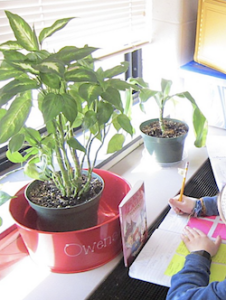 Humans need links to nature in their indoor spaces, whether that be natural light, clean air, or greenery. My own classroom has no windows, which made getting some kind of reference to the outdoors in there very important. Three low light trailing vine plants helped a lot. I recommend pothos, which are essentially bombproof and have survived even my complete neglect over two week breaks.
3. Get a diffuser.
This one I recommend with the caveat that you check to make sure students don’t have allergies or asthma that scents can trigger. That being said, a gentle diffuser with a small amount of essential oil can go a long way in creating an atmosphere in your classroom that is calming, invigorating, or focusing.
There’s loads of research on specific smells and their effects on our brains, but my go-to is cinnamon. Kids around here associate it with pleasant memories of mall shopping, baking, and holidays – you can’t beat it.
4. Get non-fluorescent lights.
Alternate lighting is powerful in a classroom – especially when most classrooms are lit like hospitals. Compact fluorescent bulbs and their minute flickers have been demonstrated to trigger stress reactions and, occasionally, seizures. You will want to check your fire code (and your students’ visual needs), but stringing up some soft white fairy lights can only help.
My colleague across the way turns off her overhead lighting completely and only uses her (fire marshal approved) natural lights through her uncovered windows, white Christmas tree lights and a desk lamp. The kids love it.
5. Get rid of rows.
There are significant repercussions to group seating that require shifts in classroom management, which is why I left this one for last.
 Nonetheless, there are huge benefits to moving away from rows, which make student to student communication difficult, obstruct collaboration, and are associated with passivity, isolation, and teacher-centered learning.
For the opposite effect, consider “pods” of four desks, a giant “U” shape, or long tables. For those of you with the financial wherewithal, you might wish to advocate for mobile desk chairs that can be easily configured to whatever learning needs to happen.
Or, as these teachers did, try flexible seating options that don’t involve desks at all. (I have a semi circle of desks, a few loose chairs that can be pulled up to a table, and a reading corner with a carpet and jumbo stuffed animals for sitting on.)
But the best reason I keep my classroom cozy, clean, organized, and attractive? I want it to be a place where I feel comfortable and work well. Happy kids equal happy teachers – but happy teachers equal happy kids, too.

