Coral reefs around the world experienced the fourth mass coral bleaching event from 2023 to 2025, impacting the health of one of the ocean’s most valuable and colorful ecosystems. Recent findings from the National Oceanic and Atmospheric Administration (NOAA) show how corals were affected.
In light of Coral Bleaching Awareness Month, a global movement led by the Coral Reef Alliance that includes hundreds of individuals and organizations, we are sharing our top takeaways from NOAA’s findings and looking at what mass bleaching events could mean for the future of coral reefs.
Want to hear from the Coordinator of NOAA’s Coral Reef Watch program? Sign up for the live Webinar: Understanding and Responding to a Very Strong El Niño Year.
Heat Stress Impacted 84% of Coral Reef Area
Mass bleaching events are linked to severe or prolonged heat stress from natural climate patterns and more frequent and severe marine heat waves driven by climate change. According to NOAA, bleaching-level heat stress from the fourth mass bleaching event was found to have impacted 84% of the world’s coral reef area.
Corals bleach when they are stressed, expelling symbiotic photosynthetic algae, called zooxanthellae, from their tissues and revealing a white calcium carbonate skeleton underneath. Not only do zooxanthellae give corals their bright colors, but they also act as their main source of nutrients. Without them, corals are left vulnerable to disease unless stress is reduced and the zooxanthellae return.
Healthier Coral Reefs Are More Likely to Survive Bleaching
Even though 84% of the world’s coral reef area experienced bleaching-level heat stress, not all of these reefs experienced coral bleaching. This suggests that some coral reefs may be more resistant than others.
Scientists are studying this to learn why some reefs bleached and others did not, and whether biological factors, environmental factors, or a combination of both played a role.
Even though we don’t have those answers yet, decades of scientific research show that healthy coral reefs are more likely to recover from stress. It works the same as a healthy person being better able to recover after a cold.
At the Coral Reef Alliance, we work with partners around the world to reduce local stressors and to develop diverse climate-resilient reef networks. This dual approach gives coral reefs a better chance to adapt and survive as the world gets warmer.
Dr. Helen Fox, CORAL’s Conservation Science Director
Coral Bleaching May Happen More Often. Reducing Stressors Can Help Corals Adapt to Climate Change.
Climate change will continue to increase ocean temperatures, and NOAA’s recent findings back up what our research shows and what many scientists fear: coral bleaching events could soon become a regular occurrence. In fact, by 2050, 90% of coral reefs are projected to experience coral bleaching annually.
While lowering CO2 emissions and slowing climate change are critical, we also need to help coral reefs adapt to changing ocean temperatures. That’s why we focus on strategies that advance science, grow partnerships, and support local efforts to reduce environmental stressors and keep coral reefs healthy.
Ensuring Clean Water
We work with local partners and communities to reduce land-based pollution that enters our oceans. This includes minimizing sediment runoff and sewage pollution, which can smother reefs, increase algae growth, and block the sunlight that corals need to survive.
In 2025, we treated over 30 million gallons of sewage across Honduras, keeping vital parts of the Mesoamerican Reef healthy.
See How Better Wastewater Management Can Protect Belize’s Coral Reefs >
Creating Well-Managed Protected Areas
Coral reefs also need enough herbivorous fish to graze on seaweed and keep algae growth in check. We work with local groups to monitor fisheries, implement protective regulations and enforcement, and expand Marine Protected Areas. In fact, one of our field sites saw a 70% increase in fish biomass last year after a seasonal fishing ban.
Learn more about the Honduras Nationwide Fishing Ban >
Building Climate-Resilient Reef Networks
We are also working to increase genetic diversity and ecological connectivity in reef networks, allowing coral larvae to spread heat-tolerant traits that help reefs evolve and adapt to warming ocean temperatures. Last year, alongside three partners, we launched a project in the Western Caribbean to identify regional reef networks that protect diversity and promote connectivity.
[Insert Roadmap to Reef Resilience Video]
Join Us for the 4th Annual Coral Bleaching Awareness Month
Coral reef protection requires an alliance.
We need more people to understand how critical it is to save the world’s coral reefs, ecosystems that support a quarter of ocean life and countless communities with food, income, and coastal protection. That’s why we are asking you to join us in spreading awareness this September for Coral Bleaching Awareness Month.
You can:
- Check out our resource center to get more information about coral bleaching. Pass the link along to your family and friends.
- Follow CORAL and partners on social media. Share our posts, bleach your profile picture, or create your own content about coral bleaching.
- Read our recommendations for reef-safe sunscreen to reduce additional stress on coral reefs.
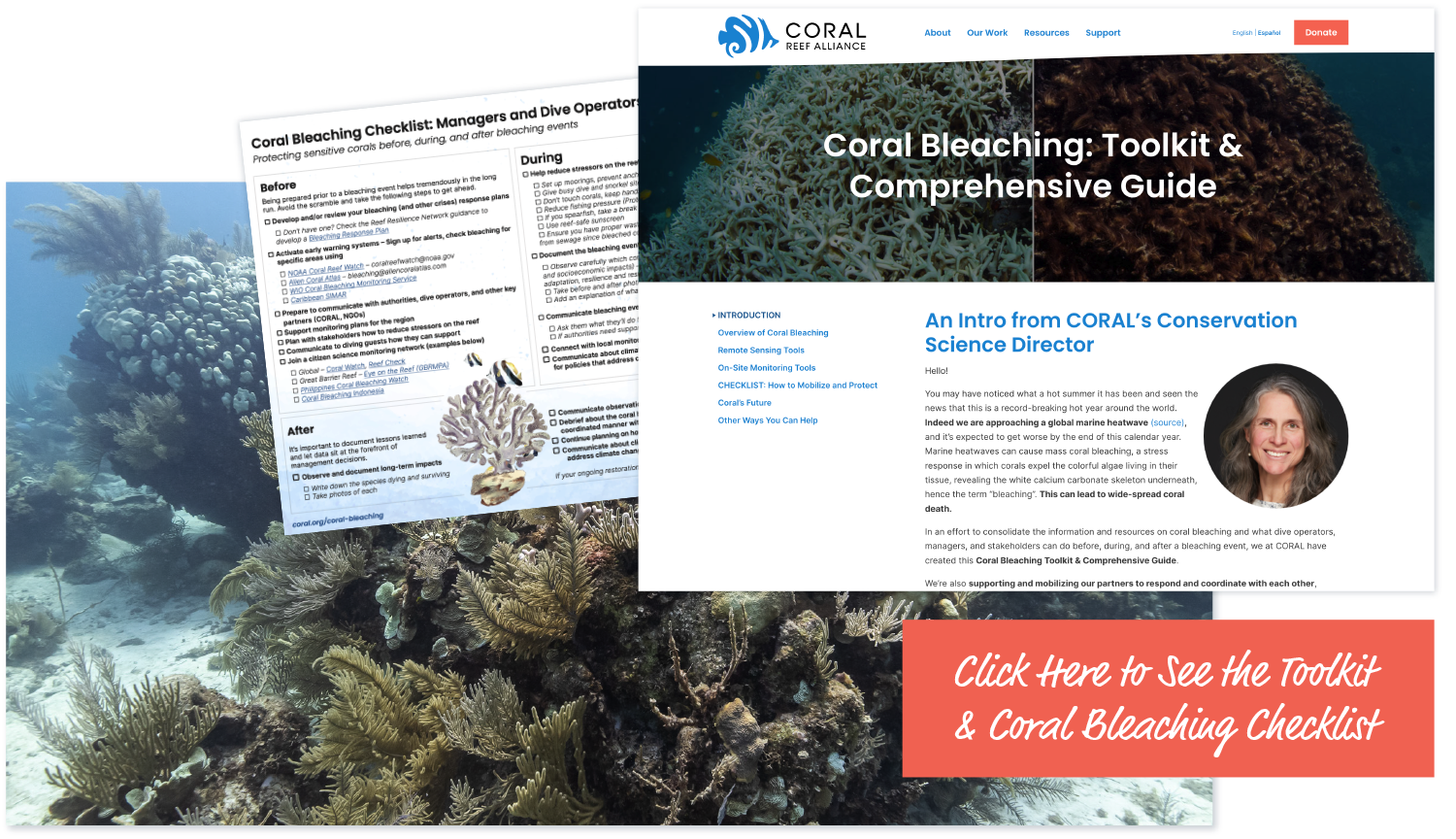
- Connect with your local dive shop and share our coral bleaching checklist.
Visit our resource hub this Coral Bleaching Awareness Month to help spread the word! It’s up to all of us to keep coral reefs healthy and thriving for generations to come. – https://go.coral.org/coral-bleaching