

(Title Photo: Trump’s Greenland antics make their way onto a satirical float at a Carnival procession in Germany)
Heard any news about Greenland recently? A stupid question these days, since Donald Trump openly set his sights on the icy island in the High North. A NATO country threatening to take control of a partner’s territory, by force if necessary. Nationalism, colonialism, undisguised greed for resources , militarisation – no wonder it jumped to the top of the media agenda, arousing feelings of shock, indignation, rage, incomprehension, anger, disgust, apprehension….
But you might have missed the announcement about the temperature record smashed in Greenland during the first month of 2026. The Arctic island this year experienced its warmest January on record. Preliminary temperature readings from the Danish Meteorological Institute in the Greenlandic capital Nuuk averaged +0.2 degrees Celsius (32.4 degrees Fahrenheit) in January, the highest on record and well above the historical average of -7.7 degrees between 1991 and 2020. – A little reminder of why the ice island should really be in our minds and in the news.
Key actor in global climate
“Climate change is already clearly visible on Greenland,” said Jacob Hoyer, head of the National Centre for Climate Research at the Danish Meteorological Institute. “From the records we can see that it is warming four times faster than the mean temperature hike in the world.”
Reuters news agency reported the January temperature record. But it didn’t make the headlines around the globe. Yet this warming that is transforming the ice island is of key significance to the whole world. Greenland should be in the news because climate change is disrupting the key role it plays in the world’s climate system and in influencing sea level, with consequences for the livelihoods and lives of billions of people around the globe.
Glaciologist Martin Siegert, Deputy Vice-Chancellor of the University of Exeter, puts it in a nutshell in an article entitled “Why Greenland is indispensable to global climate science:
“Research shows that around 80% of Greenland is covered by a colossal ice sheet which, if fully melted, would raise sea level globally by about 7 metres (the height of a two storey house). That ice is melting at an accelerating rate as the world warms, releasing vast amounts of freshwater into the North Atlantic, potentially disrupting the ocean circulation that moderates the climate across the northern hemisphere.”
In Climate Uncovered on 28.1.2026, Tom Harris writes:
“Whilst US attacks on Greenland’s sovereignty are creating dangerous geopolitical instability, the island’s ice is rewriting the rules of global climate. New evidence shows it is no longer just a victim of warming, but an active participant in it.”
The island is losing ice mass at an average rate of 25 million tonnes per hour, or 6,900 tonnes per second, Harris writes. It is discharging 52 million tonnes of ice per hour or 14,500 tonnes per second. That means all this freshwater is flowing into the Arctic and North Atlantic oceans.
Sea level rise
Global sea level is rising ever faster, primarily through increased melting of glaciers and ice sheets, as well as warming ocean temperatures, which cause sea water to expand in volume. The Greenland ice sheet is responsible for around 20 percent of current sea level rise. The IPCC projects that by 2100, Greenland could contribute 3.1 to 10.6 inches (8 to 27 cm) to global sea level, and the melting of Antarctic ice may add another 1.2 to 11 inches (3 to 28 cm). But recent studies indicate that the rise could be much higher and happen much faster. New models include additional ice dynamics or newly discovered changes in precipitation or wind patterns. Ice cores drilled from the ice sheets show us how they reacted to climate changes in the past.
While it would take centuries for the ice cap to melt completely, some recent work indicates that sea level could increase by 1 metre within 75 years.

Ocean currents running AMOC?
The other key consequence of Greenland melt is its effect on ocean circulation. The Atlantic Meridional Overturning Circulation or AMOC is a system of ocean currents that transports huge amounts of heat into the North Atlantic Region and thus determines life conditions for people in Europe, the Arctic region and beyond.
Professor Stefan Rahmstorf from the Potsdam Institute for Climate Impact Research (PIK), who has been studying changes to the AMOC for more than 30 years explains in an interview with the Guardian: “Warm surface water from the tropics flows north and releases its heat in the subpolar Atlantic, south of Greenland and west of Britain and Ireland. Then it cools and sinks to a depth of between 2,000 to 3,000 metres before returning south as a cold current. Amoc is one of our planet’s largest heat transport systems, moving the equivalent of 50 times the human energy use, and it has a particularly strong impact on the climate in Europe, affects the ocean’s CO2 uptake and oxygen supply, as well as rainfall patterns in the tropics.”
The huge influx of cold freshwater from the melting ice sheet changes the salinity balance. When the water is less salty, it is less dense, which makes it harder to sink down. That is important because the sinking process is what drives Amoc. The fresher the water, the slower it gets.
Satellite data and oceanographic measurements already show a long-term cooling trend in the subpolar Atlantic, long predicted by climate models. A string of scientific climate studies in the past few years suggests that the risk of passing the tipping point for a major ocean circulation change in the Atlantic has so far been underestimated.
Scandinavia, the UK and northern mainland Europe could then see tremendous drops in winter temperatures, while summer temperatures would continue to get warmer. Flooding would affect the East coast of the US as well as northern Europe and the monsoons that so many rely on would shift to currently arid areas. These are “world economy and civilisation ending impacts”, Tom Harris concludes in his article:
“The stability of Greenland is therefore of huge importance to the world, not for minerals, oil or to stroke the ego of a megalomanic, but for the stability of the planetary systems and the climate we all rely on.”
Tipping into uncharted territory
In an assessment recently published in the journal One Earth , some of the world’s leading climate experts synthesise recent scientific findings on what are known as “climate feedback loops” and 16 “tipping elements”. These are “Earth subsystems that may undergo loss of stability if critical temperature thresholds are passed”. The Greenland ice sheet is one of the key components referred to. Others include the Antarctic ice sheet, mountain glaciers, polar sea ice, sub-Arctic forests and permafrost, the Amazon rainforest and the AMOC.
The international collaboration led by Oregon State University’s William Ripple and including Professors Johan Rockström of the Potsdam Institute for Climate Impact Research (PIK) in Germany and Hans Joachim Schellnhuber of the International Institute for Applied Systems Analysis in Austria, comes to the conclusion that:
“Earth’s climate is now departing from the stable conditions that supported human civilization for millennia. Crossing critical temperature thresholds may trigger self-reinforcing feedbacks and tipping dynamics that amplify warming and destabilize distant Earth system components. Uncertain tipping thresholds make precaution essential, as crossing them could commit the planet to a hothouse trajectory with long-lasting and potentially irreversible consequences.”
Scientists usually take a 20-year average before declaring a temperature limit has been exceeded.
“But climate model simulations suggest the recent 12-month breach indicates the long-term average temperature increase is at or near 1.5 degrees,” said study co-author Christopher Wolf, a scientist with TERA (Terrestrial Ecosystems Research Associates).
It’s likely that global temperatures are as warm as, or warmer than, at any point in the last 125,000 years and that climate change is advancing faster than many scientists predicted, the authors find. They say it’s also likely that carbon dioxide levels are the highest they’ve been in at least 2 million years. At more than 420 parts per million, the atmospheric CO2 concentration is about 50 percent higher than it was prior to the Industrial Revolution.
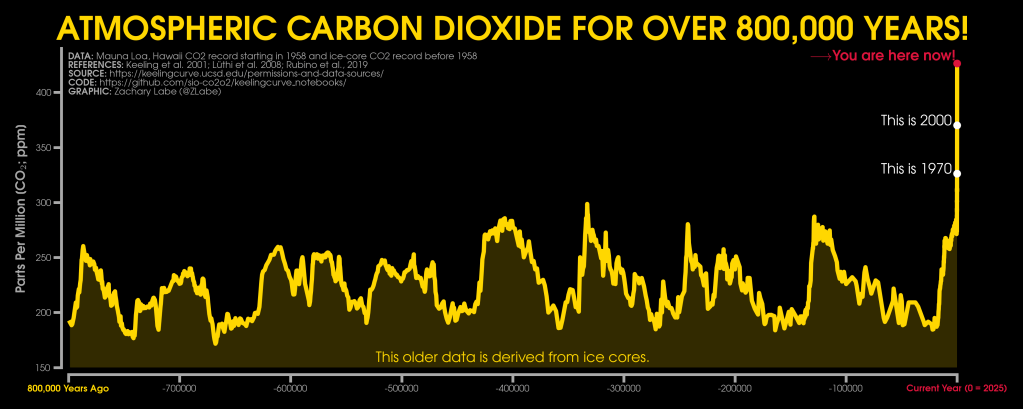
When the climate changes, the researchers note, responses can be triggered that circle back to affect the climate itself, amplifying or dampening the original change. These processes are known as climate feedback loops.
“Amplifying feedbacks increase the risks of accelerated warming,” explains lead author Ripple. Melting ice and snow, permafrost thaw, forest dieback and soil-carbon loss can all magnify warming – and in turn affect the climate system’s sensitivity to greenhouse gases, he explains.
“Uncertain tipping thresholds underscore the importance of precaution – crossing even some of those thresholds could commit the planet to a hothouse trajectory with long-lasting and possibly irreversible consequences,” says co-author Wolf. “Policymakers and the public remain largely unaware of the risks posed by what would effectively be a point-of-no-return transition. And while averting the hothouse trajectory won’t be easy, it’s much more achievable than trying to backtrack once we’re on it.”
Tipping may already be happening with the Greenland and West Antarctic ice sheets, the scientists say, and boreal permafrost, mountain glaciers and the Amazon rainforest appear on the verge of tipping.
“We need to act quickly on our rapidly dwindling opportunities to prevent dangerous and unmanageable climate outcomes.”

The economic imperative
Another study published recently by researchers from the University of Exeter and financial thinktank Carbon Tracker Initiative stresses that the collapse of the critical Atlantic currents or the Greenland ice sheet could ultimately lead to a global financial crash, as combined extreme weather disasters wipe out national economies.
As the world speeds towards 2C of global heating, the risks of extreme weather disasters and climate tipping points are increasing fast, Damian Carrington explains in the Guardian. But the study shows current economic models used by governments and financial institutions entirely miss such shocks, forecasting instead that gradually rising average temperatures will only slow steady economic growth.
“This is because the models assume the future will behave like the past, despite the burning of fossil fuels pushing the climate system into uncharted territory,” the article goes on. Governments, regulators and financial managers should pay far more attention to these “high impact but lower likelihood risks”, because avoiding irreversible outcomes by cutting carbon emissions is far cheaper than trying to cope with them.
Mark Campanale, CEO of Carbon Tracker, said: “The net result of flawed economic advice is widespread complacency amongst investors and policymakers. There’s a tendency in certain government departments to trivialise the impacts of climate on the economy so as to avoid making difficult choices today. This is a big problem – the consequences of delay are catastrophic.”
So could it be that the threat of economic collapse will spur governments and companies to action where so far all the scientists’ evidence could not?

Time to abandon the growth model?
UN chief António Guterres has been warning that the global economy itself will have to be radically transformed to avoid planetary disaster. The world’s accounting systems should place true value on the environment, he told the Guardian. At the moment, economic growth is heating the planet. The global economy must stop rewarding pollution and waste, Guterres said. Speaking after the UN hosted a meeting of leading global economists, Guterres said humanity’s future required the urgent overhaul of the world’s “existing accounting systems”, which, he said, were driving the planet to the brink of disaster.
“We must place true value on the environment and go beyond gross domestic product as a measure of human progress and wellbeing. Let us not forget that when we destroy a forest, we are creating GDP. When we overfish, we are creating GDP.”
Critics of governments’ insistence of constant growth argue stress that the planet’s resources are finite and that the growth philosophy drives the climate and nature crisis and increases inequality.
UN chief Guterres has set up a group to develop new ways of measuring economic success that take human wellbeing, sustainability and equity into account.
Jason Hickel, a political economist, author and key proponent of the degrowth school of thought, says these ideas are gaining traction. He points to a recent survey that found 73% of nearly 800 climate policy researchers around the world support post-growth positions.
Why are we ignoring the risks?
In a commentary published on Mongabay, Robert Muggahd points out that the World Economic Forum’s 2026 Global Risks Report says four of the five highest ranked risks over the next ten years are climate and ecosystem related:
“Extreme weather sits at the top, followed by biodiversity loss and ecosystem collapse and critical change to Earth systems, with natural resource shortages also near the top. In other words, the mainstream risk community is no longer treating this as a distant tail risk.”
Yet all the mounting evidence, he says, is “barely making a dent on the public narrative”.
Too many still talk about the climate and nature crisis as if it is something for a later generation.
Muggahd suggests this is partly because the crisis is diffuse and does not arrive as a single headline event. Instead, “it arrives as repeated shocks that feel local and disconnected until they become impossible to ignore. And partly because public attention is being consumed by everything else. Geopolitical disruption. Crypto meltdown. AI anxieties. The Epstein files. Each separate crisis can dominate a news cycle.”
Which brings us back to our starting point. Greenland is in the news these days because the US President says it is at risk of coming under Russian and Chinese control as a key location in military, geopolitical and economic terms. Climate change, alas, is silently taken for granted here, treated as a “given” when it comes to discussing the value of the natural resources beneath the ice and the key shipping routes becoming accessible because of warming. While the Trump administration denies the role of greenhouse gas emissions from burning oil, coal and gas and says it’s all a hoax, the warming effects of those emissions are what is driving the increased interest in the icy island.
As Courtney Federico writes for the Center for American Progress, the Trump Administration’s fixation on Greenland reinforces that climate change is a threat to Americans. The alarming warming of the Arctic is threatening to heighten geopolitical tensions in the region. Yet instead of combating this threat, President Trump has halted all U.S. international climate action, and sought to block global action on climate change at every opportunity, also putting Americans at risk, she stresses.
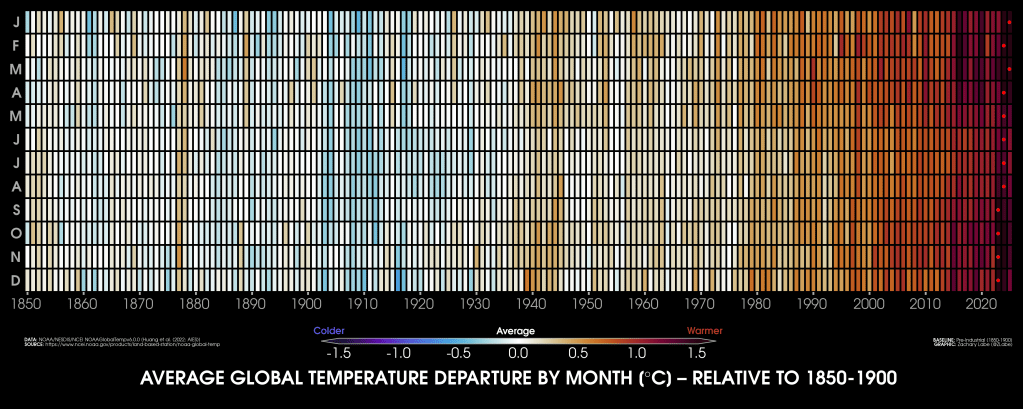
A new study published as I write this by an international team of researchers from the Potsdam Institute for Climate Impact Research (PIK), the University of Exeter, and the Centre for International Climate Research (CICERO) states clearly what we have to do:
Global warming must peak below 2°C then return under 1.5°C as quickly as possible to limit the risk of triggering tipping points in the Earth system. In the long term, global temperatures must cool to around 1°C above pre-industrial levels.
Greenland is in danger of crossing a critical threshold, with devastating results for life around the globe. It should be in the headlines because we have a choice: our actions right now could help prevent that – or speed up disaster.

