July 13, 2026 This is the second of a series of Hunger Notes articles about the re-design of the U.S. Food for Peace (FFP) program,that is now in process at the U.S. Department of Agriculture, which just released a request for informational inputs this past week.
Previously, about a decade apart, USAID commissioned two expert teams to review experience with development food-aid programming: the first in 2002–2003 and the second in 2012–2013. Neither study included food aid for emergencies (the majority share).
The 2002 “Food Aid and Food Security Assessment“ (FAFSA 1) found that success in health, nutrition, and agricultural components was largely driven by U.S. Government (USG) complementary inputs, such as technical assistance (TA) and training, both of which were primarily financed through the monetization (sale) of food aid. FAFSA 2 reinforced this, emphasizing that distributing food alone is of reduced value for improving food security and should be combined with non-food resources to build durable livelihoods and community resilience. Although styled as an ‘assessment,’ the 2002 report functioned primarily as a broad program review. It addressed the wide variety of competing mandates being pursued, including support for microenterprise, education, HIV/AIDS and emergencies, all while achieving sustainability.
During the two decade period, 1993 – 2013, the US shipped an estimated 17 million metric tons of food, worth $4.5 billion (not adjusted for inflation) for development programs (not including the larger volume for emergencies)..
Both studies found that FFP exit strategies were weak and that project outcomes were often not sustained. Both studies reported broad improvements in child nutritional outcomes across the countries reviewed though this was based on a mixed set of project evaluations that did not include randomized controlled trials (i.e., with control groups). Measures of child (under five years of age) nutritional status focused on stunting (which is a long-term outcome) and weight-for-age, not weight-for-height (wasting) that is more critical for health.
FAFSA-1: Implementing agencies “should continue to use growth monitoring and promotion as key strategies to improve the nutritional status of children under 3 years old and improve referral and follow-up of malnourished children. [They] should establish clear protocols for identification and referral of malnourished children to health facilities.”
- ◊ Agricultural programs ought to be market-driven, not just production-driven. While early programs often focused merely on increasing staple crop yields, FAFSA-2 found that the most successful agricultural programs adopted a “Pull Plus Push Model.” This approach links farmers to promising, higher-value markets (the “pull”) while simultaneously providing them with new technologies, TA, and training needed to compete in those markets (the “push”). Furthermore, FAFSA-2 emphasizes that programs should target farmers who are “vulnerable and viable.” For food-insecure populations who lack sufficient land or assets to farm their way out of poverty realistically, programs should focus instead on creating off-farm jobs and non-agricultural income generation.
-
◊ Maternal and Child Health and Nutrition (MCHN) should focus on prevention during the first 2 1/2 years of life. A major finding in FAFSA-2 was that preventive supplementary feeding, targeting all pregnant/lactating women and children under two years of age, is significantly more effective at reducing stunting than recuperative feeding, which only treats older children who are already malnourished. Additionally, evidence suggests that providing food to individual people is more effective and cost-efficient than providing larger rations to whole families.
◊ Food-for-Work (FFW) should be focused on the creation of public goods such as roads and canals. The authors viewed FFW as having poor sustainability.
…
◊ Income generation should be combined with behavioral change such as caretaker behavior for diets and improved hygiene. Increasing a household’s income does not always improve family diets or reduce child undernutrition.
…
◊ Program evaluations should be more independent, standardized, and professionalized. FAFSA-1 noted the need to reduce variability in how performance indicators were defined and measured and recommended shifting the burden of complex evaluations away from those NGOs implementing programs.
Both study teams, composed of different individuals, were led by agricultural economists, so it was not unusual that both studies focused on gains in crop yields and supply chains.
…
Differences
Co-authored by Roberta van Haeften, Mary Ann Anderson, Herbert Caudill and Eamonn Kilmartin, the FAFSA-2 (2013) report goes further than the first report by:
- » Quantifying impacts (e.g., stunting reductions, income improvements). FAFSA-2 calculated that U.S. food aid led to reductions in underweight children by 0.63%/year. Asia/LAC outperformed Africa (1.53% vs. 0.98% annual stunting reduction).
- » Emphasizing water, sanitation and hygiene interventions:
“Ninety-four percent of the Title II programs with WASH interventions created and trained Village Water Committees. This very important step greatly improved the likelihood of successful operation and maintenance once the Title II programs ended.”
- » Introducing new frameworks (e.g., risk/vulnerability, Food Security Country Frameworks).
- » Aligning with broader U.S. initiatives (Feed the Future, Global Health).
- » Documenting external critiques (e.g., monetization, urbanization).
Where the first report dwelled more on qualitative data, the second report tried to include a meta-analysis of nutritional impacts, standardized indicators (MAHFP, HDDS), and quantitative trends (e.g., stunting reductions).
The second (FAFSA-2) report reviewed total of 101 programs (projects) across 28 countries. These were distributed geographically with 64 programs in Africa, 23 in Latin America and the Caribbean (LAC), and 14 in Asia. FAFSA-2: observed that the majority (57%) of food aid beneficiaries were women (2009), with a slightly higher female participation in health and nutrition programs (59%)
FAFSA-2 addressed supplementary feeding for families with AIDS and TB patients. And it took a broader view of USAID programming, looking at alignment with non-FFP funding areas by Feed the Future (FTF) and Global Health Initiative (GHI), that had not yet been launched in 2002 when FAFS-1 was commissioned. FAFSA-2’s review included some~80% of resources going to agriculture (49%) and household nutrition (35%). A declining 8% went to food-for-education, which has been phased over USDA.
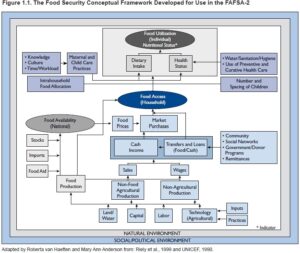
Using the conceptual model shown below, the FAFSA-2 report concluded that FFP programs were generally successful at increasing household access to food, with 92% of the reporting programs seeing improvements in the number of months of adequate household food provisioning. Furthermore, 79% of reporting programs saw improvements in household dietary diversity, and 80% exceeded their targets for increasing household income. The FAFSA-2 report highlights that by identifying and applying the specific technical models, approaches, and practices that contributed to these positive food security impacts, and by learning from the strategies that did not work well, there is a tremendous opportunity to improve overall program performance in the future.