

As this year’s UN climate conference in Turkey looms on the horizon, the UN’s Environment Programme warns of a huge gap between governments’ emissions targets and what is needed to avert ever more disastrous climate change impacts. Even countries once considered environment champions are lagging way behind.
This has not been a good week for the climate. Understatement? I am writing this in Germany, which used to have the reputation of being one of the world’s most environmentally aware and active countries. I remember as a visiting student from Scotland the excitement of observing the formation of a Green Party. The vibrant protest culture against pollution and nuclear energy. The emergence of the first “Bioläden”, or organic food shops. More recently the promotion of renewable energy: solar panels appearing on rooftops, wind turbines, electric cars. Infrastructure for bicycles and trams. The closure of polluting coal power stations.
Germany puts the brakes on climate action
Alas. What happened? The Green Party is no longer part of the government. And the coalition of conservative Christian Democrats (CDU/CSU) and Social Democrats (SPD) is taking the country backwards. Of course Germany was always famed for its car industry, and this past week saw an alliance with France to prolong the petrol and diesel car age. Measures are in place to keep these fossil fuels affordable. A missed opportunity to promote fuel saving and public transport – just the latest in a line of measures taking the country away from its climate goals.
At the same time, the government wants to make all households take out insurance against the increasing damage expected from climate change-fuelled weather extremes.
The Carbon Action Tracker (CAT) rates Germany’s overall climate targets, policies and finance as “Insufficient”, a rating that indicates Germany’s climate policies and commitments need substantial improvements to be consistent with the Paris Agreement’s 1.5°C temperature limit.
The German government is decelerating rather than accelerating climate action, drifting further from its Climate Change Act’s legally binding emission reduction targets for 2030 and 2045, the Tracker finds.
“The government has so far failed to use the global fossil energy crisis to expedite Germany’s energy transition. On the contrary, latest policy decisions risk slowing the expansion of renewable energy deployment, which reached a relatively high level of 60% share in electricity generation due to previous government action.”
Germany was a key proponent of the EU’s decision in 2026 to weaken the region’s climate policies, both on the transition to zero emission cars and allowing the use of international carbon credits to meet targets. For two years in a row, the CAT’s emissions projections for 2030 are now again higher than the previous update.
UK losing ground
In my native Britain, the Labour government has just given the green light to a controversial gas project. Plans to begin drilling in the North Sea’s Jackdaw gas field off the coast of Scotland have been approved by ministers, confirming the future of the project which at points appeared to be uncertain.
The move is controversial, with critics arguing that it goes against the government’s green commitments. Here too: what happened to priority for halting runaway climate warming?
Britain is considered a world climate leader in its pursuit of Paris Agreement goals, and has legally binding commitments to cut emissions to zero overall by 2050. Yet it goes against the advice of the International Energy Agency (IEA) that the world should not invest in new fossil fuel supply if it is to limit global warming to the key Paris Agreement target of 1.5C above pre-industrial levels.
Emissions Gap 2026 – Point of Return or No Return?
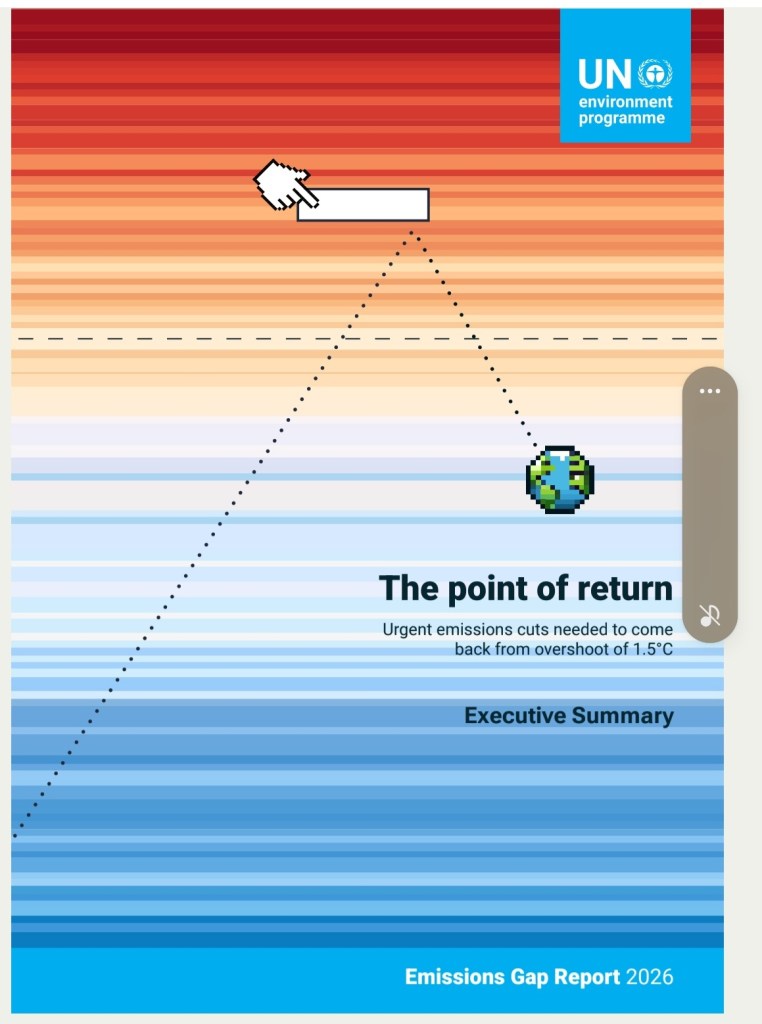
All this comes in the same week the United Nations Environment Programme confirms global temperature rise is set to exceed the once-holy 1.5°C above pre-industrial levels limit, with CO2 levels in the atmosphere again at a record high. The Emissions Gap Report 2026: The Point of Return tells us in no uncertain terms:
“Urgent and stringent cuts to greenhouse emissions are needed to minimize the magnitude and duration of overshoot and return to 1.5°C by the end of the century”.
Urgent and stringent cuts? Where are they?
As I discussed in my last post, written in the sweltering heat of that summer of disastrous weather extremes: after years of pushing for global warming to be limited to an absolute top of 1.5C compared to pre-industrial times it is shocking, disheartening, depressing to see how the world is accepting that there is now no way we can achieve that. There is no outcry, just a sense of inevitability. We have been pointing out what we would (have) need(ed) to do – and that it was possible – for so long. This abject failure means we are going to overshoot that target and can only figure out how to limit the damage.
Overshoot: grasping at a straw?
UN Secretary-General António Guterres is trying his best to stop the world from giving up on ending the fossil fuel era. Well, what choice does he have?
“Overshoot is not surrender. We can still keep it as small and as short as possible – and bring temperatures back below 1.5 degrees by the end of the century,” he said in a message on the report. “The new Emissions Gap Report from the United Nations Environment Programme shows us what it will take: Cutting global greenhouse gas emissions by 18 per cent by 2030 and 45 per cent by 2035 – compared with 2025 levels.”
2030 is just four years away.
The Report looks at a ‘lowest possible’ 1.5°C overshoot scenario, in which peak warming by around the middle of the century is limited to 1.7-1.8°C and global temperature rise is returned to or below 1.5°C by 2100, with about a 50 per cent chance.
Yes, you read right, a 50 per cent chance.

Emissions Gap or Gulf?
So how likely is it that we even get to that chance? At the moment, the full implementation of countries’ climate pledges – Nationally Determined Contributions or NDCs – would only reduce emissions by 5-8 per cent by 2030 and 11-15 per cent by 2035, relative to 2025 levels.
The report finds that if current policies continue, warming could reach 2.8°C within this century and increase thereafter. If all NDCs are delivered and similar efforts continue, warming will be limited to 2.6°C. These outcomes are worse than last year’s projections, which UNEP says is thanks to the withdrawal of the United States of America from the Paris Agreement and revised estimates of historical emissions. New NDCs submitted since last year’s report have made only a negligible difference for these projections.
Even in the most optimistic scenario, where all NDCs plus additional net-zero targets are achieved, global warming would only be limited to 2.1°C in this century. Without urgent action, keeping peak warming below 1.7 to 1.8°C will quickly become impossible. Every five years of CO2 emissions at current levels pushes peak warming up by around 0.1°C.
These are very sobering figures.
“Every additional fraction of a degree and additional year of warming above 1.5°C increases climate impacts and risks, such as the deadly floods, heatwaves and wildfires that have plagued many nations this year,” said Inger Andersen, Executive Director of UNEP. “So, we must pull out all the stops to minimize peak warming and return to 1.5°C by the end of the century.”
The report finds that there are more opportunities than ever to accelerate action. Since the adoption of the Paris Agreement in 2015, renewable energy has boomed, total energy supply from coal and oil has grown slower than projected and climate policies have cut emissions in many places.
“We have a wealth of success stories showing that emissions can be cut quickly. It is now up to nations to urgently put in place policies that spark fast, deep and sustained emissions reductions, and put the world on track for a more stable climate and more stable economies and societies,” said the UNEP chief.
But there is another major problem to consider. The lowest possible 1.5°C overshoot scenario only works if we can remove and permanently store (safely) a huge amount of CO2 during the remainder of this century. The Report quotes a figure of roughly 320 gigatonnes of CO2 (equivalent to around eight years of 2024’s global CO2 emissions). However, “socioeconomic and technological challenges make the chances of achieving this uncertain”, the Report says.
We are not in a good place.
Recent rates of change across all indicators tracking absolute GHG emissions – including CO2 emissions in energy systems, road transport emissions, and non-CO2 emissions, notably methane emissions – are heading in the wrong direction. While current policy scenarios project that some of these emissions will stabilize by 2030, none show declines occurring at the pace and scale needed to minimize the magnitude and duration of overshoot of 1.5°C.
Bad news for our frozen regions – and the rest
Another UNEP Report just published in September warns that the likelihood of crossing irreversible tipping points increases with the magnitude and duration of higher temperatures. The cryosphere, the frozen regions of our planet, are key here, with threats including the destabilization of major ice sheets, and disruption of the Atlantic Meridional Overturning Circulation. Some impacts may emerge abruptly, while others will accumulate over time, the experts warn.
The scientists have been telling us for quite some time that exceeding 1.5°C will bring not only adverse impacts, but some irreversible losses from the decline of global snow and ice regions. Studies have indicated that 1.5°C is already too high for the polar ice sheets. Now we are heading for far higher temperatures. Mass loss from Greenland and Antarctica has quadrupled since the 1990s and now represents the dominant source of global mean sea-level rise from the cryosphere. This has raised concerns about their future stability and the possibility of more rapid retreat or even collapse. Evidence indicates the risk of several metres of sea-level rise over the coming centuries, causing extensive loss and damage to coastal populations and challenging the implementation of adaptation measures, even at continued warming below 1.5°C.

The influx of fresh water from Greenland and Antarctica into the sea is changing ocean circulation. Scientists are increasingly concerned about the weakening or even potential collapse of the Amoc, the vast system of ocean currents that moves heat from the south to north in the Atlantic Ocean, thereby playing a crucial role in regulating global climate. Changes in the Amoc could affect food security, coastal flooding, storms, energy demand, migration, infrastructure planning and numerous other aspects of our daily existence.
A global assessment of mountain glaciers reveals that even temporarily exceeding 1.5°C of warming will have irreversible and long-lasting consequences for these ice reservoirs, which serve as vital water reserves for many communities. Limiting warming to lower temperatures slows glacier loss and provides much-needed time for adaptation.
The rapid landslide of ice and rock and flash floods that killed hundreds in Nepal and China’s Tibet this year were triggered when the lower part of a glacier broke off and crashed on to the valley floor hundreds of metres below.
With polar oceans acidifying rapidly, many polar marine shelled animals already face extinction under current emissions.
A mammoth task for COP31
So the negotiators set to meet at this year’s UN climate conference in Antalya in November will be under more pressure than ever to make progress at COP31. But given the huge time lapse between anything decided at one of these oversized meetings and the speed with which climate warming and impacts are proceeding, I am not sure too many of them will be optimistic.
Meanwhile, countries failed – for the sixth time running – to agree on the timeline for publishing the Intergovernmental Panel on Climate Change’s (IPCC) next set of key reports. The IPCC’s 65th session (IPCC-65) was seen by many to be the final opportunity for countries to agree on a schedule where its seventh assessment report (AR7) would be published in time for the UN’s second “global stocktake” of climate action. This should be the point when governments measure their progress against the latest science.
Some countries have reacted with dismay to the breakdown of negotiations, warning that a failure to have the IPCC’s latest assessments on climate adaptation and mitigation ready for the UN stocktaking exercise would undermine global climate action.
A climate envoy from a Pacific island state told Carbon Brief it was a “travesty that a handful of countries continue to delay the IPCC’s reports – the science we need back home to help us save lives and livelihoods”.
India, Kenya, Russia and Saudi Arabia are some of the loudest voices calling for a timeline where the IPCC’s latest assessment of climate impacts and mitigation are published after the stocktake. They have argued that developing countries need more time to prepare, review and approve working group reports. Ulterior motives, delaying tactics, especially from fossil fuel players Russia and Saudi Arabia?
Forgive me if I find it hard to be positive at this moment in time. We have no option but to keep working for a shift to a low-carbon economy as quickly as possible to keep warming impacts as low as we can, while adapting to the conditions we can no longer change. But after the devastating extremes we have seen this year, I am wondering what else has to happen before the world’s leaders come to the same conclusion?

