

By Laura Robb
 Besides building children’s love of listening to stories, teachers can improve students’ reading skill by transforming teacher read-alouds into an instructional tool and thinking aloud to make visible what good middle grades readers do before, during, and after reading.
Traditionally used to open a reading block, teacher read-alouds build a community of learners who enjoy listening to stories and viewing illustrations and photographs (Bellingham, 2019; Laminack & Kelly, 2019; Layne, 2015; Laminack, 2016). They can be adapted to many teaching situations across subjects in the intermediate and middle school grades.
Daily teacher read-alouds are also an invitation into the reading life because they develop students’ imagination, tune their ears to literary language, introduce them to a variety of genres, and enlarge their background knowledge.

Think-Aloud to Show What Good Readers Do
With your read-aloud, you can “think aloud” and show students how you apply a reading strategy or literary elements such as protagonist, setting, antagonists, etc. before, during, and after reading. In addition, think-alouds help students understand how you discover themes and big ideas, identify characters’ personality traits, explore why characters change, and use context clues to figure out a word’s meaning.
What follows are several elements that good readers use to construct meaning and to develop a deep understanding of any text they’re reading (Duke, Ward, & Pearson, 2021). Under the explanation for each element are think-aloud tips that help you plan read-aloud lessons for students.
Once you’ve completed a few think-alouds, turn the process over to your students by reading a section and inviting them to take turns thinking aloud with a partner. By listening to their responses, you can assess how much they’ve absorbed and decide whether to repeat the lesson to a small group or the entire class, or move on to a new lesson.
Constructing Meaning Before Reading
By previewing a text, students access background knowledge and vocabulary that improves comprehension. If students have little to no background knowledge, they can increase it before reading.
Preview a text by looking at and thinking about its headings, any highlighted vocabulary, illustrations, photographs, diagrams, charts, etc., to learn more about the content.
✻ Think-aloud tips: Take the time to show students how you preview a picture book, novel, informational text, or textbook. Explicitly state what you’ve learned from the preview and explain how it improves comprehension.
Use their prior knowledge to comprehend a text and build new understandings. If students lack background knowledge, they can build it by watching videos, especially when many students in your class might read two or more years below their grade level.
✻ Think-aloud tips: Be sensitive to the need for prior knowledge and decide if the entire class or a small group requires the lesson. Explain that increasing background knowledge improves comprehension of the text. Point out that students can build prior knowledge when they choose a book but know little about the topic or genre.
Constructing Meaning During Reading
Thinking aloud so students can observe how you construct meaning shows them how reading is more than just saying the words. Making meaning while reading engages students with the text and motivates them to read.
Monitor students’ understanding while reading to identify what they do and don’t grasp. Encourage readers to identify the word, phrase, or passage they aren’t comprehending. Then they can access a fix-up strategy and decide whether their comprehension has improved. If not, they can try a different strategy or ask a peer or their teacher for help.
✻ Think-aloud tips: Model fix-up strategies with your read-aloud text that show students how to improve their understanding of a confusing passage or section. Reread the section slowly, and if that doesn’t work, do a close reading. If an unfamiliar word is the problem, model how you use context clues to figure out its meaning.
Asking questions as they read engages learners with the text and motivates them to continue reading to find the answer.
✻ Think-aloud tips: Model how you ask questions about settings, the protagonist’s problems, conflicts, decisions, interactions with others, antagonists, obstacles faced, and the events or characters/people that change the protagonist.
Make predictions about what will happen next and find support in the text.
✻ Think-aloud tips: Pause during your read-aloud and make a prediction that includes text support. Then read on to confirm your prediction or to adjust it, citing supporting text details.
Visualize and imagine settings, events, characters/persons, dialogue, interactions, and information by using text details to make pictures in your mind.
✻ Think-aloud tips: Pause during read-alouds to describe the pictures you imagine and the text details that enabled you to visualize those pictures.
Apply reading strategies such as inferring, drawing conclusions, comparing/contrasting to understand content.
✻ Think-aloud tips: Show how you apply a specific reading strategy and explain how it increases your understanding of characters/people, their decisions, themes, conflicts, problems, actions, outcomes, and reasons for characters/persons changing.
Read diverse genres differently and show how text structure enables readers to navigate and comprehend the text. Help students understand the literary elements of fiction and the structure of informational texts so that they know what to expect as they read and make meaning.
✻ Think-aloud tips: Call attention to structural elements as you read fiction and nonfiction. Point out literary elements found in fictional texts such as the protagonist, antagonists, setting, conflicts, rising action, problems, themes, etc. Explain the structure of informational texts and point out these features: headings, visuals (such as charts, diagrams, or maps), and selections from primary sources. Help students understand these informational text structures: compare/contrast, sequence, cause/effect, problem/solution, concept/definition, and question/answer.
Readers won’t use all these comprehension elements while reading a text, and those they choose will vary among students. The ability to construct meaning depends on the amount of background knowledge and vocabulary related to a topic they have, the amount of independent reading they complete, and whether their teachers use daily read-alouds and think-alouds to make visible what good readers do while reading.
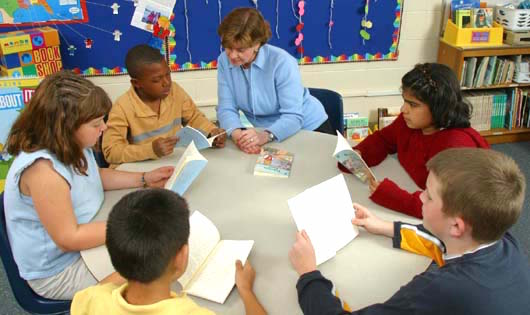
Construct Meaning After Reading
Reserving time for students to continue constructing meaning after reading deepens their comprehension, enables them to observe peers’ thinking during discussions, and ramps up their enjoyment of a text.
Reflect on their reading. This involves thinking about what they’ve read and returning to the text to clarify their understandings and recall. Looking back and rereading parts of the text are an invaluable part of reflection.
✻ Think-aloud tips: Model how you return to parts of your read-aloud to study visuals and/or to reread passages. Explain how doing this helps your recall of details, your comprehension of the story or information, and your ability to create new understandings.
Have students develop discussion questions whether they’re reading the same book or different books in the same genre.
✻ Think-aloud tips: Help students understand that open-ended questions have more than one answer and use text details and inferences to support responses. Questions that use words such as why, evaluate, judge, conclude, how, compare/contrast, analyze, create, and justify can help students develop open-ended questions. Develop questions based on your read-aloud text and show how you test a question to ensure it has at least two different answers. Students can also create open-ended questions for different texts in the same genre by using literary elements for fiction and text structure for informational texts.
Reserve time for students to discuss open-ended questions.
✻ Think-aloud tips: Before organizing small discussion groups, conduct a whole-class discussion based on your read-aloud using open-ended questions. Point out diverse interpretations and discuss the importance of respecting and valuing responses when they differ from yours.
Write about reading in readers’ notebooks. The research of Graham and Hebert (2010) and Graham, Harris, and Santangelo (2015) points out that when students write about books that they can read independently, their comprehension can improve up to 24 percent.
✻ Think-aloud tips: Write sample responses in your teacher’s notebook, model how you think before writing a response by jotting a few notes, and post these onto a whiteboard. Writing to show what a notebook response looks like provides students with a mental model of your expectations and the structure of a response. As students write, circulate among them to offer support and honor their progress.
Before the school year starts, invite K–12 ELA teams to meet and discuss which elements of comprehension to introduce or review at each grade level during the school year. Then review decisions annually or bi-annually to adjust instruction based on students’ progress.
Closing Thoughts
When students participate in instructional read-alouds, they have multiple opportunities to practice what their teacher models and develop a mental image of the process that enables them to construct meaning independently. Not only does constructing meaning engage students with texts, it also can motivate them to read independently in school and at home and develop a lifelong love of reading!
References
Bellingham, R. (2019). The artful read-aloud: 10 principles to inspire, engage, and transform learning. Heinemann.
Duke, N. K., Ward, A. E., & Pearson, P. D. (2021). The science of reading comprehension instruction. The reading teacher, 74(6), 663-672.
Graham, S., Harris, K. R. & Santangelo, T. (2015). Research-based writing practices and the Common Core: Meta-analysis and meta-synthesis. Elementary school journal, 115, 498–522.
Graham, S. & Hebert, M. (2010). Writing to read: evidence for how writing can improve reading. Carnegie Corporation and Alliance for Excellent Education.
Laminack, L. L. (2016). The ultimate read-aloud resource. Scholastic.
Laminack, L. L. & Kelly, K. (2019). Reading to make a difference: Using literature to help students speak freely, think deeply, and take action. Heinemann.
Layne, S., L. (2015). In defense of read-aloud: Sustaining best practice. Stenhouse.
 Author, teacher, coach, and speaker Laura J. Robb has devoted 40+ years to teaching in grades 4-8. She presently coaches teachers in reading/writing workshops and serves as a visiting teacher in middle grades classrooms. Laura has written over thirty books; her work continues to influence teachers and student learning. She received NCTE’s Richard W. Halle Award as an Outstanding Middle Level Educator in 2016. Read all her MiddleWeb articles here.
Laura’s most recent book is Promote Reading Gains with Differentiated Instruction: Ready-to-Use Lessons for Grades 3-5 (Shell Education, 2023) written with Tim Rasinski and David Harrison. Her Increase Reading Volume: Practical Strategies That Boost Students’ Achievement and Passion for Reading (NCTE, 2022) is reviewed here at MiddleWeb.

