

Plans for a celebrity-backed “hyperscale” data center in rural Utah, so massive that it would consume more than double the state’s current electricity use, have generated an intense public and political backlash in a state where the motto is “industry” and a Republican supermajority tends to be deferential to development.
The project, brought by “Shark Tank” TV personality Kevin O’Leary, would span 40,000 acres, demand 9 gigawatts of power once completed, and raise the state’s carbon emissions by 64 percent, according to estimates. While its water needs remain unknown, the sprawling data center would neighbor the northernmost tip of the shrinking Great Salt Lake, which will likely hit a record-low elevation this year following an unprecedented dry winter.
It could also create a massive heat island capable of devastating the area’s ecology, said Robert Davies, a physics professor at Utah State University. Davies estimated that the finished project would cover about as many square miles as Washington, D.C., making it the largest data center on the planet, and that it could produce enough heat to spike nighttime temperatures by as much as 28 degrees Fahrenheit in the high-desert valley.
“I suspected it would not be good,” Davies said. “What I’ve found is, it’s so much worse than I even thought it would be.”
News of the proposed data complex, dubbed the Stratos Project, became public in April after the three commissioners of Box Elder County, the mostly agricultural community that would host it, approved the project. They pointed to the project’s approval by more powerful state agencies and asserted that stopping it was out of their hands, while refusing to hear comments from more than 1,000 people who showed up to share their concerns. Utah Governor Spencer Cox, a Republican, has since walked back some of his full-throated support.
“Many are asking questions about water, air quality, energy, land use, and the long-term impact on rural Utah,” Cox wrote in a thread on X earlier this month after intense public outcry over the project. “Those are real concerns, and all Utahns should expect clear standards and accountability.”
The controversy in Utah is a stark illustration of a wider trend. Across the United States, data centers are drawing bipartisan backlash as communities clash with tech giants and developers over strained water supplies and spiking energy costs.
At least two other massive data campus projects are proposed elsewhere in Utah, but they have not received anywhere near the pushback as the Stratos Project. Many opponents have pointed to efforts state leaders have made in recent years to support water conservation — Utah is among the driest states in the country — and the state legislature’s multi-million dollar investments to help the Great Salt Lake refill. The lake’s drying bed has already become a source of toxic dust threatening the health of millions of residents living on the Wasatch Front, Utah’s urban core.
It seems contradictory, then, to build a potentially water-intensive and explosively hot industrial development right next door to such an endangered and iconic spot.
“The greed behind this deal is clearly blinding the officials to just how much is at stake for the rest of us,” wrote Monika Norwid of Salt Lake City, one of the Utah residents who sent comments to the state’s Division of Water Rights protesting the project. “I refuse to let this greed imperil our already fragile wildlife, I refuse to allow some useless technology steal the rest of our insufficient water for a project that is way beyond the scale of this area.”
In an interview with CNN, O’Leary downplayed the environmental impact of his project, saying Stratos is “not going to destroy air quality” and “not going to drain the Great Salt Lake.”
Romain Maurice / Getty Images
Austin Pritchett, a cofounder of West GenCo, the developer partnering with O’Leary Digital Limited on the project, said that they plan to purchase roughly 3,000 acre‑feet of on‑site water rights and already have around 10,000 acre‑feet under contract from the nearby town of Snowville if needed.
Added together, that’s enough water to supply the basic needs of more than 20,000 Utah households. Utah’s Division of Water Rights has only received one application for the project so far — to transfer 1,900 acre-feet currently used for irrigation by the Bar H Ranch. That application was pulled last week, but a representative with the ranch said it will refile and “fully intends to move forward with the project.” A division spokesperson said they anticipate more applications from the data center developers soon.
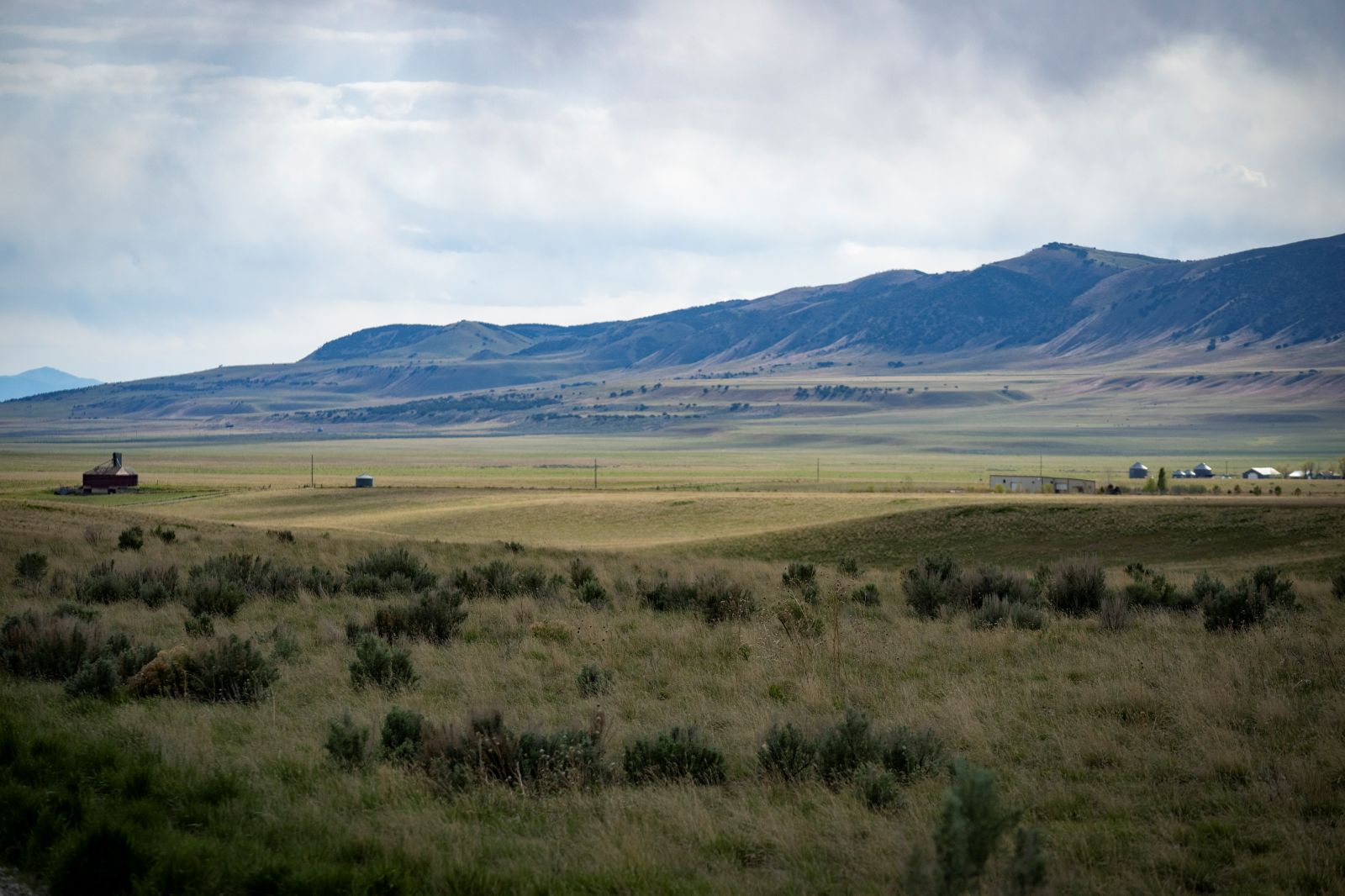
Some scientists worry the project’s power demands and resulting heat island effect will transform its high-desert climate into something more akin to the Sahara.
Stratos would build its own power plant, state supporters have said, and its fuel will likely come from a corridor carrying natural gas from Wyoming to Nevada, Oregon, and California called the Ruby Pipeline. O’Leary specifically chose Box Elder County’s Hansel Valley to build the complex because the pipeline spans it, state officials have said.
“It could generate power at a significant level,” said Paul Morris, executive director of Utah’s Military Installation Development Authority, a powerful quasi-governmental state agency that provides tax incentives for development, during a public meeting in April. “This location was picked because of the gas pipeline.”
Rick Egan / The Salt Lake Tribune
Davies, the physics professor, has done some back-of-the-envelope calculations to better understand the sheer scale of the 9-gigawatt project. And what he’s penciled out so far has him alarmed.
“Nine gigawatts, that’s a number that’s really challenging to get your brain around,” the professor said. ”Communicating the scale has been a real problem.”
The entire project will actually produce roughly 16 gigawatts of thermal energy, according to Davies. It starts with the massive on-site power generation, which will generate 7 to 8 gigawatts of waste heat just producing the needed electricity for the data center, since gas plants are only about 57 percent efficient.
And once that electricity reaches the data center, every watt will turn into pure heat, because anytime a gadget consumes power, it converts it into heat, Davies explained, whether it’s a toaster, a car, or a sprawling rack of computer servers.
Typically, waste heat from end uses of electricity is dumped far from a power plant, in homes, businesses, or on roads where it dissipates. In this case, the Stratos project will release roughly 16 gigawatts of thermal energy into Hansel Valley, according to Davies. That trapped thermal load is the “equivalent of about 23 atom bombs worth of energy dumped into this local environment every single day,” Davies said.
That doesn’t mean the project would wipe out the landscape with an explosion or release dangerous nuclear radiation, but the heat it creates could devastate the local ecology.
“What happens if you deposit that much energy continuously into a topography like this?” Davies wondered. “Right at the north end of the Great Salt Lake, a watershed that’s in collapse. A high-desert environment? A valley?”
Davies thinks dumping that much heat into Hansel Valley will raise local temperatures by 5 degrees F during the day and up to 28 degrees at night.
“That’s the difference between Utah’s semi-arid climate and the Sahara Desert,” said Ben Abbott, an ecology professor at Brigham Young University who has reviewed Davies’ estimates. “This would absolutely change the landscape.”
Evaporation would spike. The dew point could collapse, with devastating consequences on wildlife, plants, and the fertility of land owned by other ranchers in the valley, Abbott and Davies said. Abbott suspects Hansel Valley would become another source of dust on the Wasatch Front, in addition to the exposed and drying lake bed of the shrinking Great Salt Lake.
“I’m happy to be further educated. Maybe I’m getting something wrong here,” Davies said. “But that is kind of the point, right? You literally have a hyperscale project that is getting no due diligence.”
Salt Lake Tribune reporter Samantha Moilanen contributed to this story.

