

How do you build peace in a place where climate change is making it harder to find water and grazing land? Where communities have lived side by side for generations, but also fought over the same resources? This is the question at the heart of International Alert’s work in the Kenya-Ethiopia borderlands.
Since 2024, we have been working alongside communities in this region through a project that looks at the links between climate, conflict and gender equality. We are working together with our local partners TUPADO and the Ethiopian Institute of Peace.
At the end of February, we travelled to Kangaten in southwestern Ethiopia to see how the project is going and to meet the people at the heart of it. The best part of our visit? Sitting down with local women and hearing their stories firsthand.
The heat in Turmi was already intense when we arrived. Despite the high temperatures in Nyangatom Woreda in southwestern Ethiopia, the local centre was buzzing with activity. People moved in and out of small shops, elders gathered in discussion, and children played nearby. Life carried on as usual.
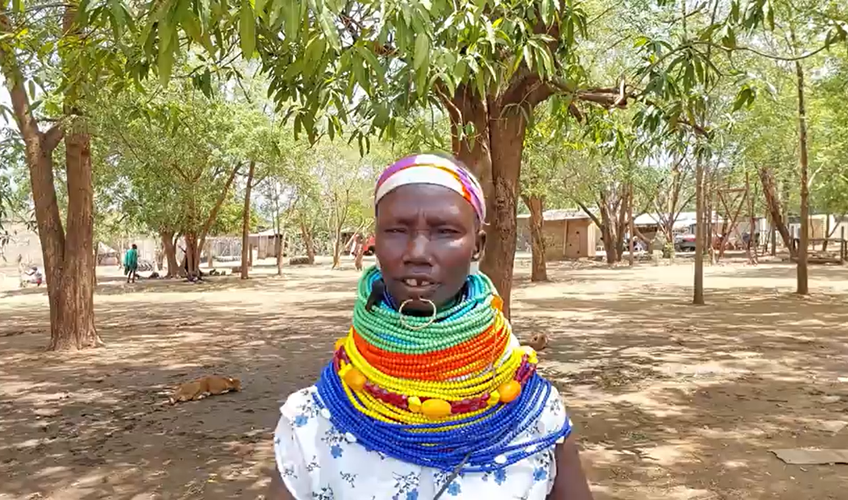
We eventually settled under the shade of a large tree, one of the few places offering relief from the heat. The tree is more than just shade. It is where the community gathers to talk, settle disputes, and sometimes simply rest. Not far away, the waters of the Omo River flow quietly through the dry landscape, sustaining communities on both sides of the border.
It was here that we met two remarkable women whose courage and leadership are quietly shaping peace in their community.
“Peace is like fresh milk”
The first woman we spoke to was Akuru Ekeno, widely known in the community as Mama Peace. She earned this name after saving a Turkana woman who was about to be killed by Nyangatom youth following a cattle raid. Her intervention helped prevent a tragedy and strengthened trust between the two communities.
When asked what peace means to her, she paused for a moment before offering a powerful metaphor: “Peace is like fresh milk. When you drink it, it feels good in the stomach. It is also like rain. Watch closely, for when it comes, it will wash the dust from everything and make the grass grow green again.”
For Akuru, peace is not an abstract concept. It is something that can be felt in daily life: in the ability to farm, to trade, and to move freely without fear.
The predominantly pastoralist communities of the Turkana, Dassenach, Nyagatom and Hamer have experienced ongoing conflict in recent years, particularly in the border areas. Competition over access to water, pasture and grazing areas has traditionally driven the conflict, with tensions exacerbated by increasing migration during cycles of prolonged drought.
Akuru explained how, seven years ago, the area was torn apart by raids, violence and death. While hyenas and vultures had plenty to eat, the people were starving.
Peace is like fresh milk. When you drink it, it feels good in the stomach.
Now, she says, the corridor between the Turkana, Nyangatom and Dassanech is enjoying relative peace, thanks to the work of peacebuilding organisations such as the Ethiopian Institute of Peace and Turkana Pastoralist Development Organization (TUPADO). Peacebuilding efforts have focused on dialogue, mediation training and promoting the role of women in decision-making.
Relations have improved between the neighbouring communities to the extent that, as Akuru explained, people from the Hamer community had earlier been in the market buying and selling livestock alongside other communities, something that would have been impossible just a few years ago. The different groups have begun travelling to use facilities in other areas, improving economic opportunities. Across South Omo, communities are holding dances together again. What was once unthinkable has become the new normal.
“The soil itself smells good again. People are returning to their irrigation projects, work that had been closed for years due to insecurity. Now, finally, we can plant,” she said, with a smile on her face.
But Akuru has not stopped there. Determined to inspire other women, she has helped form several local groups that bring women together to support each other’s daily activities and economic independence. Through these groups, women are now able to sell goats and sheep and contribute to household income, a step that quietly challenges traditional gender norms.
A moment of bravery
We also spoke with Kampolo Lochim, a member of the local peace committee whose quick thinking once prevented a potential escalation of conflict.
One day, a group of armed Nyangatom youth passed near her home. Something immediately caught her attention. They were carrying guns, and with them were ten donkeys that clearly did not belong to them. Kampolo suspected the animals had been stolen from the Turkana community.
Instead of confronting them directly, she took a different approach. She invited the young men to eat. Knowing they needed food, they accepted. Kampolo then suggested that they hand over their guns while they ate so she could keep them safe.
They agreed. Once they finished their meal, Kampolo calmly told them they had two options: she would keep the guns, or they could return the donkeys they had taken.
Her courage and calm resolve caught the young men off guard. Moved by her bravery, they agreed to return the animals. Kampolo then escorted them to a local elder, and together they ensured the donkeys were returned to their rightful owners.
A raid had been stopped and, with it, the possibility of further violence.
Women standing for peace
Stories like these are rarely told, yet they reveal the quiet but powerful role women play in preventing conflict. Across Nyangatom, women are increasingly stepping into spaces traditionally dominated by men. They negotiate across communities, speak to young warriors, and encourage dialogue where violence might otherwise take root.
Kampolo reflected on the importance of everyday peacebuilding: “Peace starts within. Being able to resolve even the small conflicts with your neighbour is very important.”
In communities affected by cattle raiding, climate pressures, and long-standing tensions, women often act as the first line of defence against conflict.
Being able to resolve even the small conflicts with your neighbour is very important.
Why their voices matter
In the Omo-Turkana borderlands, communities face intertwined challenges of conflict, climate pressures and limited opportunity. Working alongside local partners, International Alert supports peacebuilding efforts by strengthening women’s participation in dialogue, providing mediation training and amplifying their voices in decision-making. This collaboration empowers women like Akuru and Kampolo to play an even stronger role in sustaining peace within their communities.
On International Women’s Day, the stories of women like Akuru Ekeno and Kampolo Lochim remind us that peace is not built only in formal negotiations or national policies. It is also built in homes, under trees where communities gather, and in courageous moments when someone chooses dialogue over violence. These women are challenging patriarchal norms, organizing across borders, and protecting their communities in ways that often go unnoticed.
Their voices deserve to be heard not only as stories of resilience but as evidence of the powerful role women play in sustaining peace. As we celebrate International Women’s Day, we must continue to amplify these voices and call on policymakers and development partners to invest more in regions like South Omo, where local leadership, especially by women, is transforming communities from within.

