

Word Problem Workshop: 5 Steps to Creating a Classroom of Problem Solvers
By Mona Iehl
(Routledge, 2026 – Learn more)
Reviewed by Kathleen Palmieri
 Mona Iehl’s Word Problem Workshop offers a practical framework designed to ignite how elementary learners engage with math. The book outlines a structured, daily routine that makes word problems less scary by building confidence, connections, and wonder in each session.
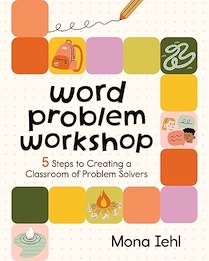 The workshop structure is a high-impact routine that is manageable in terms of time, which is important in the busy elementary schedule. Iehl presents a framework that involves sessions held three to five times per week, lasting 15 to 30 minutes per session, and focused on just one to two problems per day. This approach ensures a consistent, low-pressure, high-impact routine.
5 Steps to Boosting Math Learning
The core of Iehl’s framework is a five-step process that moves students from initial curiosity to deep reflection. This structure allows both procedural skills and mathematical discourse. The five essential steps to problem-solving include:
1. Launch (p. 31): The session begins with a “hook question” to capture students’ attention, followed by a story that puts the problem in context. This establishes the wonder and purpose before the actual work even begins.
2. Grapple (pp.33-37:) This is where students engage in productive struggle as they work on the problem. They develop resilience and initial problem-solving strategies.
3. Share (p. 37-38): Students take turns sharing their work and strategies with peers.
4. Discuss (pp. 38-39): Using the Turn and Talk strategy, students process what they just heard, deepening their connections to different concepts and methods.
5. Reflect (pp.39-41): This step wraps up the discussion and is followed by a quick problem based on the day’s learning. The students then complete a two-sentence reflection on something they noticed, heard, or learned.
The Power of Reflection
Emphasizing the power of reflection enhances the math workshop model. This is a notable commonality I found with my own practice as a math teacher in the intermediate grades.
Iehl significantly enhances this stage by focusing on “mathematician qualities” (checklist on p.142), very much like I do in my own math classroom. Qualities such as understanding the problem, keeping work organized, and persevering without giving up shift the focus from merely getting the right answer to developing the right habits. This emphasis on mindset and process helps elementary students view themselves as problem solvers with confidence, enticing them to look forward to the next problem.
Focusing on the reflect step in Iehl’s framework, I believe it provides a critical wrap-up and opportunity for students to consider what they’ve learned, directly supporting the development of a “growth mindset” in mathematics.
Providing a smaller problem designed to apply the strategies and concepts just learned is powerful in identifying student progress. Iehl’s “Two-Sentence Reflection” helps students state what they noticed, heard, or understood that day. This simple exercise makes the learning process explicit and visible.
By providing a clear, five-step structure and intentionally emphasizing the characteristics of a mathematician, Iehl ensures that Word Problem Workshop: 5 Steps to Creating a Classroom of Problem Solvers is an essential resource for any elementary educator looking to foster a love of mathematics with confidence, a growth mindset, resilience, and wonder.
Kathleen Palmieri is a National Board Certified Teacher, NBCT Professional Learning facilitator, and education writer. She is a fifth-grade educator in upstate New York who reviews and writes regularly for MiddleWeb. With a passion for literacy and learning in the classroom, she participates in various writing workshops, curriculum writing endeavors, and math presentations. As a lifelong learner, Kathie is an avid reader and researcher of educational practices and techniques. Follow her at Bluesky @kathleenpalmieri.bsky.social and learn more about her education adventures at www.kathleenpalmieri.com.

