

May 10, 2026 By Lani Marquez
My husband and I recently visited Oslo, Norway, a beautiful city surrounded by the Oslo Fjord. One of the many very interesting museums we visited there was the Fram Polar Exploration Museum, which houses Norway’s most famous polar ship, the Fram, which sailed to both the North and South Poles. The ship was designed by the Norwegian scientist Fridtjof Nansen (1861-1930) and launched in 1892.
Nansen had gained fame while pursuing a doctorate in Zoology when at the age of 27, he led a six-month expedition in 1888 to be the first to successfully cross Greenland on skis. He published two books about the journey with his own photographs and drawings, bringing him international fame. He then set his sights on being the first person to reach the North Pole.
Forcing ships through the Arctic ice to reach the North Pole had been tried and had failed many times in the 1800s. But in 1884, a Norwegian professor of meteorology, Henrik Mohn, had put forward a theory of an east-west current over the Arctic Ocean when the remains of the American expedition ship Jeannette were found by the Greenland coast after the ship had been crushed in the ice and had sunk sunk near the New Siberian Islands in 1881. Nansen noted this and related it to the driftwood from Siberia that he had seen in the ice off Greenland.
Nansen conceived the plan of building a ship “so small and so strong as possible … that it was improbable that it could be destroyed by the ice”. With such a ship he believed that he could drift over or very near to the North Pole. In 1893, he and his crew prepared for a two-year journey in which they would let the Fram get frozen in the drift ice north of Siberia with the hope that the currents would carry the ship to reach the pole. While they did not reach the pole, the expedition returned home safely, and Nansen later sailed on the Fram on an expedition to reach the South Pole. He did not reach that goal either. (Robert Peary became the first person to reach the North Pole in 1909, and Roald Amundsen the South Pole in 1911.)
The story of Nansen’s polar expeditions was fascinating enough, but what really captivated me about this man was his humanitarian work.
Upon his return to Norway after his polar expeditions, Nansen became Norway’s first ambassador to Britain, and in 1917 led a Norwegian delegation to the United States to seek grain aid for Norway, since the country had depended on imports of grain from Germany and Russia before the first World War due to the very low proportion of its land that is arable and since most of the country is made up of mountains, forests, and glaciers. Soon afterwards, horrified by the slaughter of World War I, Nansen became a champion for the League of Nations and attended the Versailles Peace Conference in 1919 which helped shape it.
In 1920, the League of Nations appointed Nansen as High Commissioner in charge of the arrangements for the safe exchange of some 250,000 German and other foreign prisoners of war held by the Russians and some 200,000 Russian prisoners of war held in Germany.
At the same time as the prisoner exchange was being organized, the new Soviet Union was experiencing widespread famine. Nansen arranged for food, clothing, and medicines to be provided to the prisoners of war on Soviet territory and appealed for food aid for the Soviet Union. When Western governments refused to provide such aid to the Communist government, Nansen toured Europe and the United States to raise private donations to fund food for starving people in the Soviet Union.
He argued in the League of Nations for a £5 million loan to address the Russian famine, but his pleas were denied. Nansen estimated that 7 million people died in the Soviet Union as a result of the famine—more than twice the population of Norway at the time. Nansen led relief efforts as High Commissioner for Relief in Russia for the International Committee of the Red Cross (ICRC) and associated organizations, after the League of Nations declined official involvement due to distrust of the Soviet government. His work combined advocacy, logistics, fundraising, and on-the-ground aid distribution.
Through the Nansen Mission (involving Red Cross branches from multiple countries and groups like Save the Children), he helped set up free canteens at orphanages, railway stations, and factories. Field kitchens (hundreds deployed) provided daily rations like half a liter of soup and over 100 grams of bread per person. The effort served hundreds of millions of meals overall.
“The difficult is what takes a little time, the impossible is what takes a little longer”
— Fridtjof Nansen
After that, in 1922, the League of Nations appointed Nansen as its First High Commissioner for Refugees, the first High Commissioner for Refugees (what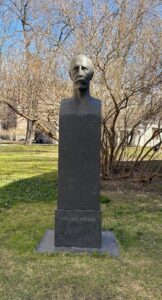 would later become UNHCR), where he continued to use his fame as a polar explorer and diplomat to call attention to the victims of famine and genocide in Russia, Ukraine, and Armenia. In 1922, Nansen received the Nobel Peace Prize for his tireless work for refugees in Europe after the war.
In his biography Nansen: The Explorer as Hero, Roland Huntford wrote, “Nansen is among the few really worthy winners of the Peace Prize, although he is probably the one who spent the shortest time earning it.” Nansen spent the prize money on the purchase of tractors and the establishment of model farms to develop agricultural improvements in Russia.
Nansen’s legacy as a diplomat and hunger activist is worth remembering today. His Nobel Prize recognized this work alongside his refugee initiatives. He approached it with the same determination he showed in polar exploration—practical, innovative, and relentless. His legacy influenced modern humanitarian organizations like UNHCR.
see also: https://www.unhcr.org/il/en/about-fridtjof-nansen-unhcr-israel

