

Ask Kathleen Flower what drives her work in biodiversity science and she’ll tell you about people: a village of 500 in rural Cameroon where residents saw large volumes of timber leaving their surrounding forest each day or women on the South African coast harvesting mussels.
Today, as Conservation International’s biodiversity science lead, Flower brings that same perspective to some of the biggest questions in conservation — how to measure what we’re losing, how to protect it through a changing climate and how conservation science can evolve to address increasingly complex environmental challenges.
She spoke with Conservation News about a career spent at the intersection of biodiversity and the people who depend on it.
Your career has taken you all over the world — let’s start at the beginning.
KF: I grew up loving science and knowing I wanted to explore the world. I got my first chance in college, while studying abroad as a biology major at the University of Ghana. Through that experience, I enjoyed getting to better understand West African culture and music and also learned what it took to do field science in places where you don’t always have the resources you need at hand.
A few years later, I was excited to return to Africa as a US Peace Corps volunteer. I was posted to eastern Cameroon, in a remote village on the edge of the Congo Basin rainforest. Life there was woven with the land, and it shaped my perspective on what it meant to depend so directly on nature.
Was there a moment when this shift in perspective clicked?
KF: One day stands out clearly. I lived in a small village, around 35 kilometers (22 miles) from the nearest town with shops and a telephone. The only way to reach the town was to wait for a bus or to ride my bike along a clay road. Every day, several heavy logging trucks would pass by my village — empty ones traveling East and fully loaded trucks going West. During the rainy season, the massive logging trucks would churn up the wet road, which could then be closed for days at a time.

One day after a big rain, I decided to ride my bike into town. At a big muddy patch, I came across a long line of logging trucks, stuck in the mud and loaded down with felled trees. One, two, three — I counted 50 trucks, which had all gotten there in the past 24 hours. I remember thinking to myself, there is probably an acre of forest on the back of these trucks. I marveled at the volume of timber coming out of the forest each day just along this road.
I started doing the math: multiplying what I saw by the number of days, number of roads, number of forest areas affected throughout the Congo basin. Even with limited information, it was a big number. This realization about the magnitude of the situation became a galvanizing moment for me.
It’s a powerful image. How did it lead you to work on biodiversity?
KF: People and nature are inseparable, but how we interact with nature isn’t always under our control. In Cameroon, I saw how some people lived in and directly depended on nature for food, shelter and income — and yet they felt vulnerable because they were not in a position to control what happened to the forests they relied on. Any time global forces drive the destruction of nature, we’re providing income for some people — for example, the local community members working for the logging company — while depriving others of their ability to make a living and take care of their families. Protecting nature is deeply intertwined with considerations of equity, justice, rights and dignity.
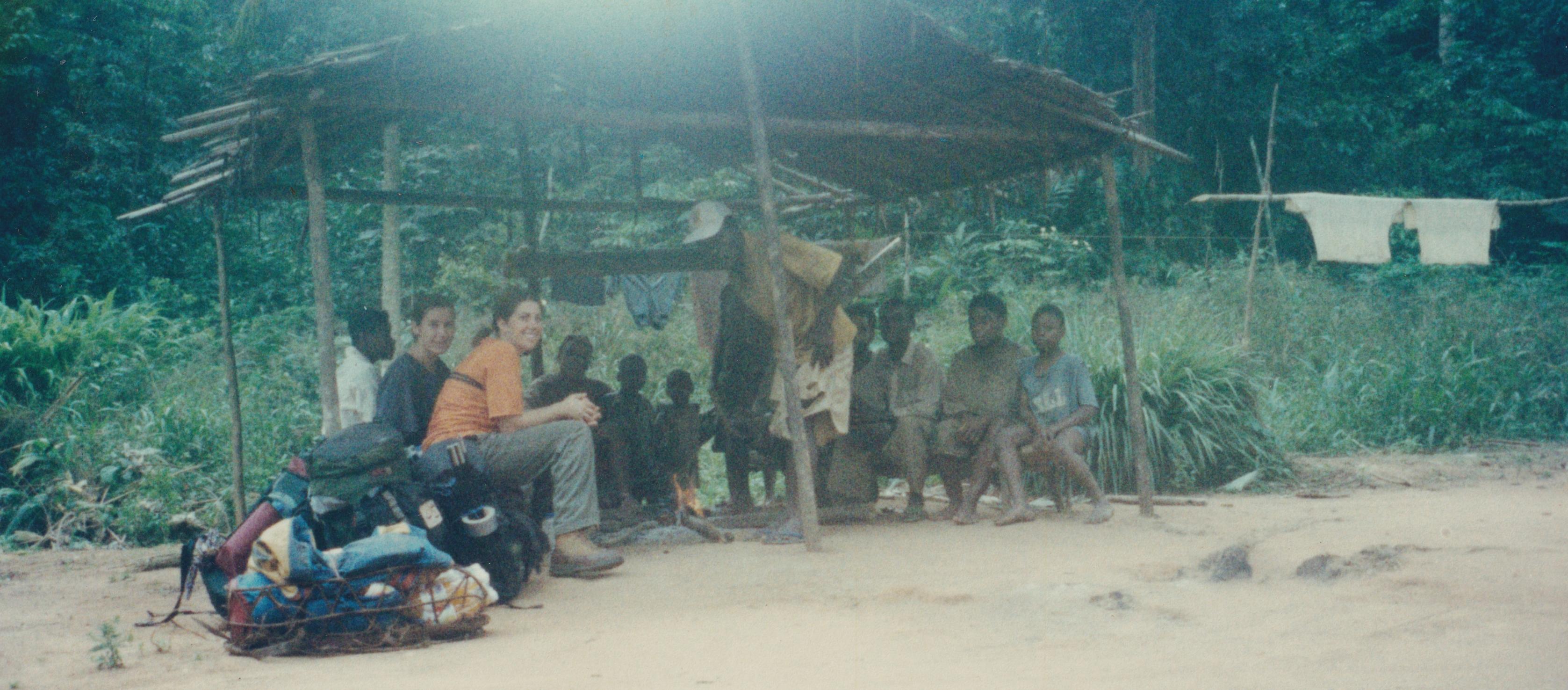
That complexity at the heart of peoples’ relationship to nature that I’d sensed on that road in Cameroon — and a desire to work to better understand that intersection — led me to the University of Cape Town. What was meant to be a one-year postgraduate honors degree in zoology turned into six years and a PhD. The early 2000s was a transformative time in post-apartheid South Africa, when academics, government and communities were working together to figure out how to equitably and cooperatively manage nature. Inspired by and in support of this nation-wide effort, my research focused on a coastal fishery whose fishers were mostly women. My goal was to help these women effectively manage the mussels and other invertebrates they harvested at low tide so they could continue to get enough protein to feed their families. Overfishing was a real threat and understanding the biodiversity, ecology, and the physical processes of the rocky shores and coastal ocean was a foundation of that work. You can’t manage a fishery if you don’t understand the ecosystem it is built on.

You now lead biodiversity science at Conservation International — what are you focused on?
KF: Our planet is vibrant and full of life — I want to help keep it that way. I want my kids to grow up on a healthy, stable Earth, one that supports them and is still full of wonder. That’s what drives me. And to get there, my team and I are focused on three things.
We have to recognize that we’re still learning. It’s easy to assume we’ve discovered everything. We haven’t — not even close. For example, a team of our scientists discovered four new mammals in the Amazon — that’s astonishing, and almost unheard of in this era.
Also, we need to continue to drive innovation. Advances in eDNA, satellite imagery and artificial intelligence are transforming our ability to measure biodiversity, analyze large datasets, make predictions and inform conservation decisions, and find new ways to fund its protection, management, and restoration.
And, of course, we must use what we know now to plan for the future. We understand so much about how climate change affects both the physical and natural environment. How do we design strategies that don’t just protect biodiversity as it is today, but actively enable biodiversity to persist and adapt as climate change intensifies and eventually, we hope, recedes over the next decades?
The task is enormous, but it’s a privilege to dedicate my career to this.
How has conservation science changed over your career?
KF: There’s a lot of ways, but one that really hits home for me personally is that computing power is finally catching up to the complexity and richness of ecosystems.
My father is a physicist and develops and tests sophisticated computer simulations. In 1985, our family moved across the country so that he could accept his dream job, including using a new supercomputer that had just been installed at a national laboratory. He believed then, as I do now, that modern computing allows us to understand, describe and work in the world in continually new and important ways.
As it turns out, that machine had the equivalent computing power of an early iPad. Today, we have exponentially more power at our fingertips. That means that we finally have processing power that is up to the task of analyzing the amount of data that we can collect about ecosystems and biodiversity. What used to take hundreds of hours of manual work can now be done in minutes. Just pull out your phone and you’ll find apps that can identify bird calls or plants in real time. The insights we can generate from this data were imagined but unattainable just a generation ago.
With technology changing the field so rapidly, what advice would you give aspiring conservationists?
KF: Pay attention to what makes you curious — communications, the law, medicine, fishing, gaming, really almost anything — and you’ll find a way to bring your passion into this field.
Humans are part of the environment, so learn to identify key features of your ecosystem. Your backyard or neighborhood park is a great place to get familiar with nature. Knowing the names of plants and animals in your neighborhood grounds you — that deep familiarity is the foundation of everything. It’s like knowing all your neighbors: if someone stops showing up, you notice.
Then, travel or learn a language. I started learning French in high school and Portuguese as an adult, and continued study and practice has opened up incredible opportunities. Being able to speak to people in a language that is more comfortable for them changes the conversation entirely.
Finally, pay attention to how other people live, so that when you enter diverse spaces, you can lead with empathy.

