

For decades, Jon Zehr was haunted by an organism he knew was here — but couldn’t see.
It all started in the ‘90s on a research boat in the middle of the ocean. Zehr was an oceanographer studying nitrogen-fixing bacteria — simple, microbial life forms that could pull the element straight from the air, making it bioavailable to plants and animals. Scientists at the time had only seriously studied one species of nitrogen-fixing bacteria in the entire ocean, but Zehr wanted to change that. His plan was to gather and test samples of seawater with the hope that he might find something that other scientists had missed.
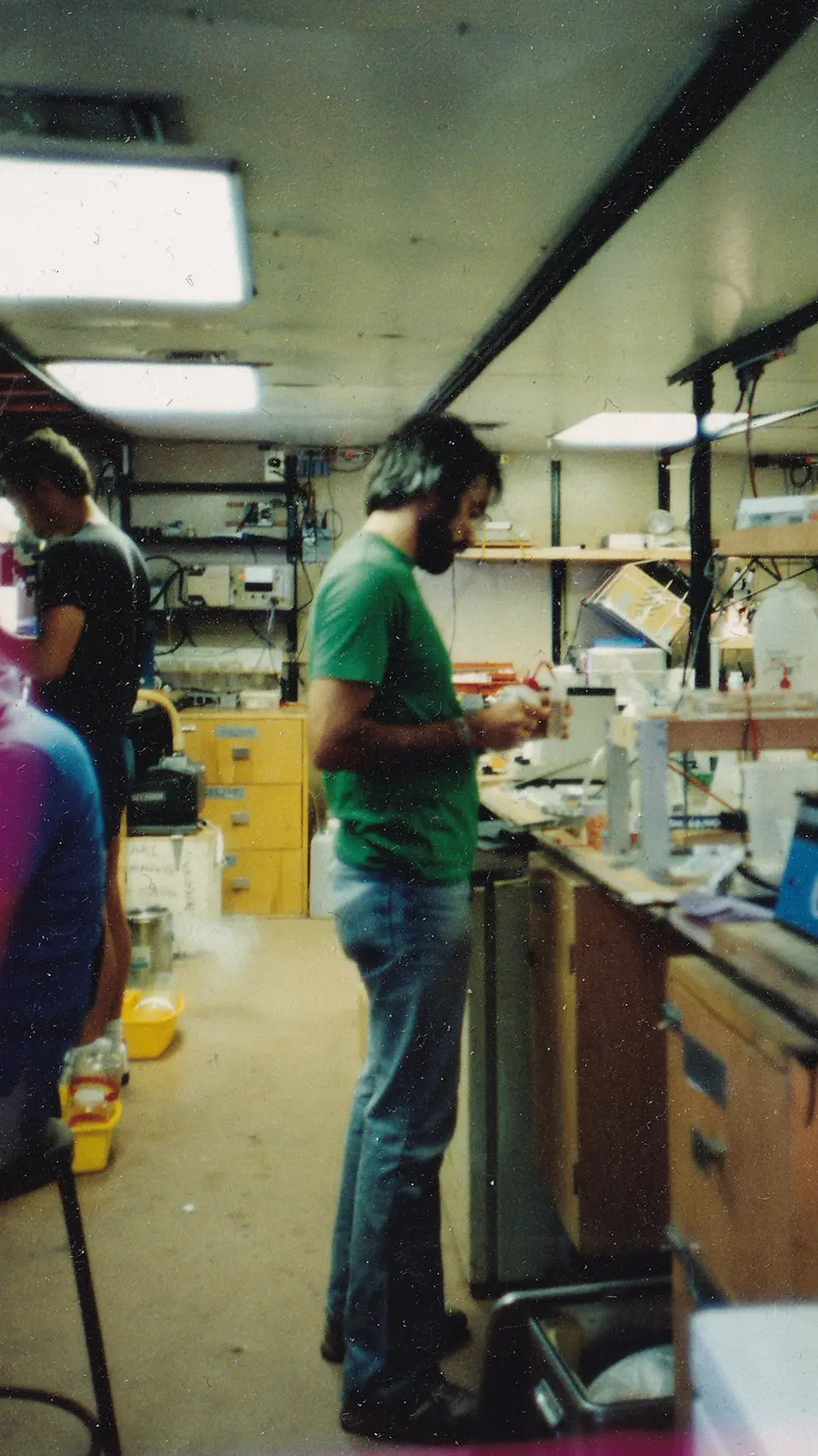
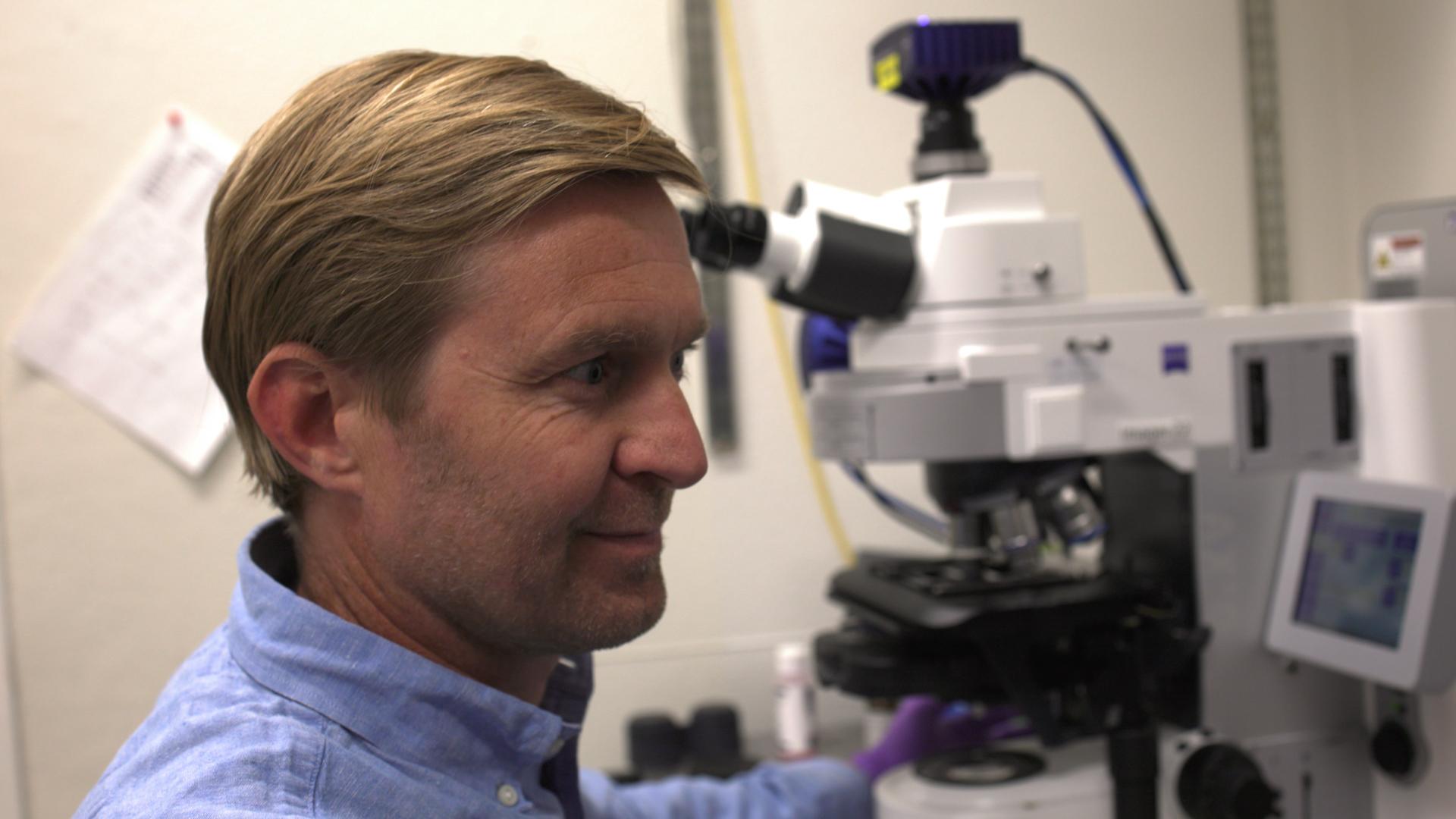
Left: Jon Zehr (bottom center) sits aboard a research vessel. Right: Zehr studies nitrogen-fixing bacteria in the lab. Courtesy of Jon Zehr.
Zehr’s plans involved something pretty cutting-edge for the time: DNA. He gathered seawater samples and ran tests for the presence of the gene for nitrogenase, the enzyme that gives bacteria the ability to pull nitrogen out of the air. If he got a hit, it would hopefully mean the seawater contained some new kind of nitrogen-fixing bacteria.
And it worked. Almost immediately, he found traces of a species of nitrogen-fixing bacteria previously unknown to science. Looking at the genes themselves, he could get a pretty good idea of what this new bacteria should look like. It was likely a unicellular cyanobacteria, around 3 micrometers in size, that should fluoresce orange under the microscope. Full of anticipation, he popped the seawater samples under the microscope, expecting to see that bacteria everywhere.
Instead, he found nothing. There weren’t any organisms in the sample that matched the right description.
Surprised, Zehr repeated the process over and over. He tested samples of seawater from the tropical waters of Hawaii and the southern Caribbean, all the way to the cold waters in the Arctic. Again and again, the genetic signature surfaced but not the visible bacteria. It was as if he had discovered a footprint without an animal.
But he didn’t want to stop looking. He knew that any new discovery could represent a vital link in the Earth’s fragile nitrogen cycle. “This one I kept chasing, because it’s globally important,” Zehr said.
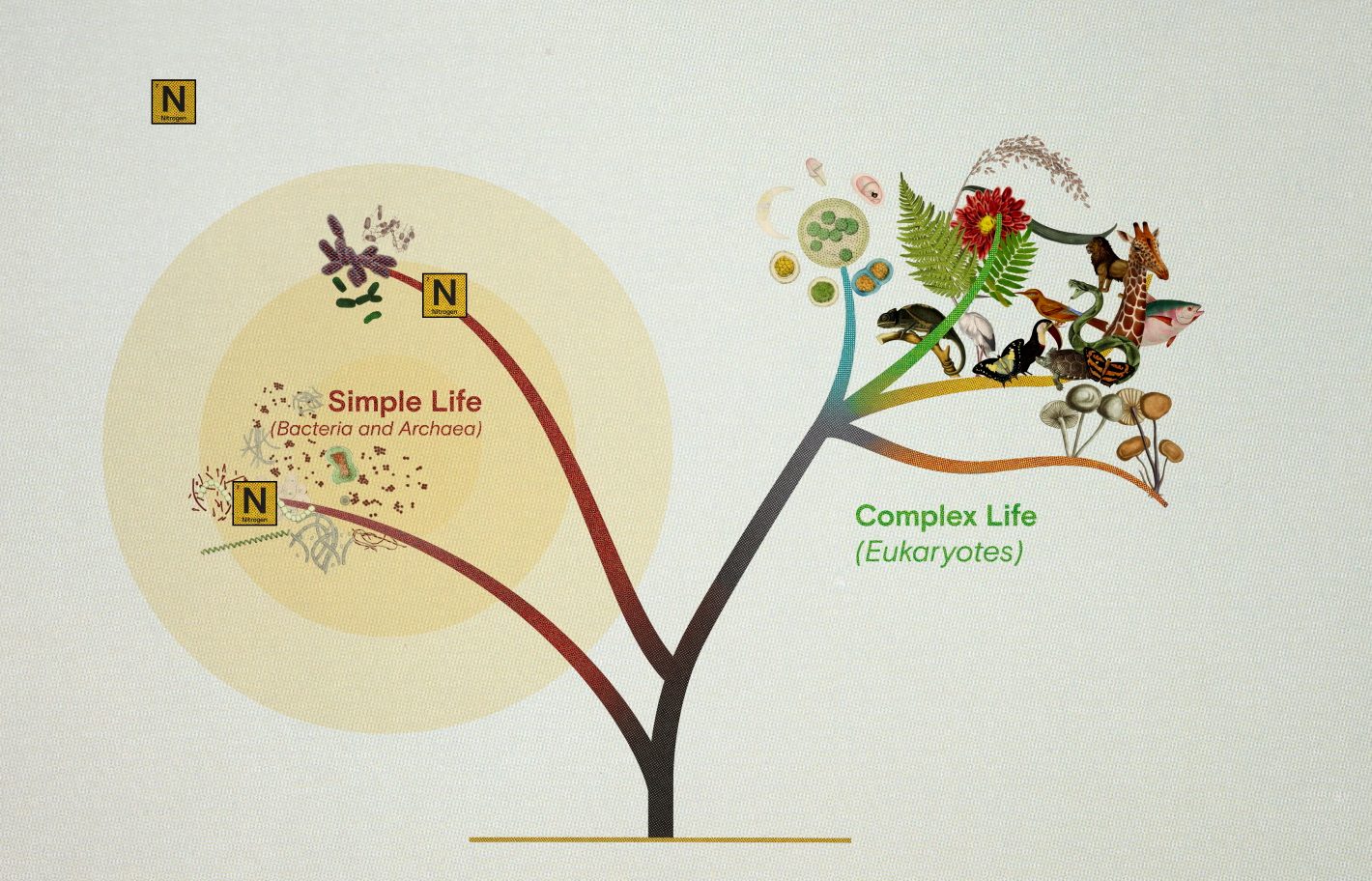
To understand Jon’s obsession, it helps to start with a peculiar biological constraint — a cruel joke, as one scientist put it — at the heart of all life on Earth. It goes like this: All living organisms need the element nitrogen to survive. It’s a key part of proteins, DNA, and RNA. But while our atmosphere is absolutely packed with nitrogen, the one enzyme that can pull nitrogen from the air so that living organisms can actually use it basically falls apart in the presence of oxygen. So even though plants, animals, and fungi are constantly surrounded by nitrogen in the air, they can’t get a hold of it on their own.
The only organisms that can actually pull this off are ones that can survive without oxygen: super simple bacteria and archaea. That means the entire natural world relies on a relatively small number of microscopic species to make nitrogen usable by more complex forms of life.
Jesse Nichols / Grist
This biological bottleneck has had major impacts on human civilization. Nitrogen is a major component of fertilizer, since plants need it to grow. Enriching soil with nitrogen drastically increases crop yields — important for feeding a growing population. Centuries ago, fertilizer was in such short supply that countries fought wars over islands covered in nitrogen-rich bird guano. In the early 20th century, German scientists created an industrial method to create synthetic, or lab-made, fertilizer. While this invention saved billions of lives from starvation, it also wreaked havoc on the environment. Producing synthetic fertilizer uses a massive amount of energy, and the overuse of fertilizer has polluted the water enough to lead to massive “dead zones” in the ocean.
These dueling problems — the consequences of too much and too little nitrogen — have led scientists to muse about innovations like self-fertilizing plants. But despite these dreams, researchers hadn’t been able to develop a form of complex life capable of fixing its own nitrogen. It seemed to be an ironclad rule of biology that no organism from the complex side of the tree of life could pull nitrogen out of the air.
Which made it all the more puzzling that Jon Zehr’s particular type of nitrogen-fixing bacteria didn’t seem to be playing by the usual rules. His research team had plenty of the organism’s DNA, but no actual organism. Not only that, but the more they studied it, the less the bacteria’s DNA seemed to make sense. They could tell from its genetic markers that it was photosynthetic bacteria, but it didn’t actually seem to have the genes to photosynthesize. In fact, it seemed to have lost about 80 percent of its entire genome, including several genes it should technically need to survive. The organism seemed less like a complete bacterium than a collection of absences. How was it even alive?
After years of studying this puzzle, Zehr started to notice a pattern: Every sample of seawater that contained the mystery bacteria DNA also contained DNA for one specific type of algae. What if the reason that he had never seen the bacteria under the microscope was because it was hiding in plain sight, inside another organism? That might also explain how the bacteria could survive, even with all those missing genes.
Zehr began to suspect the algae was the missing piece he had been chasing for decades. What he didn’t know was that someone else had spent years trying to solve the other half of the same puzzle from the other side of the world.
Naotomo Umewaka / Grist
Kyoko Hagino is an algae scientist from Kochi, Japan. Just like Jon Zehr, her story also started in the late ‘90s, with a microorganism that changed the course of her career. She was part of a paleontology research team, studying tiny algae fossils on the ocean floor, to piece together information about Earth’s past climate.
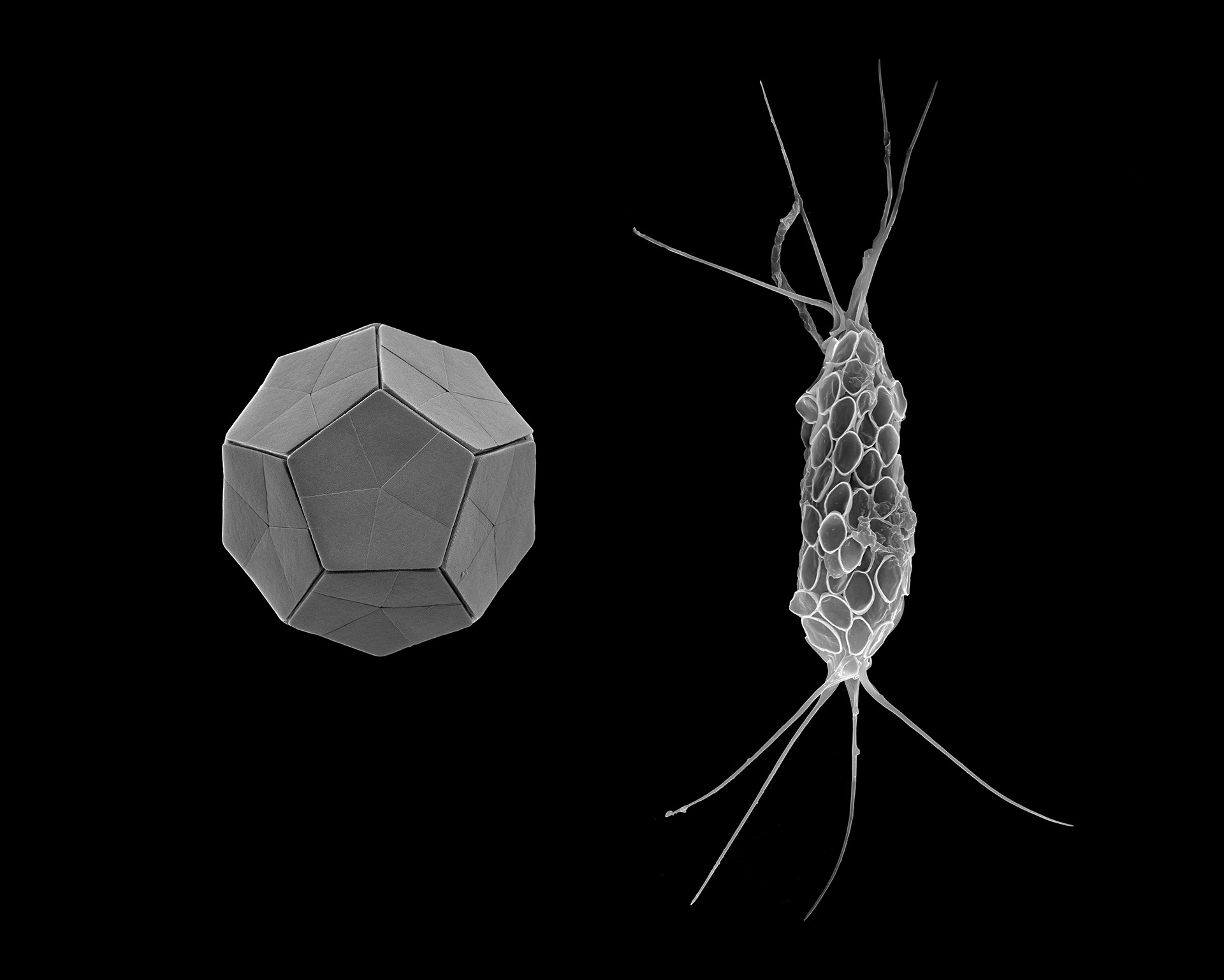
Among the countless microscopic fossils she examined, there was one that absolutely captivated her. It was a type of algae called Braarudosphaera bigelowii. Hagino fondly just calls it Bigelowii.
At certain points in Bigelowii’s life, it surrounds itself with this beautiful geometric shell, and Hagino would find these pentagonal skeletons throughout her samples. “When I first spotted Bigelowii, I thought it was in such a beautiful shape,” she said. “It has a very beautiful shape like a jewel.”
But no one really knew anything about the algae living inside. This was what Hagino wanted to study. But no one else seemed to share her fascination.
Courtesy of Kyoko Hagino
“When I first started the research, my boss at the time objected to it,” she said. “[I was told] even if you do such research that nobody reads, it won’t land you a job.”
At the time, Hagino was having trouble finding a position at a university. At the same time, she was taking care of her young kids. And she was moving to a new city where her husband had found work. Everything in her life seemed to be sending the clear message that she should just drop it and find something else to study. But Hagino just couldn’t do that. For whatever reason, there was something about this algae that just absolutely fascinated her, and she wanted to learn everything about it. Even if that meant studying it on her own.
So Hagino and her daughter started taking trips to the beach, collecting samples of seawater in the hopes of finding this elusive algae. Over the years, they ended up taking hundreds of these trips. They did this so often that her daughter genuinely didn’t know that people went to the beach for other reasons, like to go swimming.
“‘The ocean — isn’t that the place to collect seawater?’” Hagino recounted her daughter saying.
Kyoko Hagino and her daughter collect samples of seawater. Courtesy of Kyoko Hagino
Hagino would then spend hours at home with the microscope, searching for Bigelowii cells and individually picking them out when she’d find them. This was incredibly time-consuming, but it was kind of the only way to study them. No matter what she did, the cells didn’t seem to want to grow in a test tube.
For years, Hagino worked on growing a culture without any kind of university salary. To make ends meet, she ended up picking up a part-time job washing test tubes in a lab. One day, she was talking to one of the scientists there, and he suggested adding an unusual ingredient to her culture. It wasn’t a chemical or anything else you’d normally find in the lab. It was tokoroten, a type of traditional Japanese jelly noodle made from seaweed.
To Hagino’s amazement, the noodles were just what Bigelowii needed.
“I saw Bigelowii swimming and increasing in number,” she said. “I was extremely happy.”
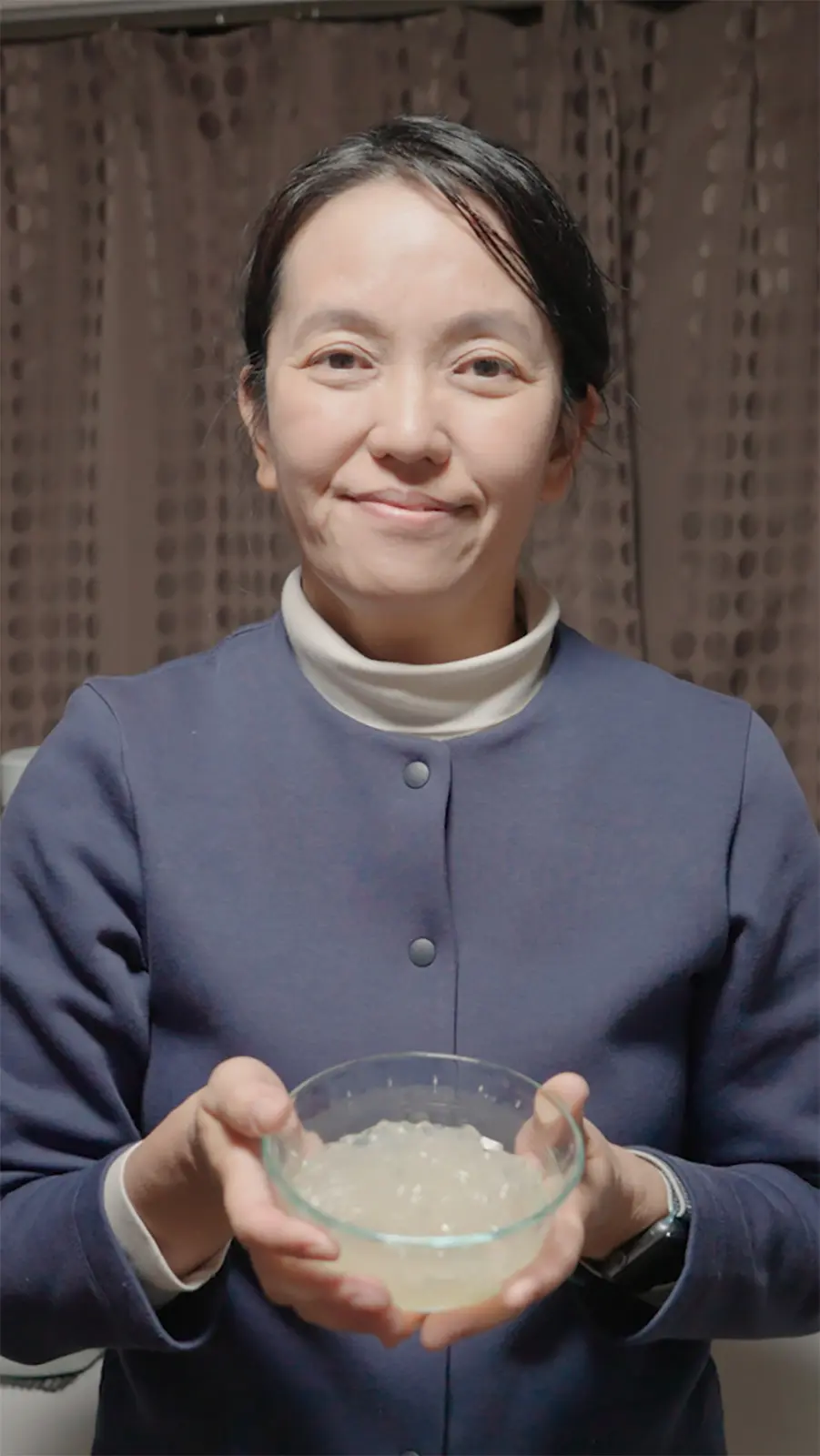
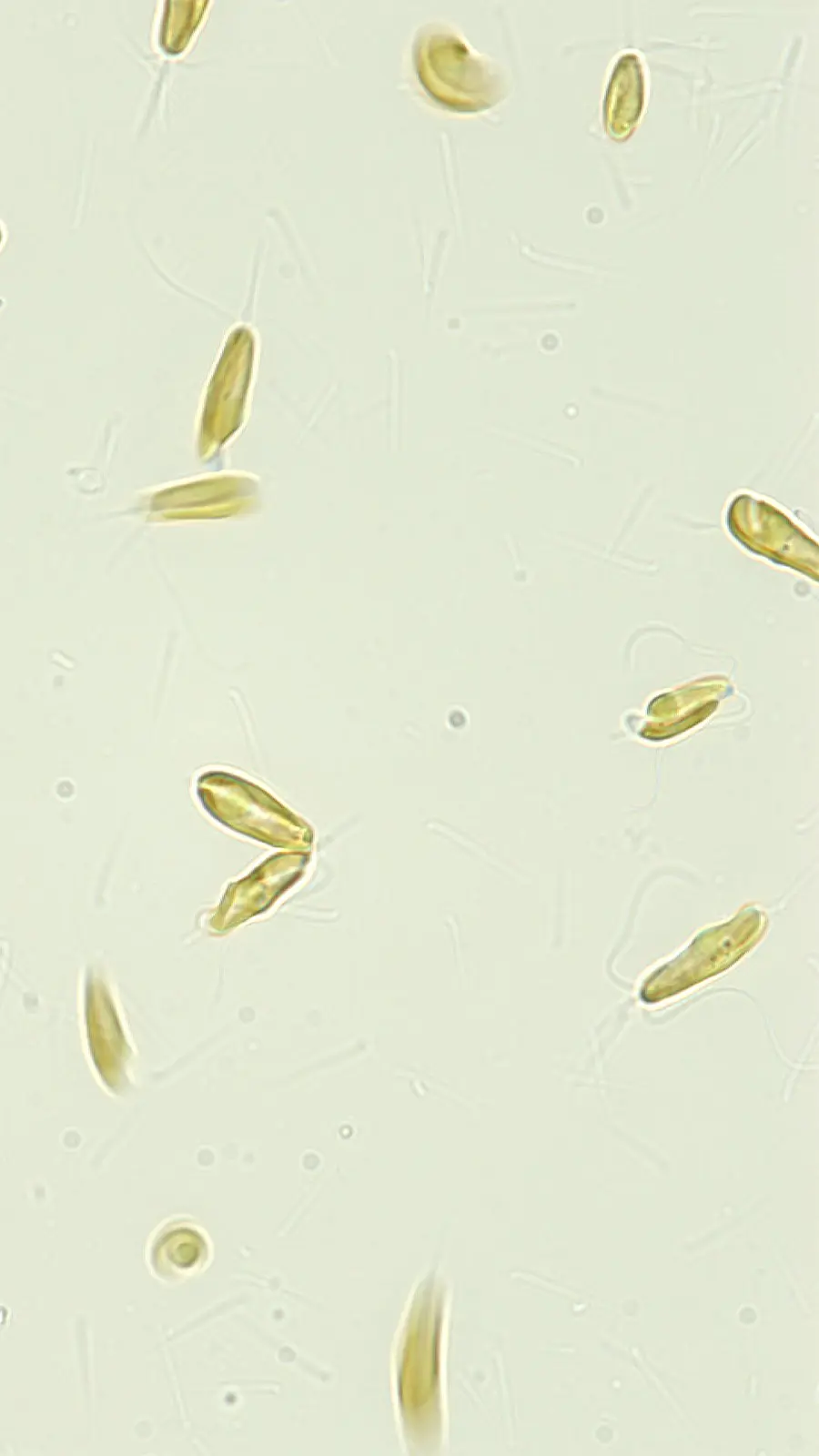
Left: Kyoko Hagino holds a bowl of tokoroten, the secret ingredient she used in her Bigelowii culture. Naotomo Umewaka / Grist. Right: A microscope image of Hagino’s culture. Courtesy of Zehr Lab.
Now that she had a culture, she could finally grow enough cells to answer some of the big questions about this organism. And there was one big question at the top of Hagino’s mind. Over the course of her many years studying Bigelowii, she noticed something odd. It had all the normal components of an algae cell. But then it also had something she couldn’t explain — something she had never seen in any textbook. It was a black dot in the center of the algae.
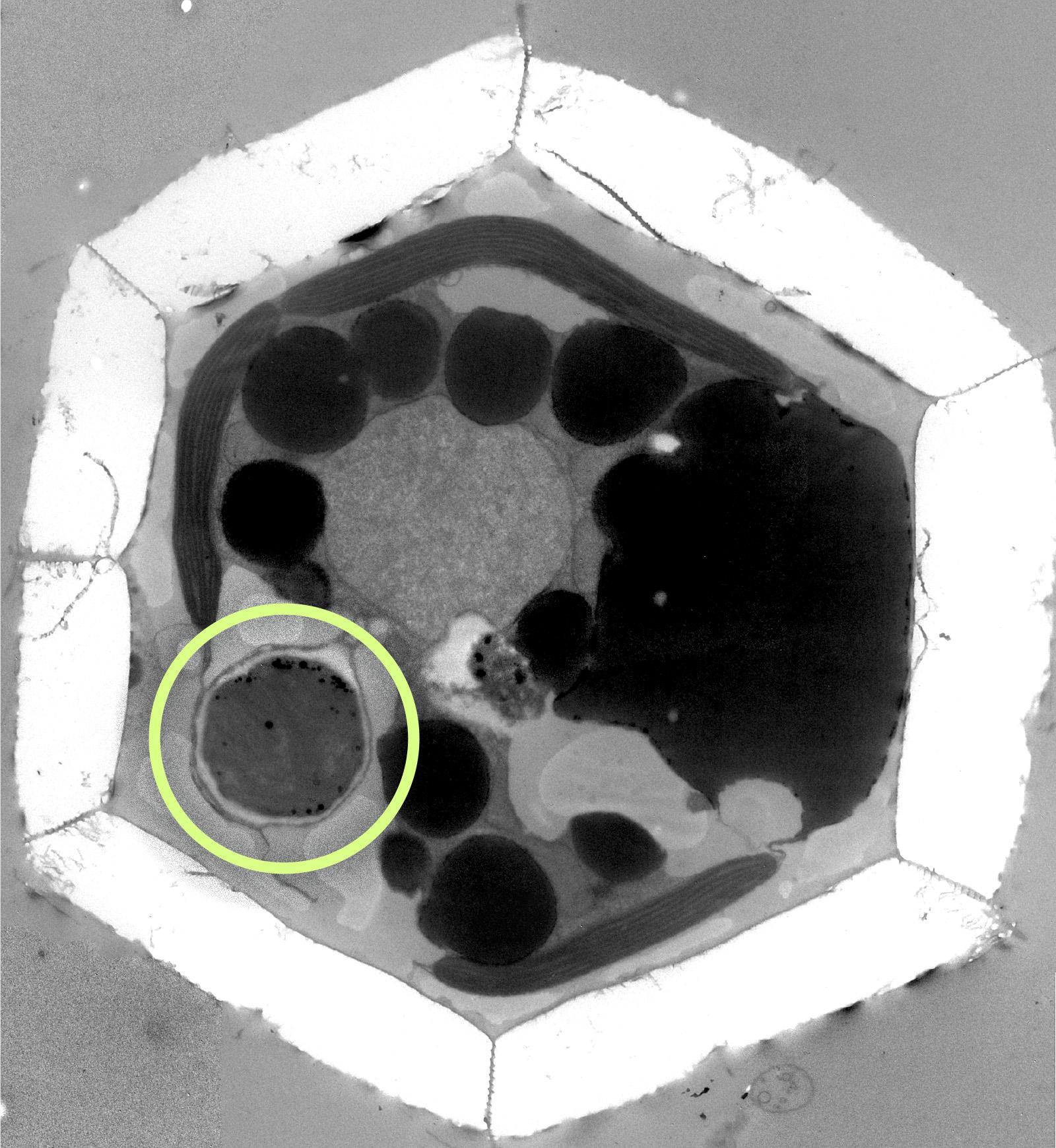
Courtesy of Kyoko Hagino
Hagino was preparing to publish a paper on this mysterious dot, when she stumbled upon an article that had just come out in the American journal Science. It described the search for a seemingly invisible nitrogen-fixing bacteria that the author theorized was likely living inside a species of algae. The author of the article was Jon Zehr, and he was talking about Braarudosphaera bigelowii.
Hagino thought about the strange object she had discovered inside Bigelowii. The pieces fit. She ran a genetic test on Bigelowii, and it came out positive: She had found the nitrogen-fixing bacteria that Zehr had spent so many years searching for.
“I never imagined that someone was doing research on Bigelowii,” she said. “I was shocked to think that I had been surpassed.”
Zehr was also surprised when Hagino reached out to share her discovery with him — the same puzzle, worked on from an ocean away. “Neither one of us knew that the two things went together!” he said.
Hagino and Zehr had both spent their careers trying to solve a scientific puzzle, with no idea that they each held the other’s missing piece. Now that they had a culture, they had the chance to unravel a mystery that would end up going deeper than they’d ever imagined.
Together, they would reveal a level of cooperation that would rewrite a fundamental rule of biology.
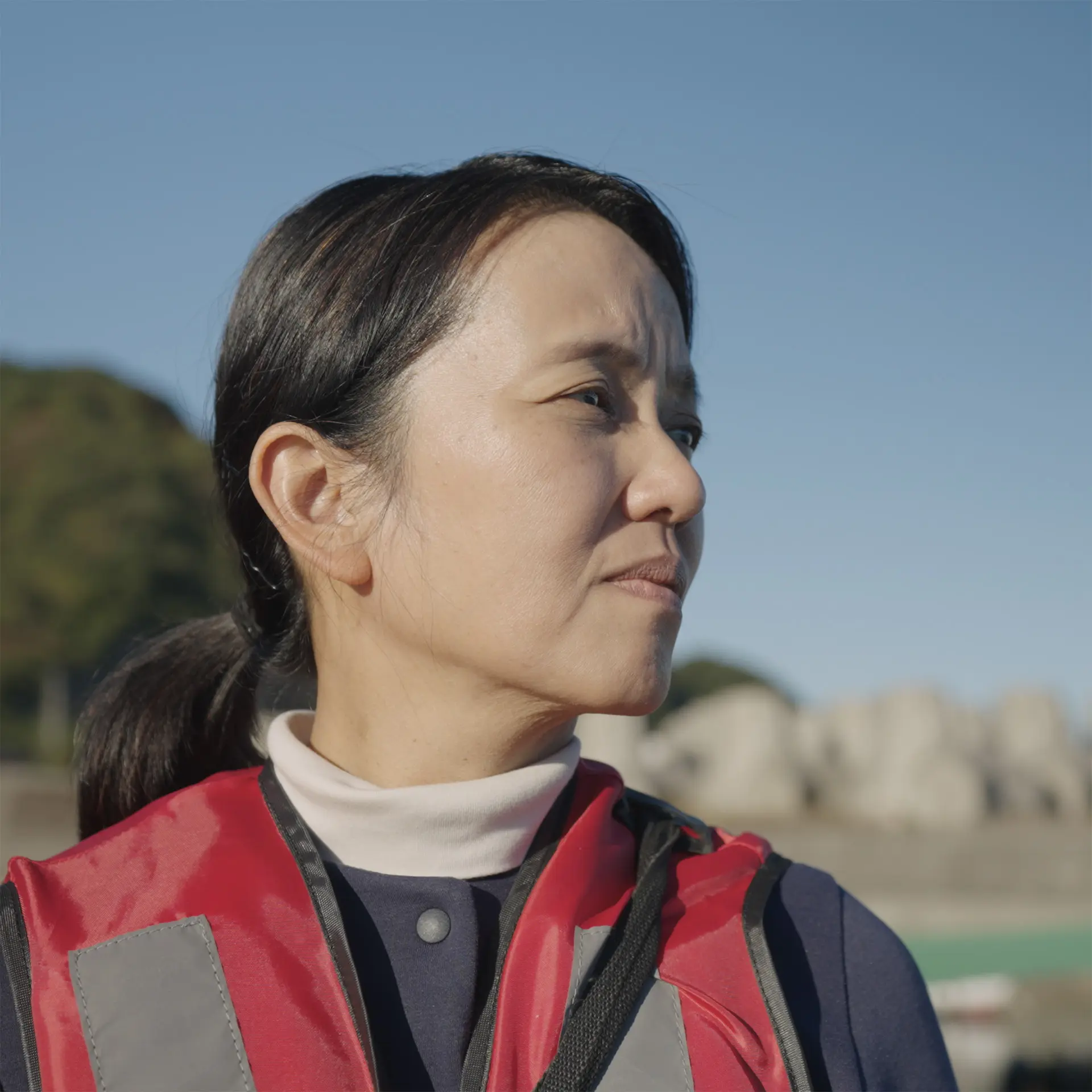

Zehr and Hagino look out at the Pacific Ocean. Left: Naotomo Umewaka / Grist Right: Jesse Nichols / Grist
Nature is full of symbiotic relationships: two organisms, each helping the other out. The clownfish from Finding Nemo is a good example of this — it looks after its sea anemone partner, in exchange for a safe place to live. But these helpful relationships can get closer and closer. There are organisms that live inside other organisms, like corals, which get food from zooxanthellae algae living in them. And you even have cells that live inside other cells. At a certain point, the relationship becomes so close that we’re not sure where one organism starts and the other begins.
Now, two organisms converging — going from being considered separate entities to part of the same being — is pretty mind-bending, and it’s a line that’s only been crossed a few times in the history of life on Earth. The two famous examples of this are mitochondria, the powerhouse of the cell found in every complex life form on Earth, and chloroplasts, the parts of plant cells that use photosynthesis to turn sunlight and carbon dioxide into food. Both of these examples started as independent cells that over time got so close to their partners that they became organelles: little organs inside other cells.
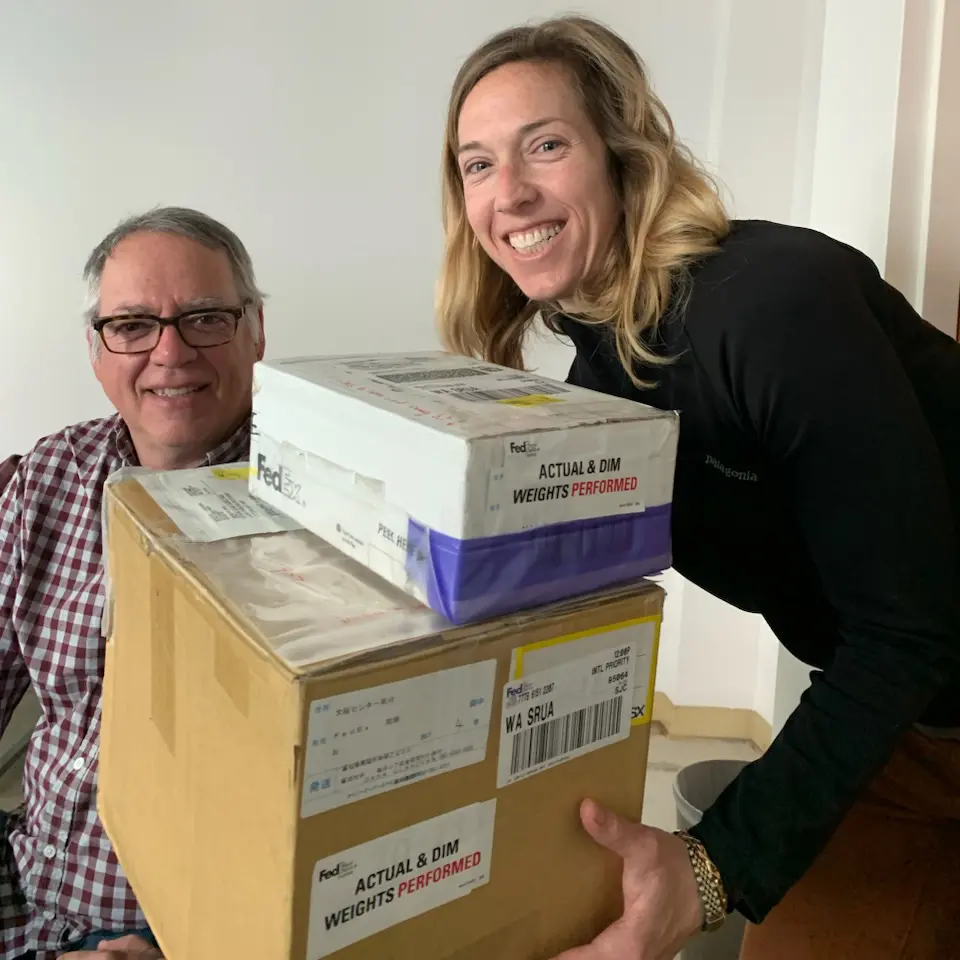
But what about Bigelowii and its internal bacteria? There was no doubt the relationship between the two was close. Zehr and Hagino were eager to find out just how the two worked together. So they teamed up. She sent a culture to John’s lab with hopes to visit California as the experiment went on.
When the culture arrived at Zehr’s office, he was so excited he took a photo to capture the moment. His team debated over which experiments they were going to run first.
Courtesy of Zehr Lab
“We sat around as a lab, and we decided the ten things we were going to do first, because we didn’t know how long the culture would stay alive,” he said. “And within three days, Covid lockdown started.”
The pandemic threw a wrench in all of their plans. Japan put up very strict travel restrictions that ended up staying in place for years. After all her hard work, Hagino couldn’t join Zehr in person. But the two were still hungry for answers, and they decided that Zehr’s lab should proceed with the tests. Hagino, who had funding from a grant she shared with Zehr, would help as much as she could from afar.
And pretty quickly, they started to find clues that the algae and the bacteria’s relationship was not a standard case of symbiosis. Bigelowii and the bacteria always divided at the same time. They also grew at the same rate, and in ways that looked really similar to mitochondria or chloroplasts.
But the most compelling piece of evidence came from Tyler Coale, a postdoc in Zehr’s lab. He was studying the proteins inside of the two organisms, when he noticed something strange: the bacteria were full of proteins that they didn’t have the genes to make. Instead, these proteins were being produced from extra genes found in Bigelowii. And on the very ends of each of these extra genes, there was the same short DNA sequence that kept showing up over and over.
Jesse Nichols / Grist
This pattern reminded Coale of an earlier mystery: The nitrogen-fixing bacteria that had somehow lost many of the genes for proteins it needed to survive. Could Bigelowii be supplying them instead? To find out, he ran an experiment, lining up the missing genes from one organism with the extra genes from the other. The match was striking. For nearly every gene that the bacteria had lost, Bigelowii had evolved an extra copy. And each of those extra genes were tagged with that same sequence of DNA on the end — molecular delivery instructions to send the protein over to the bacteria.
This discovery was huge because this kind of system had only been seen a small handful of times in mitochondria and in chloroplasts and now, in the tiny dot Zehr and Hagino had found inside of Bigelowii. The nitrogen-fixing bacteria were no longer bacteria anymore. It had become a part of Bigelowii, an independent microorganism-turned-organelle.
Zehr and his team decided to call it the Nitroplast.
And that also meant Bigelowii had broken the fundamental rule that only simple organisms like bacteria could pull nitrogen out of the air. The algae are the first known organisms on the complex side of the tree of life that can pull nitrogen out of the air.
While it’s early days, Coale says the discovery could have big implications for industries like agriculture. “This organism has done what decades of biotech couldn’t do, right? It has engineered this capability into this cell. It’s natural to think that there might be lessons here that we could learn.” he said.
Zehr, while cautiously optimistic, thinks that self-fertilizing plants are still a long way from becoming a reality. “The downer is it’s really difficult to go from what we know about the nitroplast to engineering a plant,” he said. “But if you don’t take one step, you’re not going to make 100 steps.”
Zehr and Hagino are excited to see where the research takes them next. But for them, it’s never really been about changing the world. They spent their careers studying their tiny pieces of the puzzle, not knowing what they’d find, but with the hope that whatever they discovered could teach them a little more about how the natural world works.
And on that front, there’s so much more to learn.
“This experience has shown that we don’t know which research will be useful and when,” Hagino said.
“Some of the biggest, biggest advances might come from things that you didn’t expect,” Zehr said. “And this might be a case like that.”

