

July 28, 2026 By Nadira Kabir The United States is one of the wealthiest nations in history, a global agricultural powerhouse that produces enough food to feed millions beyond its borders. Yet beneath this abundance lies a growing contradiction: more middle‑class Americans are struggling to afford groceries.
These are not households facing chronic poverty. They are teachers, nurses, military families, first responders, nonprofit staff, government workers, and small business owners, people who work full time, often own homes, and once felt economically secure. Increasingly, their paychecks no longer stretch far enough.
Prosperity Does Not Equal Security
Traditional indicators paint a picture of economic strength: low unemployment, steady consumer spending, and continued growth. But national statistics rarely capture what families experience around the kitchen table.
According to the U.S. Department of Agriculture, 13.7% of American households, or nearly 48 million people, experienced food insecurity in 2024, the highest rate in almost a decade. Nearly one in five households with children struggled to afford enough food for an active, healthy life. 51 million U.S. households are ALICE, Asset Limited, Income Constrained, Employed (United Way, 2024).
Food banks now report more first‑time visitors from suburban neighborhoods, including people arriving directly from work in uniforms or business attire. Some who once donated to food drives now rely on them.
The Cost of Being Middle Class Has Changed
For much of the twentieth century, a middle‑income salary could support a family, cover housing, allow modest savings, and reliably put food on the table. That equation has unraveled. Housing costs have increased. Childcare rivals college tuition. Healthcare premiums continue to rise. Transportation, insurance, utilities, and property taxes consume larger shares of household budgets. Grocery prices rose 25% between 2020 and 2024 (BLS CPI).
Food becomes the only flexible expense. Families stretch groceries by buying fewer fresh fruits and vegetables, reducing meat purchases, choosing generic brands, shrinking portions, or skipping meals, often parents first, so children can eat normally. These sacrifices rarely appear in GDP reports, yet they increasingly define middle‑class life.
When Groceries Become Debt
A recent Urban Institute analysis found that many Americans are not just paying more for groceries, they are borrowing to buy them. Working‑age adults increasingly rely on credit cards, emergency savings, or short‑term financing to cover food costs. Credit card balances reached a record $1.37 trillion in 2024, with food purchases among the fastest‑growing categories (Federal Reserve). This trend mirrors other reporting from World Hunger Education Service, which highlights rising financial strain among working families, including farm workers, the very people who harvest the nation’s food. Hunger Rising in America, offers a deeper look at how economic pressures are reshaping who struggles to afford food: https://www.worldhunger.org/hunger_rising_in_america/ and https://www.worldhunger.org/america-farm-workers-face-food-insecurity/
A growing number of households fall into the “missing middle”: earning too much to qualify for assistance but too little to absorb rising costs. SNAP remains one of the most effective tools for reducing food insecurity, yet many working families sit just above eligibility thresholds. This benefits cliff, where a small increase in income results in losing assistance even though financial strain remains, is one of the most pressing challenges in U.S. anti‑hunger policy. Food insecurity is highest in the South and Southwest, with rates exceeding 15% in states such as Louisiana, Mississippi, and Texas (Feeding America).
What Middle-Class Hunger Looks Like Today
Hunger is not defined by homelessness. Today, it may be:
- A suburban family whose mortgage doubled.
- A teacher working a second job.
- A nurse juggling childcare costs.
- A military family navigating another relocation.
- A retiree watching food prices outpace Social Security.
These households work full time, pay taxes, and appear financially stable — which makes their struggles easy to overlook. A family of four becomes ineligible for SNAP at roughly $40,000–$42,000 annual income, even though average living costs exceed $60,000 in most states.
Hunger Is About More Than Food
Food insecurity affects far more than grocery budgets. Children facing food insecurity are at higher risk of developmental delays, behavioral challenges, and lower academic performance. Adults experience higher rates of stress, anxiety, depression, diabetes, and hypertension. Poor nutrition also increases healthcare costs, reduces workplace productivity, and strains social service systems.
Rethinking Hunger in a Prosperous Nation
Anti‑hunger efforts have long focused on households below the federal poverty line. But today’s food insecurity demands a broader lens. Strengthening food security entails improving economic security: affordable childcare, reduced healthcare costs, wage growth, and modernized nutrition assistance programs that reflect real household budgets.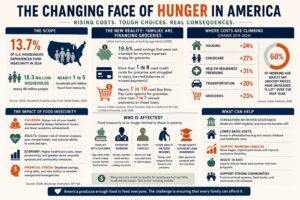
A Global Lens on a Domestic Crisis
International development practitioners have long recognized that hunger is rarely caused by a lack of food. It stems from inadequate access — shaped by poverty, conflict, or economic shocks. The same principle applies in the United States. Grocery shelves are full. Agricultural production is strong. The challenge is affordability.
Toward a More Honest Measure of Prosperity
A prosperous nation is not defined solely by the size of its economy or the abundance of its harvests. It is defined by whether working families can meet basic needs with dignity. Recognizing the changing face of hunger is the first step. The next is ensuring public policy reflects the realities families face today. See: The Politics of Hunger, which examines how policy decisions shape who receives support and who is left behind:
Further Reading
- U.S. Department of Agriculture. Household Food Security in the United States, 2024.
- Urban Institute. Many Families Rely on Credit and Savings to Afford Groceries (2026).
- Feeding America. Map the Meal Gap.
- Federal Reserve Bank of New York. Food Insecurity and Consumer Pessimism (2026).
- Bureau of Labor Statistics. Consumer Price Index.
- Brookings Institution. Research on Affordability and Middle-Income Households.

