

August 19, 2026 The new 2026 State of Food Security and Nutrition in the World (SOFI) report (jointly by FAO, IFAD, UNICEF, WFP, and WHO; focus: “Understanding and addressing the high cost of a healthy diet”) shows modest global progress on hunger alongside persistent structural problems and some notable shifts. SOFI has become an annual common reference about global malnutrition.
It estimates that 645 million people were hungry during 2025, while approximately 2.7 billion could not afford a healthy diet. The improvement in global prevalence occured while there was deterioration in parts of Africa and some conflict-affected countries.
The image above left shows the reports trend analysis of the decline in the number of under-nourished children worldwide.
For the first time, Africa recorded the highest absolute number of undernourished people at 309 million, surpassing Asia. The average global cost of a healthy diet rose to $4.28 Purchasing Power Parity (PPP) per person per day in 2025, up from $3.44 in 2021. As a result, almost 2.69 billion people (roughly one-third of humanity) could not afford a healthy diet.
SOFI about prevalence of malnutrition:
“In Africa [it] decreased from a peak of 20.3 percent in 2024 to 20.0 percent in 2025, still nearly 4 percentage points higher than in 2015 when the SDG Agenda was launched. However, this marginal improvement in prevalence from 2024 to 2025 did not translate into a decrease in the absolute number of people facing hunger, due to the growing size of the population in Africa.”
Looking at general dietary diversity, including micronutrients: In Africa, 66.6% of the population could not afford a healthy diet in 2025, compared to 28.9% in Asia and 25.7% in Latin America.
For these balanced diets with micronutrients: An estimated ~30.8% of children aged 6–23 months get a minimally diverse diet (largely unchanged over a decade); ~62.7% of women aged 15–49 meet minimum dietary diversity.
These trends suggest that hunger is not inevitable when supported by economic policies, social protection, and investments in agrifood systems—but progress remains slow and insufficient for the 2030 Zero Hunger target of many governments and the SDG.
Projections still point to ~510–520 million people being hungry in 2030, with ongoing, uncertain risks from conflicts, El Niño, and reduced financing.
The report presents scenarios of progress against Zero Hunger targes by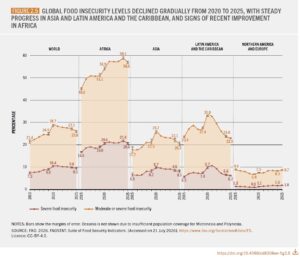 continent and scenarios, extrapolating from the experiences of recent decades.
To access the full report: as PDF
– Contributed by WHES Board member, Steven Hansch

