

If you care about your health so much that it would be unthinkable to light up a cigarette before and after lunch, maybe you should order a bean burrito instead of a meaty one.
According to the Global Burden of Disease Study, diets high in processed meat, like bacon, ham, hot dogs, lunch meat, and sausage, may kill more than 100,000 people every year, due largely to heart disease, but also cancer and diabetes. This results in millions of healthy years of life lost every year around the world, as you can see below and at 0:29 in my video How Much Does Meat Affect Longevity?.
It doesn’t take much either. The Union of Concerned Scientists estimated that if Americans could cut down to just an ounce of processed meat a week, thousands of cancer deaths could be averted every year. But that’s on a population scale. How can we better understand our individual risk?
In the last few blogs, I’ve talked a lot about the NutriRECS meat papers published in the Annals of Internal Medicine. Though the panel discarded its own findings, analyses determined that a reduction in red and processed meat consumption is in fact associated with a 13% lower risk of premature death—and that’s using its own numbers. What does a 13% difference in mortality risk actually mean? To get a better handle on it, let me introduce the concept of microlives.
Acute risks, like skydiving or riding a motorbike, could result in an accident. A good way to compare such risks is with a unit known as a micromort, defined as a one-in-a-million chance of sudden death. (I made a really fascinating video about it.) “However many risks we take don’t kill you straight away: think of all the lifestyle frailties we get warned about, such as smoking, drinking, eating badly, not exercising, and so on. The microlife aims to make all these chronic risks comparable by showing how much life we lose on average when we’re exposed to them: a microlife is 30 minutes of your life expectancy.”
Why is that? Well, someone in their 20s—say a 22-year-old man or a 26-year-old woman—may have, on average, about 57 years of life left. That’s about 20,000 days, or 500,000 hours, or a million half hours. So, that’s how they define a microlife—a reduction of one of the million half hours we may have left. What would, on average, cost a 30-year-old man one microlife?
- smoking two cigarettes
- drinking two pints of strong beer
- living every day 11 pounds (5 kg) overweight
See how helpful this can be in terms of comparing risks? So, drinking a pint of strong beer shortens your life expectancy as much as smoking one cigarette would. If it’s unthinkable to have so little respect for your own health that you’d light up twice a day, maybe one cigarette in the morning and one at night, then it should be just as unthinkable to be 11 pounds overweight.
Alternatively, you can compare life-extending behaviors. For example, eating at least five servings of fruits and vegetables a day may add an average of four years onto your lifespan for men and three years for women. That’s up to twice as beneficial as exercising every day. But guess what—exercise for 20 minutes, and the payoff is an extra hour of life (two microlives). So, for everyone who says they don’t have time to exercise, it’s like a 3-to-1 return on investment! Give 20 minutes of your life to get 60 minutes of life. Beyond that, there’s a bit of diminishing returns, but exercise an hour a day and get back more time than you put in, as you can see below and at 3:45 in my video.
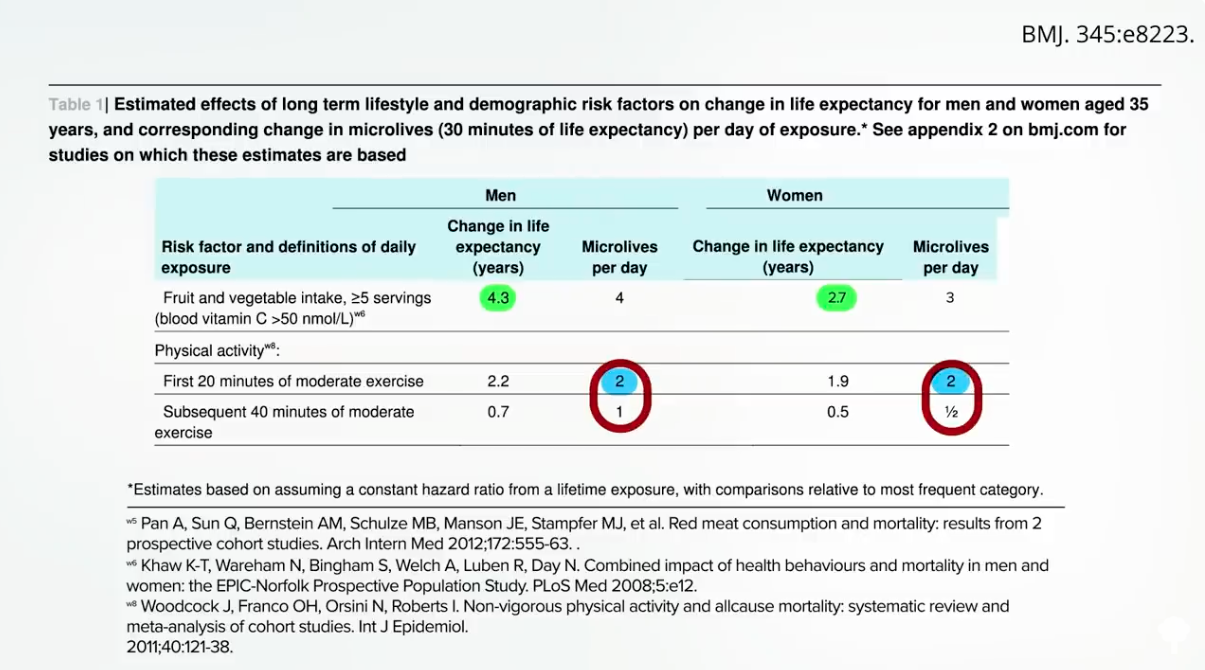
So, what about meat? Each burger is associated with the loss of one microlife; it’s as if each burger were taking 30 minutes off your life. So, in terms of your lifespan, one burger appears to equal two cigarettes. If lighting up at lunch seems unimaginable, maybe a bean burrito is a better choice.
Processed meat is even worse. Here are a few ways to put it into perspective:
- Imagine two people who are completely identical except in one way: One person eats about 50 grams of processed meat a day (roughly one large sausage or a few strips of bacon), and the other eats none. Eating that single serving of processed meat every day is expected to take about two years off the length of that first person’s life. That’s two fewer years with loved ones, grandkids, or a spouse, and two more years of being mourned.
- Or think about it on a day-to-day basis. Eating a bologna or ham sandwich every day—just two slices of deli meat—is expected to take about an hour off life each day. If there never seem to be enough hours in the day, you may effectively have one less depending on what you pack for lunch.
- Another way to think about it is in terms of “effective age.” Eating 50 grams of processed meat a day is expected to add about two years to a person’s “effective age,” meaning the annual risk of death is similar to that of someone two years older.
In summary, wrote the chair of nutrition at Harvard and his colleagues, the NutriRECS meat recommendations “suffer from important methodological limitations and involve misinterpretations of nutritional evidence. To improve human and planetary health [as a side bonus], dietary guidelines should continue to emphasize dietary patterns low in red and processed meats and high in minimally processed plant foods such as fruits and vegetables, whole grains, nuts, and legumes,” that is, beans, split peas, chickpeas, and lentils.
Let me end with a quote from Dr. Dean Ornish about the Annals of Internal Medicine meat papers that suggested people should continue to eat meat with abandon. His Lifestyle Heart Trial was one of the many studies the meat panel ignored. It showed that a plant-based diet and lifestyle program could reverse the progression of even severe coronary heart disease, a top killer of men and women. The control group actually made modest reductions in meat similar to those in the Annals review and showed continued worsening of their atherosclerosis. “I take solace,” Ornish said, “in knowing that the light drives out the darkness. But, these days, the light has to be very bright indeed. Caveat emptor. Don’t be fooled. Your life may depend on it.”
Doctor’s Note
If this concept of comparing different risks is interesting to you, I think you’ll love my micromorts video: Micromorts: How Risky Is It to Go Under Anesthesia?.
This is the final blog in an eight-part series on how industries impact dietary and health guidelines. If you missed any of the others, see the related posts below.
I have a number of videos on longevity, including this popular one: How to Increase Your Life Expectancy 12 to 14 Years.

