

Together with Mercociudades, the network brought the voice of South American local and regional governments to all three Rio Conventions in 2026. On food systems, positions developed with Brazil’s Ministry of Social Development (MDS) and the LUPPA Network reinforce food as climate action.
On 11 November, during COP31 in Antalya, ICLEI South America and Mercociudades brought the priorities of South American local and regional governments directly into the climate conference by officially delivering their joint political position to Dan Ioschpe, COP30 High-Level Climate Champion. The documents were handed over by Rodrigo Neves, President of Mercocities and Mayor of Niterói, in a moment that marked an important step in strengthening the region’s voice in international climate discussions.
The delivery also brought together the results of a broader process of cooperation between the two networks, which began in August, when they renewed their partnership agreement and committed to developing shared positions for the three Rio Conventions: desertification (UNCCD), biodiversity (CBD) and climate change (UNFCCC). Throughout 2026, as the three COPs took place within just a few months, cities and subnational governments from across Latin America contributed to building a common regional agenda, connecting global commitments with the challenges and experiences emerging from their territories.
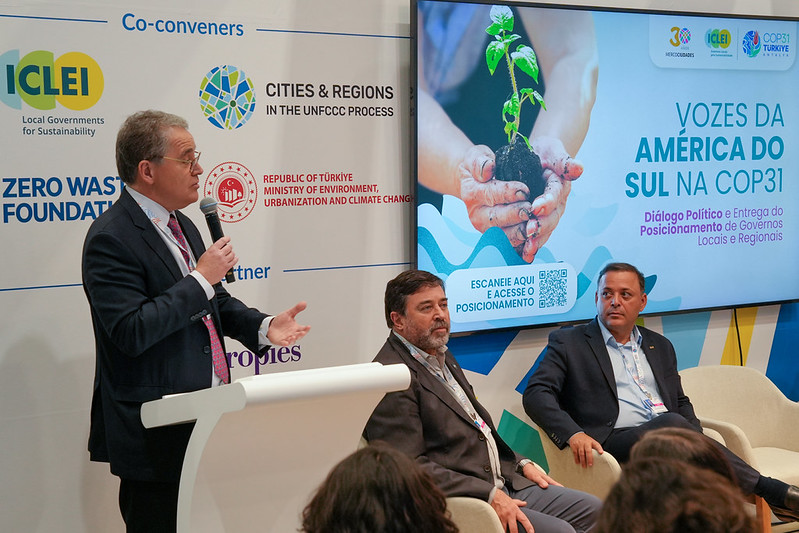
The documents were presented during the political meeting “Voices of South America at COP31: Political Dialogue and Delivery of the Position of Local and Regional Governments”, held at the Multilevel Action Pavilion, ICLEI’s space in the Blue Zone. Moderated by Rodrigo Perpétuo, Executive Secretary of ICLEI South America, the session opened with remarks from Perpétuo and Rodrigo Neves, who also shared Niterói’s experience in advancing its climate agenda.
The central moment was the delivery of the positions to Dan Ioschpe, whose role as High-Level Climate Champion includes connecting the climate negotiations with the broader community of non-state actors, including cities, regions and businesses. By bringing the region’s priorities to this space, ICLEI South America and Mercocities sought to ensure that the perspectives and demands of local and regional governments are considered in the coordination of the Global Climate Action Agenda.
The meeting also provided an opportunity to present two other documents developed through regional cooperation: the Medellín Declaration and the position paper on food systems, “From recognition to implementation: food as climate action”. They were presented by Bianca Cantoni, Institutional Relations and Advocacy Coordinator for South America at ICLEI, Alejandro González, Director of ICLEI Colombia, and Gisele Ane Bortolini, General Coordinator for the Promotion of Healthy Eating at Brazil’s Ministry of Development and Social Assistance, Family and Fight Against Hunger (MDS).
Signed in September during Climate Week Medellín 2026 by Asocapitales, the association of Colombian capital cities, the Medellín Declaration calls on local and subnational governments to accelerate climate action from the territories, highlighting the importance of permanent cooperation spaces among cities and mechanisms capable of mobilizing resources for local implementation.
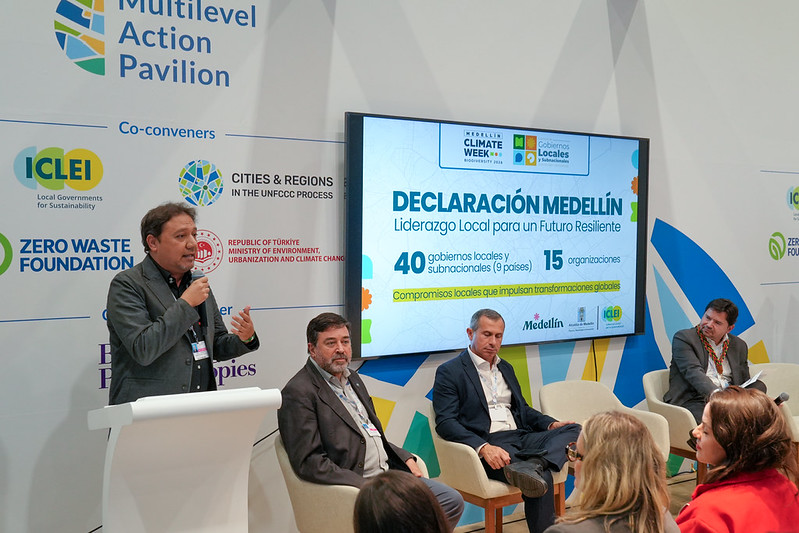
The political dialogue continued with representatives of the South American delegation, who discussed the region’s priorities and the conditions needed to turn commitments into action. Among the participants were Cristina Fabian Gregoletto, Director of Food and Nutrition Security of Caxias do Sul, and Raúl Santiago Toledo Guevara, Director of the Consortium of Provincial Autonomous Governments of Ecuador (CONGOPE).
Although the three Rio Conventions operate through separate institutional frameworks and negotiation processes, the challenges they address are deeply interconnected. Climate change accelerates biodiversity loss and ecosystem degradation, while desertification and land degradation increase climate and social vulnerabilities, creating impacts that are felt simultaneously by communities and governments.
For local and regional governments, these crises rarely appear as isolated issues. They are reflected in everyday challenges involving water and food security, public health, infrastructure, land use and people’s living conditions. This is the common thread connecting the three positions developed by ICLEI South America and Mercocities: global commitments can only deliver meaningful results when translated into coherent territorial policies, supported by coordinated financing and effective multilevel governance.
As the position delivered in Antalya highlights, “International negotiations may take place in separate forums, but their outcomes must translate into integrated responses for territories and their communities.” This approach is also reflected in ICLEI’s Global Position on coherence across climate, biodiversity and land.
The regional cooperation process took shape in August, with the development of the joint position for UNCCD COP17, held in Ulaanbaatar, Mongolia. With significant contributions from Brazil’s Northeast Consortium, the document highlighted how desertification threatens food, water and climate security, while also drawing attention to the connections between land degradation and urban dynamics.
The next step came in October, when the position for CBD COP17 was presented in Montevideo, ahead of the conference in Yerevan, Armenia, which hosted the first global review of the Kunming-Montreal Global Biodiversity Framework. Building on the understanding that biodiversity is also part of urban life, the document emphasized the role of local governments in generating knowledge, evidence and practical solutions that contribute to achieving global biodiversity targets.
Together, these two milestones laid the groundwork for the third and final position, bringing the regional agenda to the climate negotiations at COP31.
The position for COP31 brings together the demands of South American local and regional governments and reinforces the need to recognize them as strategic partners in implementing the Paris Agreement. Aligned with the global position of the Local Governments and Municipal Authorities (LGMA) Constituency for COP31, it argues that climate goals will remain out of reach unless subnational governments have the capacities, resources and effective spaces for participation needed to turn international commitments into action.
To advance this agenda, the document identifies five interconnected priorities:
- Strengthening multilevel governance and subnational participation in implementing the Paris Agreement. Local and regional governments need permanent spaces for cooperation and a meaningful role in designing, implementing and monitoring Nationally Determined Contributions (NDCs) and National Adaptation Plans, as well as in the second Global Stocktake and COP31 implementation initiatives such as BRIDGE.
- Accelerating territorial adaptation, resilience and the response to loss and damage. This requires incorporating the subnational dimension into the indicators under the Belém–Addis Vision and ensuring that the commitment to triple adaptation finance by 2035 reaches cities and regions, particularly vulnerable territories and medium-sized cities. The position also calls for local governments to have access to technical assistance from the Santiago Network and support instruments from the Fund for responding to Loss and Damage.
- Transforming the financial architecture to enable local climate action. Climate finance needs to become more direct, agile and proportionate, with access criteria that do not exclude cities in developing countries. The document therefore advocates for increased grant funding, technical assistance for project preparation and financial instruments that do not deepen municipalities’ fiscal vulnerabilities.
- Promoting a just energy transition and inclusive urban decarbonization. Expanding access to technology, capacity-building and financing is essential to advance renewable energy, transport electrification and energy efficiency. The position also highlights the importance of ensuring effective representation of local and regional governments in the governance of the Just Transition Mechanism.
- Advancing the circular economy, food security and methane emission reductions. Cities and regions have a strategic role to play in the transition towards zero waste, including through measurable targets for reducing methane emissions from waste in NDCs, alongside policies that strengthen sustainable urban food systems, prevent food waste and promote food recovery and redistribution.
To demonstrate how these priorities are already taking shape on the ground, the position includes an annex featuring experiences from 17 local and regional governments across Latin America. Among them are Belo Horizonte’s Heat Protocol, Godoy Cruz’s green bonds in Argentina, community-based risk management in Chone, Ecuador, and São Paulo’s fleet of more than 2,000 electric buses, showing how different territories are developing practical responses to shared climate challenges.
Food systems were another important part of the regional agenda presented in Antalya. At the same session, ICLEI delivered the position paper “From recognition to implementation: food as climate action”, developed in partnership with Brazil’s Ministry of Development and Social Assistance, Family and Fight Against Hunger (MDS), and drawing on the experiences of Osasco, Brasília and Caxias do Sul.
The starting point is clear: food systems account for up to one third of global greenhouse gas emissions, while also being among the sectors most directly affected by climate impacts such as floods, droughts and heatwaves. This makes food policies an essential part of both climate mitigation and adaptation, particularly in cities, where food security, public health and social inequalities intersect.
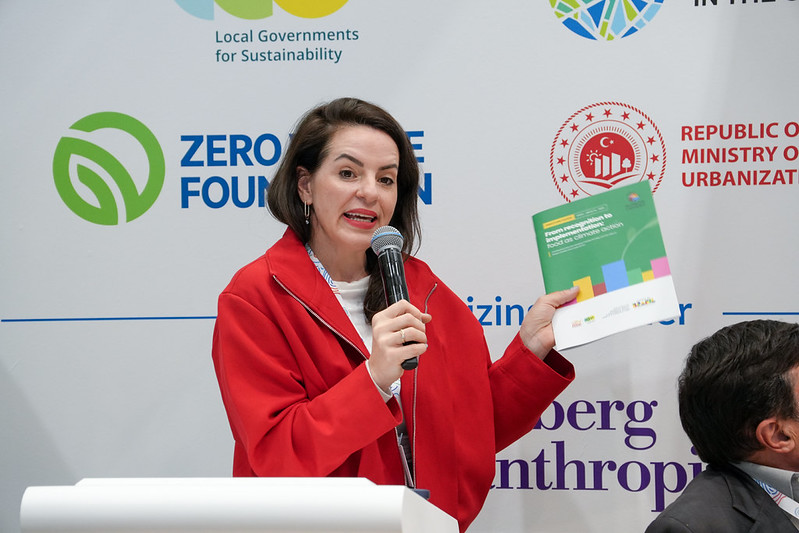
The paper draws on the Alimenta Cidades Strategy, a federal government policy coordinated by the MDS that supports 1,102 municipalities, home to approximately 55% of Brazil’s population. ICLEI supports the implementation of the Strategy and coordinated the development of the position paper, bringing together experiences that demonstrate how local food policies can contribute to a more sustainable and resilient food system.
The three participating cities illustrate different approaches to this challenge. Osasco has invested in its Food Bank and urban orchards, Brasília has incorporated food security into its master plan, and Caxias do Sul has built a long-standing food policy agenda over two decades, including the provision of 61,500 school meals every day.
Drawing on these experiences, the paper presents five proposals for COP31, aimed at bringing food systems closer to the center of global climate action:
- Putting food systems at the center of climate commitments, with clear targets and financing. The conclusion of the Sharm el-Sheikh joint work on agriculture and food security at COP31 represents an opportunity to establish an implementation pathway that considers the entire food system, from production to consumption.
- Recognizing urban centers as priorities for climate adaptation. Since cities are often where the impacts of climate change on food systems first affect vulnerable populations, adaptation plans and indicators should include access to adequate and healthy food, alongside climate financing for local governments.
- Including urban food systems in indicators and emissions inventories. Better monitoring of climate impacts and emissions requires the incorporation of urban food systems into adaptation indicators and inventories, supported by technical assistance that enables local governments to develop this work.
- Connecting NDCs to territorial food policies. The Brazilian experience, in which the NDC establishes the political commitment and the Plano Clima defines the pathway for implementation, demonstrates how national climate instruments can be connected to urban policies such as Alimenta Cidades, offering an approach that other countries could adapt.
- Treating food system transformation as a mitigation strategy. Shorter supply chains, greater public procurement from family farming, agroecological transitions, reduced food loss and waste, food recovery and composting are all important pathways to reducing emissions while strengthening local food systems.
This agenda also connects with the LUPPA Network’s position, developed during the 5th Urban Laboratory of Food Public Policies, which recognizes food systems as a key opportunity to bring together climate action, biodiversity protection and the fight against desertification.
By bringing these different agendas together, ICLEI South America and Mercocities reinforce a shared message emerging from the three Rio Conventions: local and regional governments are not simply implementing actors at the end of the process, but essential partners in shaping solutions, mobilizing resources and ensuring that global commitments translate into concrete improvements for people and territories.

