

There is a peculiar irony in the history of education technology.
For over half a century, the promise has remained unchanged: Digital tools will revolutionize learning, freeing students from the tyranny of rote instruction and enabling them to explore knowledge on their own terms. And through all that time, evidence has accumulated that this promise is largely unfulfilled. Yet the industry has grown from a modest enterprise into a $400 billion behemoth, now woven into nearly every aspect of schooling. Jared Cooney Horvath’s The Digital Delusion is the most comprehensive attempt yet to explain this paradox and chart a path forward.
Horvath, a neuroscientist who has worked with schools across six continents, opens with a stark claim: “Our children are less cognitively capable than we were at their age.” This is not hyperbole dressed as provocation. For nearly the entire 20th century, IQ scores rose steadily; each generation gained approximately six points over their parents, a phenomenon known as the Flynn Effect. Starting around the year 2000, this trend reversed across much of the Western world. Crucially, in countries where traditional schooling has remained largely intact, the decline has not occurred. But is this the fault of technology or merely a correlation?
The overlap of this cognitive decline with the meteoric rise of classroom technology is difficult to ignore. Over half of students now use computers for one to four hours daily in school; a full quarter spend more than four hours on screens during a typical seven-hour school day. And the evidence suggests that less than half of this screen time is spent on actual learning; students are off task for up to 38 minutes of every hour when using classroom devices. Far from the promised revolution, we appear to be witnessing an unprecedented experiment in cognitive attrition.
The Data
The strength of The Digital Delusion lies in its systematic marshalling of evidence. Horvath draws on international assessments, meta-analyses, and domain-specific studies to build a case that is difficult to dismiss.
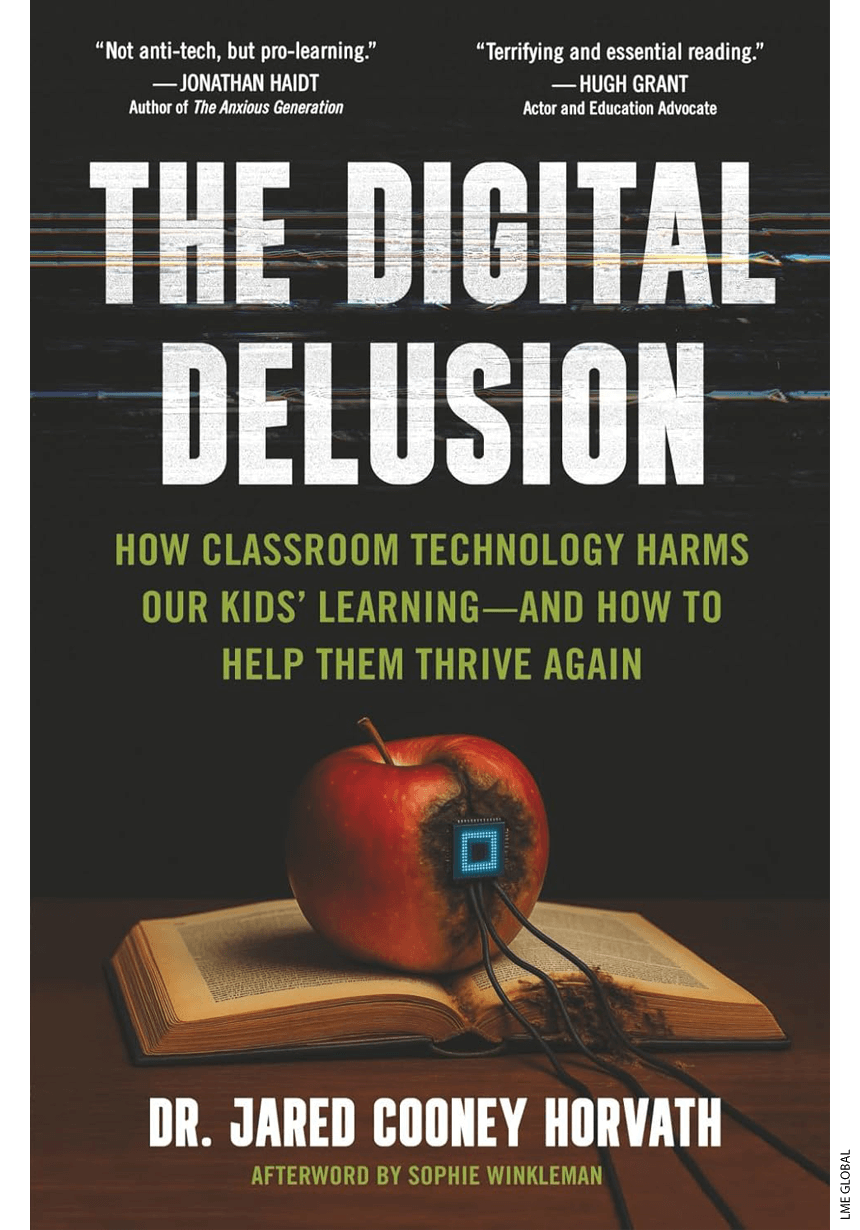
by Jared Cooney Horvath
LME Global, 2025, $18.99, 360 pages
The international picture he paints is bleak. On PISA assessments, students who use computers more than six hours daily score 66 points lower than nonusers—a gap equivalent to moving from the 50th to the 24th percentile, or roughly two letter grades. The 2022 PISA results showed a 15-point drop in mathematics, the largest single-cycle decline in the assessment’s history. TIMSS 2019 data reveal similar patterns: Daily computer users scored 41 points lower in mathematics and 51 points lower in science compared to infrequent users.
The meta-analytic evidence is equally sobering. Horvath synthesizes 398 meta-analyses covering over 21,000 individual studies, finding an overall effect size of +0.29 standard deviations for education technology. This sounds modestly positive until one recognizes that meaningful educational gains typically require effect sizes of +0.40 to +0.50. Only intelligent tutoring systems (+0.52) and interventions for learning disorders (+0.61) consistently exceed this threshold. One-to-one laptop programs, that great hope of education reformers, show an effect size of just +0.16. As Horvath dryly notes, investing in air conditioning has a more beneficial impact on learning than investing in a laptop for every student.
Three specific findings deserve attention. First, reading comprehension is consistently worse on screens than on paper, with effect sizes of –0.15 overall and –0.29 for expository text. Screens lack the spatial anchoring that supports memory formation. Second, handwritten notes produce better learning outcomes than typed notes, with effect sizes of –0.19 for immediate recall and –0.42 when reviewing notes. Typing enables shallow transcription, while handwriting forces the brain to process and condense information. Third, handwriting itself builds fine motor skills linked to reading circuits, providing embodied engagement that typing cannot replicate.
The Mechanisms
What elevates this book above a mere catalogue of failures is Horvath’s attention to mechanisms. It is not enough to show that screens harm learning; we must understand why. Here, Horvath identifies three intractable problems rooted in the architecture of human cognition.
The first is attention. The lateral prefrontal cortex can hold only one ruleset at a time. Humans cannot truly multitask, only switch between tasks. Each switch incurs costs: time loss, reduced accuracy, and weaker memory formation. Digital environments are specifically engineered for rapid task switching. They are, as Horvath puts it, “trying to serve two masters: learning requires stillness; profit requires attention capture.” Children now spend over 2,500 hours annually using devices for rapid-fire media consumption, compared to roughly 450 hours engaged in formal learning. The attentional habits formed in the former context inevitably contaminate the latter.
The second mechanism is empathy. The student–teacher relationship produces one of the largest effect sizes in educational research (+0.57), and affective empathy contributes similarly (+0.68). But empathy, Horvath argues, is not merely an emotion; it is physiological synchrony between biological systems. When two people interact, their brain activity, heart rate, and breathing align. Digital tools lack biology, making genuine empathy impossible. The approximately 85 percent dropout rates typical of online learning, echoed during pandemic-era remote schooling, offer a stark illustration of what happens when this biological connection is severed.
The third problem is transfer. Where we learn becomes part of what we learn; context is encoded alongside content. Variety in learning environments enables flexible retrieval, while the narrow uniformity of digital contexts creates skills that are far less likely to transfer to complex real-world settings. Horvath draws an important distinction between subtractive and additive transfer. Moving from a more demanding context to a less demanding one (subtractive transfer) is relatively easy, but the reverse (additive transfer) is not. Students who learn primarily on screens develop skills calibrated to that environment; when context changes, particularly in high-pressure situations like examinations, they find themselves stranded.
The Myths

Perhaps the most valuable contribution of The Digital Delusion is its systematic dismantling of the foundational myths that sustain education technology. Horvath identifies five.
First is the claim that education is broken. It was not, Horvath argues, until EdTech arrived and began measuring its success against metrics it had itself created. Second is the belief that multimedia enhances learning. Entertainment and learning are not the same thing; the confusion between them produces what Horvath calls “Duolingo learning”: all engagement, little retention. Third is the notion that free choice leads to better learning. The fluency illusion leads students to prefer what feels easy rather than what actually works; ease of processing is mistaken for depth of understanding. Fourth is the assumption that children learn best on their own. The brain stops automatic acquisition of complex knowledge around age five. Thereafter, guided instruction consistently outperforms trial-and-error discovery. Fifth and finally is the promise that intelligent tutors make children more intelligent. In narrow applications, perhaps this is true, but there is no evidence of meaningful transfer beyond the specific skills trained.
The Stakes
No book of this scope is without limitations, and at times the evidence Horvath presents risks overclaiming. The reversal of the Flynn Effect is a real phenomenon, but its causes remain contested; attributing it primarily to education technology, while plausible, requires more careful causal analysis than meta-analytic correlations can provide.
Some of the international assessment data also conflate different types of computer use. Not all screen time is equal, and the harmful effects appear concentrated in particular applications. A student using a well-designed intelligent tutoring system for spaced retrieval practice is doing something categorically different from a student clicking through a gamified quiz app designed to maximize time on platform.
EdNext in your inbox
Sign up for the EdNext Weekly newsletter, and stay up to date with the Daily Digest, delivered straight to your inbox.
These caveats notwithstanding, The Digital Delusion is an impressive piece of work and deserves serious attention from anyone concerned with education outcomes. The equity implications alone should give one pause. Disadvantaged students, who most need the accumulated wisdom of effective instruction, are instead subjected to the highest doses of education technology. Effect sizes for EdTech interventions among disadvantaged populations (+0.18) are among the weakest in the literature. We are, in effect, conducting an experiment on the children who can least afford to be subject to it.
There is a deeper lesson here about the nature of educational progress. For two decades, reformers have sought the easy path: adopt the shiny new tool, the engaging platform, the personalized algorithm. But the evidence suggests there are no shortcuts. Effective instruction is built on clear explanation, guided practice, deliberate feedback, and the irreplaceable human relationship between teacher and student. These are not glamorous strategies; they do not attract venture capital or generate TED Talks. But they work.
The most powerful aspect of Horvath’s book for me is the fact that he has a very deep and insightful understanding of how learning happens. It’s clear he has not merely surveyed the literature but internalized its implications. He grasps why retrieval strengthens memory while re-reading does not, why effort is a feature of learning rather than a bug, and why the relationship between teacher and student is not merely sentimental but a powerful agent of change and human development. This matters because so many critiques of EdTech fall into the trap of nostalgia or technophobia. Horvath’s concerns cut deeper. He understands that digital tools fail not because they are new but because they are built on a flawed model of how the brain acquires knowledge.
The book closes with a provocation: “Will you be a Luddite with me?” The original Luddites, he reminds us, were not technophobes raging against progress; they were skilled craftsmen defending a way of life they valued against tools designed to reshape the world without reckoning with the cost. Two centuries later, the battleground has shifted from factories to classrooms, but the question remains the same. Education is not a matter of tools; it is a matter of values. The Digital Delusion makes a compelling case that we have lost sight of what those values should be.
Carl Hendrick is the author of How Learning Happens and The Learning Dispatch newsletter.
Suggested citation format:
Hendrick, C. (2026). “A Latter-Day Luddite Pulls the Plug on EdTech: New book argues it’s not the tools we use but the values we hold that make the difference in education.” Education Next, 26(1), 10 February 2026.
The post A Latter-Day Luddite Pulls the Plug on EdTech appeared first on Education Next.

