

A Professional Learning Network offers a practical, sustainable way to grow as a teacher. Dr. Curtis Chandler shares a summer game plan to build your own PLN.
A MiddleWeb Blog
 Teaching is demanding – mentally, emotionally, and physically (Taylor, Roberts, & Zarrett, 2021). Most of our work days move by quickly, and by the time the final bell rings, there’s little time or energy left for our own professional growth.
We get so busy teaching that we don’t always make time to learn. Yet as “lead learners” in our classrooms, it’s hard to model growth for students if we aren’t continuing to grow ourselves. A Professional Learning Network (PLN) offers a practical, sustainable way to engage in that growth.
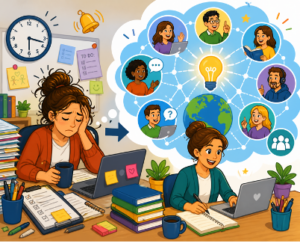 When teachers build PLNs, we become connected professionals with access to a kind of “collective brain” – educators across schools, districts, and even the world (Oddone, Hughes, & Lupton, 2019).
Unlike traditional professional development offerings that may or may not meet our particular needs, PLNs are flexible and personalized. They allow us to seek out ideas that matter to us, right when we need them (Trust et al., 2016).
Our personal learning network doesn’t appear overnight. It grows as we connect with colleagues, explore digital spaces, and engage in ongoing conversations about teaching and learning. Strong PLNs are built through consistent participation – asking questions, sharing ideas, and contributing resources. Over time these interactions become a dependable source of insight, support, and inspiration.
Summer break is a perfect time to begin shaping a PLN that will strengthen your practice in the years to come.
Start with Purpose: Identify Your Professional Growth Goals
Strong PLNs begin with clarity. When we identify specific areas for growth, our learning becomes more focused, efficient, and impactful. Research shows that goal-directed professional development leads to deeper engagement and more meaningful changes in practice (Darling-Hammond et al., 2017). As you begin to build your PLN, consider the following:
►Clarify what you want to improve. Start by identifying your professional goals. What aspects of your teaching do you want to strengthen? Connecting with educators who share similar goals – or who align with your school or district priorities – makes your PLN immediately more relevant.
►Invest in learning that matters to you. Spend your hard-earned teacher dollars on professional books and resources tied to your interests. When we choose what we learn, we’re far more likely to apply it.
►Create a customized learning stream. Use a free service like Edutopia’s Homeroom to build a personalized professional learning feed, helping ensure the ideas coming your way are already aligned with your goals.
►Join or form a focused book club. Professional book clubs – online or in person – offer a powerful way to engage deeply with ideas alongside others. When matched to your interests, these discussions often lead to immediate classroom application.
Build the Habit of Connection
Strong PLNs aren’t built in a day – they’re built through consistent, intentional interaction. The good news? Many of the most powerful connections are already within reach.
►Start small and stay consistent. A quick check-in, a shared lunch, or a short conversation with a colleague can go a long way. Over time these moments build the trust needed for deeper collaboration.
►Ask more than you answer. Curiosity accelerates connection. When we treat colleagues as sources of insight, we not only learn more – we strengthen relationships.
►Make classrooms open spaces. Observing others and inviting feedback into your own classroom creates authentic learning opportunities. These shared experiences often lead to lasting professional partnerships. (Learning walks, for example, offer quick snapshots of practice that spark reflection.)
►Lean into your PLC. When approached with purpose, PLCs can move beyond compliance and become spaces for real growth. Focus on exchanging ideas, solving problems, and improving instruction – not just completing tasks.

Broaden Your Professional Circle
Growth accelerates when we step outside our immediate environment. Expanding your PLN introduces new thinking and connects you to educators facing similar challenges in different contexts.
►Show up and engage. Whether it’s district PD or a conference, attendance alone isn’t enough – participation matters. The conversations during and between sessions often lead to the most valuable connections.
►Be willing to initiate. In school and district meetings, sitting with new people or starting a conversation may feel uncomfortable, but it’s often the first step toward meaningful collaboration.
►Step into professional leadership. Attend – and consider presenting at – professional state, national, and international conferences. Presenting affords us the opportunity to share our expertise, collaborate with colleagues, and expand our reach while building a “brain trust” of like-minded educators.
►Collaborate with teacher preparation programs. Partnering with local universities or mentoring preservice teachers connects teachers to fresh perspectives and strengthens the bridge between theory and practice.
►Engage in edtech communities. Programs like Google Certified Educator or Microsoft Educator offer more than credentials – they provide access to active communities, ongoing learning opportunities, and events that connect educators throughout the year.
Think Beyond the Building: Create a Digital PLN
In today’s connected world, your PLN doesn’t have to be limited by geography. Digital spaces make it possible to learn from – and with – educators across the globe.
►Leverage social media intentionally. Social media platforms allow teachers to connect globally and gain diverse perspectives on current educational trends. By following and engaging with thoughtful educators and organizations, you can turn your feed into a powerful professional resource.
Bluesky. A fast-growing hub for educators, often compared to the early, collegial days of Twitter. Many teachers are migrating here to build PLNs, share ideas, and engage in meaningful discussions in a less cluttered environment.
Instagram. A rich source of classroom ideas – from management strategies to lesson design. It’s a great place to find practical, ready-to-use resources.
TikTok. Thousands of educators share quick ideas, activities, and even comic relief. Save what works and contribute when you can.
Facebook groups. Communities like Cult of Pedagogy and other similar groups connect educators around shared interests and challenges, often leading to rich discussion and resource sharing.
EdWeb.net. This site serves as a free professional network offering webinars, collaboration, and even PD certificates. It functions as both a learning hub and a community space.
MiddleWeb. This site for educators serving students in grades 4-8 has published nearly 4000 articles and book reviews written by educators. Each article offers an opportunity to make comments and dialogue with other educators. In addition, MiddleWeb Substack curates content from the site by topics.
►Learn in small, steady ways. Microlearning – engaging with short, bite-sized content like quick videos, podcasts, or peer-shared tips – allows teachers to solve immediate classroom challenges. These small moments of learning add up to continuous, self-directed growth without overwhelming your schedule.
►Join structured online communities. Platforms like Edutopia and EdWeb provide organized opportunities to learn and connect. These spaces often combine flexibility with high-quality content.
►Invest in deeper learning. Books, journals, and certifications provide depth that complements quick online learning. Together, they create a well-rounded professional growth experience.
Sharpen the Saw: Sustain Yourself and Your Network
Strong PLNs aren’t just about professional growth – they’re also about sustainability. The relationships we build are strengthened when we connect as people, not just as educators.
►Connect outside of work. Spend time with colleagues doing things you enjoy – walking, hiking, mountain biking, or just spending time together. These shared experiences deepen relationships.
►Engage in hobbies and personal interests. Pursuing interests – especially with others – builds connection and balance. Often these experiences strengthen your network in unexpected ways.
►Prioritize your well-being. Taking care of your physical, mental, and emotional health allows you to both contribute to – and benefit from – your PLN.
We don’t need to build a massive global network overnight to see the benefits of a PLN. Growth often happens in the micro-moments – a quick tip from a podcast, a meaningful conversation in the hallway, or a shared resource online. These small, intentional acts of connection gradually build a foundation of support that makes the daily whirlwind of teaching more manageable.
As you move forward, remember that the most effective networks are built on both giving and receiving. When we share our classroom wins – and are honest about our challenges – we help create a community that sustains everyone involved.
Spend some time over summer break exploring ways to begin building your PLN. Start small, stay consistent, and watch your network strengthen both your practice and your well-being.
References
Darling-Hammond, L., Hyler, M. E., & Gardner, M. (2017). Effective teacher professional development. Learning policy institute.
Taylor, S. G., Roberts, A. M., & Zarrett, N. (2021). A brief mindfulness-based intervention (bMBI) to reduce teacher stress and burnout. Teaching and Teacher Education, 100, 103284.
Trust, T., Krutka, D. G., & Carpenter, J. P. (2016). “Together we are better”: Professional learning networks for teachers. Computers & education, 102, 15-34.
Oddone, K., Hughes, H., & Lupton, M. (2019). Teachers as connected professionals: A model to support professional learning through personal learning networks. International Review of Research in Open and Distributed Learning, 20(3).

