

The AI Assist: Strategies for Integrating AI into the Very Human Act of Teaching
By Nathan Lang-Raad
(ASCD, 2025 – Learn more)
Reviewed by Ralph Covino
As someone who is invested in AI literacy at the middle school level, I was hooked immediately by the title of this book. Succinctly, it captured something that I had been struggling to put into words myself as I try to convince my friends and colleagues that AI is not a thing to be feared.
I argue that AI has such potential to personalize learning and to cut down on the mundane tasks teachers dread. I freely admit that I’ve never generated my annual goals as quickly as I did this year with an AI assist.
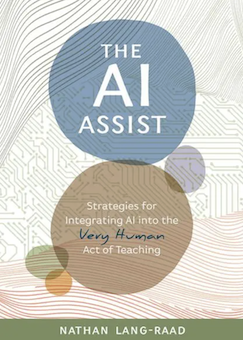 Lang-Raad’s book promises “essential guidance” and a clear road map for educators. In many ways it delivers. Its structure is straightforward and familiar to readers of the ‘teaching strategies’ genre of professional books.
The author challenges readers to consider how a potential AI tool might “support emotional intelligence, foster empathy, or enhance creative expression” and “complement your expertise, allowing you to focus more on individual students’ needs and higher-order thinking skills” (p. 73).
His accompanying message – that teaching must remain a deeply human act – is timely, important, and worth bringing up in most every conversation about AI and the classroom.
Where AI Can Amplify Learning
The book’s seven chapters move through familiar stages: understanding context, identifying goals, tool selection, planning and designing activities, implementation of same, assessment and reflection, and fostering a culture of continuous improvement.
It builds on a former model for tech integration (the SAMR model – Substitution, Augmentation, Modification, Redefinition), and introduces its own acronym, HAIL. The text hangs on the HAIL model, standing for Humanizing, Augmenting, Integrating, and Leveraging AI, which serves as a useful anchor throughout the text. As the author states, “human connection, empathy, and creativity are the soul of education. These are the elements that no algorithm can replicate; they’re the qualities that AI should aim to support and elevate” (p. 4).
The book underscores the genuine benefits AI can bring to personalization. The increasing speed with which we can tailor learning experiences to students’ needs is an unquestionable boon, and the author conveys this potential without drifting into hyperbole.
I also appreciated the inclusion of links to websites that continually update lists of AI tools. In a fast-moving field where any static list risks being outdated almost immediately, these curated links are a thoughtful touch.
Digging Below the Surface
At the same time, I wished that the book dug deeper into what makes an AI-enhanced educational experience distinctive. Often, the author’s integration approaches and strategies felt generic, giving advice that could fit any integrative effort, technological or otherwise.
There were some aspects of the text that confused me. For example, Chapter 1 includes a section called “Data Analysis Approach for Educators,” which suggests conducting a survey. The next logical step, using AI to actually crunch the data or identify patterns, is not suggested. This struck me as a missed opportunity as AI is exceptionally good at this kind of task.
The book also contains a number of templates that, while functional, could easily have been generated by AI with the right prompts. Templates have their place, but given that AI excels at generating customizable worksheets and the rest, the book’s inclusion of them without suggestion of an AI assist was a bit perplexing.
Middle school teachers are among those educators who will be guiding students’ first steps into the AI-assisted world of learning. We need to have a particular focus on not just AI exposure but on the promotion of AI literacy as the path to the AI fluency that will be a requisite for the workforce of tomorrow.
On base, most agree that AI literacy should incorporate ethical awareness, critical evaluation, and scaffolding for students who may otherwise be tempted to treat AI as a replacement for their own critical thinking. Here, for me anyway, the book felt thin. The very human art of teaching needs to center students as human beings who are creative thinkers, not just as tool users or passive consumers of AI-generated anything.
I wanted more guidance as to how students might be taught to not just evaluate AI’s reliability, identify LLM bias and issues of that ilk, but also to reflect on their own role in creating and revising content with AI’s help. That, I think, is where the humanity really is, not just at the start, but throughout the interaction with AI, as a part of the iterative process of creation and refining.
A Helpful Read for Teachers New to AI
For teachers approaching the task of AI integration without much preparation, The AI Assist offers a solid starting point. It provides the steps, useful guiding questions, and a framework that emphasizes the importance of keeping the human at the center.
But for educators already experimenting with AI, or for those searching for strategies to build students’ critical literacy and ethical discernment, the book may feel too generic. By leaning heavily on familiar models (SMART goals, etc.), templates, and surface-level strategies, the author misses opportunities to explore AI’s true potential, and its very real challenges, at least as it applies to middle school teaching.
Dr. Ralph Covino is the Humanities Coordinator and 7th grade Ancient Civilizations teacher at the Girls Preparatory School in Chattanooga, Tennessee, an AMLE School of Distinction. He is a Tennessee Geography Teacher of the Year (grades 7-12) and an National Geographic Education ‘Educator of the Week’ recipient. ChatGPT gets him out of “grammar tangles” all the time.
Covino recently completed a two-year fellowship with the Global Action Research Collaborative in Girls’ Education of the International Coalition of Girls’ Schools. He currently serves as the Executive Secretary of the Southeast World History Association, on AMLE’s Teacher Leaders Committee, and on the Teacher Advisory Panel for R.E.A.L. Discussion.

