

April 26, 2026
The 2026 Global Report on Food Crises (GRFC), jointly published on April 24 by the Food and Agriculture Organization (FAO), the World Food Programme (WFP), and the Global Network Against Food Crises, estimates that some 35.5 million children were acutely malnourished across 23 nutrition crisis countries. “This tenth edition… reveals an alarming reality: hunger is increasingly being used as a weapon of war.”
“Ending hunger is a test of our shared humanity. It is a test we cannot fail.” the U.N. Secretary-General wrote in the Foreword.
In 2025, approximately 266 million people across 47 countries and territories faced crises or acute food insecurity, requiring urgent humanitarian assistance. The report discusses rates of malnutrition based on medical clinic screening in Gaza and western Sudan, including El Fasher and Kadugli. Much of the rest of the Sudan is also seen as at risk.
The Global Network Against Food Crises itself is described as an alliance including the UN, EU, Germany’s BMZ, UK FCDO, Ireland, g7+, and other governmental/non-governmental agencies.
Comparing reports over the years, the trajectory from 2020 to 2025 is stark. In 2020, approximately 155 million people faced high levels of acute food insecurity) across 55 countries, already a sharp rise from 105 million in 2016. By 2025, that figure stood at 266 million across 47 countries, though the 2026 report explicitly cautions that the apparent drop from the 2023 peak of 282 million partly reflects reduced country coverage rather than genuine improvement. The share of the analyzed population in acute food insecurity nearly doubled from about 11 percent in 2016 to nearly 23 percent in 2025, and had already crossed 21 percent by 2020.
In 2019 and 2020, David Beasley, as the Executive Director of the World Food Programme (WFP), highlighted the risk of multiple concurrent famines, while the organization was awarded the Nobel Peace Prize in 2020. Beasley delivered the Nobel lecture where he called for action to prevent widespread starvation. In 2020, the primary crisis concentration was already in a familiar set of countries, Afghanistan, the Democratic Republic of the Congo, Nigeria, the Sudan, Syria, and Yemen, which the 2026 report notes have been among the ten largest food crises for most of the decade.
Myanmar [Burma] and South Sudan were newly classified as very severe nutrition crises in 2026, categories they did not hold in the earlier period.
Meanwhile, some populations showed meaningful improvement. Bangladesh saw a significant 32 percent decrease in acutely food-insecure people between 2024 and 2025, and Syria reduced its share from 39 to 29 percent of the population — though both remained at alarming absolute levels.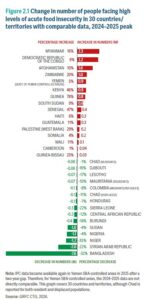
The report covers various causes of malnutrition, including war and climate. Weather extremes had grown enormously as a driver — from 15 countries affecting 15.7 million people in 2020 to 16 countries affecting 87.5 million people in 2025, a roughly five-fold increase in affected population. The 2023–2024 El Niño, described as one of the strongest on record, drove much of this, devastating Southern Africa in particular.
The report and its annexes reviewed methods. For instance, WFP conducted 800,000 survey interviews in 2025, a 30 percent reduction from 1.1 million the prior year. FAO’s Data in Emergencies surveys fell 31 percent, from about 170,000 to 118,000 interviews. An ongoing Acute Food Insecurity Trends Study was specifically designed to correct for temporal, methodological, population, and spatial omission biases that make year-to-year comparisons unreliable. This work was not yet in place for the 2020 edition. Additionally, the 2026 report notes specific methodology changes in individual countries — for instance, Zimbabwe’s IPC methodology changed between periods, and Uganda shifted from FEWS NET to IPC classification, adding 3.3 million people to Phase 3 counts simply through the methodological switch.
Access the report:
Technical notes: https://www.fightfoodcrises.net/sites/default/files/resource/file/2026_GRFC_APP_TECHNOTES.pdf
https://www.fightfoodcrises.net/global-report-food-crises
https://reliefweb.int/report/world/2026-joint-analysis-global-report-food-crises
Past reports:
https://www.fightfoodcrises.net/knowledge-hub/search?f%5B0%5D=series%3A39

