

The question we face at this turning point of civilization is not how to interpret everything through the framework of modernity, nor whether we should return to the ways of the past.
In Japan, a form of primordial animism has long existed: a sensibility that perceives mysterious power in stones, trees, and even mountains themselves, revering them as sacred presences. What is important is that many of these traditions are not merely religious beliefs, but forms of practical wisdom rooted in everyday life and in careful observation of nature.
Iwakura—Sacred Boulders
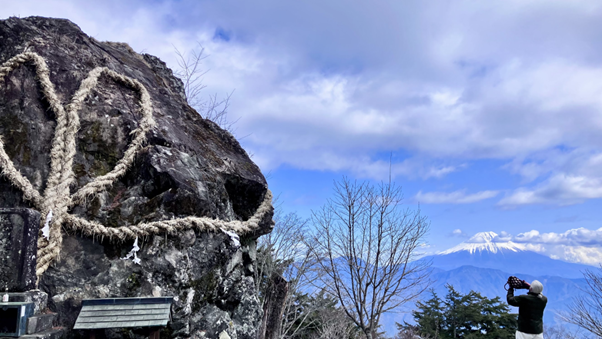
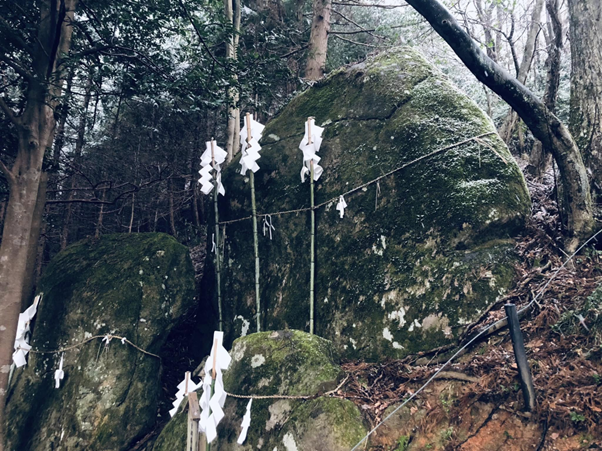
One example is the iwakura (磐座)—sacred boulders believed to be dwelling places of the kami. In many cases, these large stones stand near the water sources of a settlement and have been revered as protectors of springs and headwaters. Exposed bedrock such as iwakura works together with fungal mycelium and tree roots, drawing water upward from the ground through gravity-driven flows, supplying minerals, and creating rich ecological conditions in which large trees can flourish.
The surfaces of exposed rock remain moist because of capillary action within cracks and joints in the stone, as well as the moisture retained by fungal networks that spread through them. Moss, root exudates, and fungal activity gradually dissolve the rock, releasing minerals. As a result, these rocky surfaces become ideal environments for seeds to germinate and for great trees to grow.
The minerals released from the rock seep down along its base through rainwater and fungal pathways, where they are taken up by the deep roots of large trees and distributed through underground mycelial networks. In this way, nutrients circulate through the surrounding ecosystem, supporting a thriving web of life.
Thus, the towering trees that stand upon great boulders are not there by accident. Ecologically speaking, they perform important functions and arise out of the very dynamics of the landscape.
When the underground water cycle of the surrounding soil becomes disrupted, however, exposed rock begins to dry. The mycelial networks once woven through its joints disappear, and the rock can no longer maintain its moist environment. Fine roots that had spread through the stone die back, and during strong winds—such as typhoons—trees may topple away from the rock as if peeled from it.
Without fungal networks, the cracks within exposed rock gradually clog, reducing both permeability and water-retention capacity. Weathering accelerates, and the rock itself begins to break down. The degradation of invisible underground environments can therefore lead, in surprisingly short periods of time, to the collapse not only of vegetation and habitats but even of bedrock and landforms themselves.
Recent research has also revealed the importance of what is known as bedrock groundwater—the movement of water within rock layers beneath the soil—in maintaining the water-retention capacity of forest ecosystems. Even during periods of drought, water that has slowly migrated downward from the soil can continue to seep from the bedrock, helping to buffer the effects of water shortages and maintain the hydrological stability of mountain landscapes (Kameyama et al., 2025).
The tradition of revering iwakura may have contained an intuitive understanding of these relationships: that great stones draw in water, collaborate with mycelium, moss, and trees, and together create the rich environments that nurture life.
For this reason, people in the past likely protected these stones—key nodes within ecological cycles—as sacred places, ensuring that they were not trampled or disturbed, and offering quiet prayers in their presence.
Seen from another perspective, the landslides, ground subsidence, and floods that have increasingly occurred across Japan in recent years may not simply be “natural disasters”. They may also be the consequence of human actions that have severed the invisible connections within nature—connections that once held landscapes, water, soil, and life together.
The Dragon
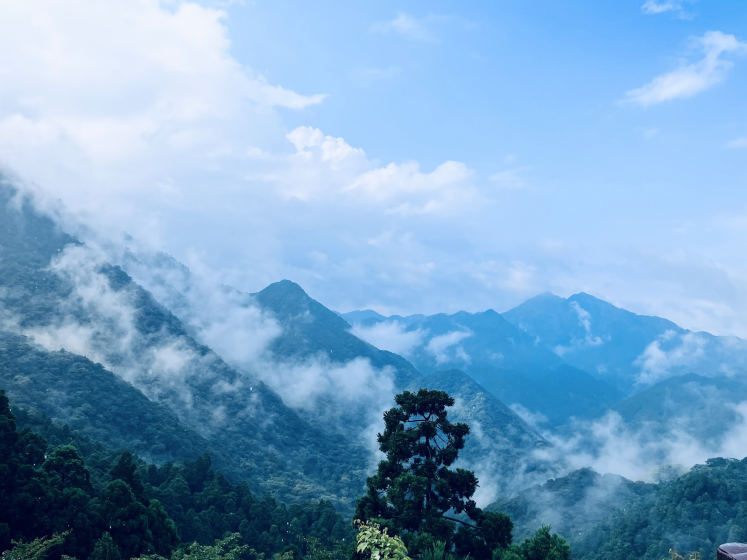
The reverence shown to iwakura is echoed in other ways of perceiving nature as well. For instance, when clouds rise from the mountains during rainfall or just after the rain has passed, the swirling mist has long been worshipped as the presence of the dragon deity.
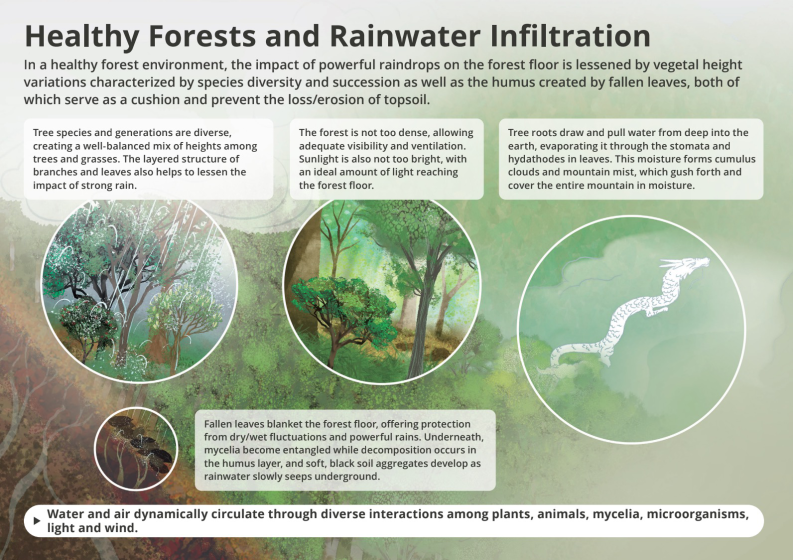
In scientific terms, these are clouds formed through forest transpiration. Moisture released from tree canopies through transpiration and respiration increases humidity in the air. As this moisture-laden air moves upward along mountain slopes, it cools and condenses, forming cumulus clouds and drifting mountain mist.
In a healthy forest ecosystem, tree roots draw water from deep underground, lifting it upward through their trunks and releasing it through tiny openings in their leaves. The moisture that rises from the forest becomes clouds and mist that gather around the mountainside, gently humidifying the landscape. Even during stretches without rainfall, this process helps keep the entire mountain environment moist.
Since ancient times, such phenomena in which water circulates between heaven and earth have been understood through the image of the dragon and have become objects of reverence. Yet behind this faith likely lay something more practical: gratitude for the natural systems that sustained local life and livelihoods, and an awareness that if humans disrupted their balance, disaster—understood as the dragon’s anger or curse—could follow.
In this sense, such beliefs may have functioned as a kind of collective sensing system. Communities continually observed and responded to the shifting dynamics of their ryuiki, maintaining an embodied awareness of the living landscape. The ryuiki (流域) was also understood as ryuiki (龍域), the dragon’s domain.
Looking beyond Japan, similar insights are being rediscovered elsewhere. In California and Australia, catastrophic wildfires have led to renewed recognition of cultural burning practices maintained by Indigenous peoples for thousands of years. By introducing carefully managed, small-scale fires into ecosystems, these practices encouraged forest regeneration and prevented the buildup of fuel that leads to devastating wildfires.
At AMBIENT AGENCY, the Ecological Memes forum I recently convened in Paris, a speaker cited an Indigenous elder in Australia who stated:
“The land is waiting for fire”.
Such words remind us that the wisdom cultivated by Indigenous communities—through long relationships of attentiveness and kinship with the natural world—is becoming urgently relevant once again.
Sugasugashisa—The Sense of Clarity Inseparable from the World
Step through the torii gate and into the precinct of a Shinto shrine, and something within you settles—a quiet clarity, a gentle sense of renewal. This sense is called sugasugashisa in Japanese.
A Shinto priest once told me:
“The kami love clear, clean places.
That is why we always keep them so.”
Within the quiet grounds of a shrine, surrounded by stillness, sunlight filters softly through the trees. A cool breeze brushes the cheek. The rustling of leaves, the scent of earth, the faint presence of water mingles together. One often finds that the breath deepens without noticing, and the restless movements of the mind begin to settle.
Shinto holds two important concepts: kegare and harae.
Kegare is often translated as impurity, but its meaning is closer to a state in which ke—vital life force—has withered or been depleted. It does not simply refer to physical dirt; illness, injury, exhaustion, or emotional disturbance can also be forms of kegare—conditions in which body and spirit fall out of balance. Harae refers to the rituals through which this vitality is restored. Through prayer and ceremony, the diminished life force is renewed.
The waterfall practice mentioned at the beginning of this essay is one such act of purification. The priest who guided me once said:
“To cleanse one’s own impurity is to cleanse the world.”
In other words, the self is not separate from the world. The world is within the self, and the self within the world.
Yet it may be that those of us living in modern society are gradually losing this sense of sugasugashisa—a quiet clarity and freshness of spirit inseparable from the world. Amid the noise of cities, the constant stream of information, and the relentless pursuit of efficiency and convenience in human-centered systems, our senses grow dull. The vitality of body and mind slowly withers. Many of the illnesses that mark our age—depression, anxiety, chronic fatigue—may not be unrelated to this condition of kegare, the exhaustion of life force.
Seen in this way, sugasugashisa is not merely a feeling or emotion. It is a sign that a deeper rhythm of life—one that exceeds the individual self—is in balance. Shrines, then, may be understood as cultural devices: places where people replenish vitality through connection with the unseen world, and where human beings are reminded that they live as part of the great ryuiki of life in which all things resonate together.
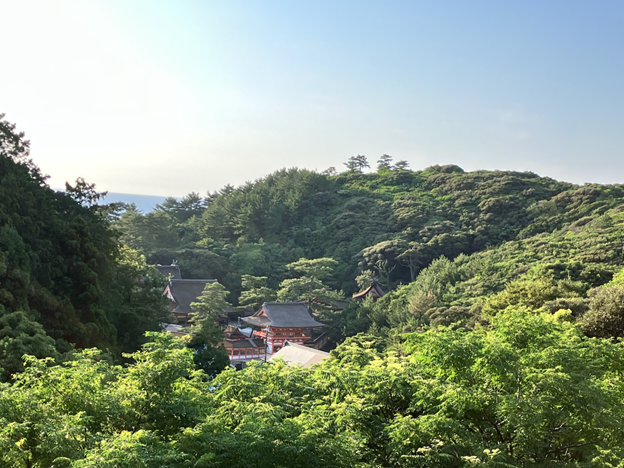
Across Lake Shinji from Sada Grand Shrine, where the gods of Japan are said to gather during the sacred tenth month of the traditional calendar, stands another shrine called Suga Shrine.
According to legend, after Susanoo subdued the Yamata no Orochi and was united with Kushinadahime, he searched for a place to build a new home. When he arrived at this spot, he exclaimed:
“My heart feels clear and at ease (sugasugashii) here.”
Because of those words, the place was named Suga, and the phrase is often considered one of the origins of the word sugasugashii.
What is interesting is that Susanoo, who at the beginning of many myths appears as a violent and unruly deity, gradually emerges as a figure embodying both wildness and clarity.
As we have seen in the preceding chapters, Susanoo represents a visiting deity who brought new technologies and knowledge—a symbolic figure of civilization itself. Yet many myths also depict him as a troublemaker among the gods, disrupting the existing order. New technologies and knowledge often destabilize existing systems. Used only for private gain, they can easily bring calamity or curse. That is why Susanoo does not become “clear” simply by acquiring his benefit. Only when he subdues the Yamata no Orochi and saves Kushinadahime—only when he dedicates himself to others and the community—does he truly become sugasugashii.
Shrines and Chinju no Mori
Today, Japan is home to more than 80,000 shrines.
Shrines are typically accompanied by chinju no mori, sacred guardian forests. Many are located at ecologically and geographically significant points—fault lines, river confluences, or locations where landscapes bend, and energies converge. It is well known that the distribution of shrines across Japan often aligns with the Median Tectonic Line and other major geological structures. These places may have been revered as sacred not only to calm the energies rising from the earth, but also to ensure that humans would not disturb fragile ecological nodes.
The naturalist Minakata Kumagusu, who fiercely opposed the Meiji-era policy of shrine consolidation that destroyed countless local shrines and chinju no mori, warned that their loss would threaten not only natural ecosystems but also the cultural and spiritual foundations of society.
He wrote:
“The natural landscapes unique to our country are the very mandalas of our land.”
The religious philosopher Kamata Toji (1951–2025) stated that the essence of Shinto cannot be understood without an aesthetic sensibility. He suggested that when one steps into a shrine precinct and encounters its quiet clarity and solemn atmosphere, a certain posture begins to take shape— an aesthetic way of being, and a readiness to face a world that extends beyond anthropocentrism.
This sensibility at the heart of Shinto—something that might be described as a Japanese sense of wonder—is often overlooked by those who live within it, precisely because of its familiarity. Yet, it is sometimes perceived more vividly by those arriving from elsewhere. Lafcadio Hearn (Koizumi Yakumo)—born in Greece, raised in Ireland, and later a researcher of Japanese culture—was surely one such figure. He came to share this sensibility, finding the “workings of kami” in all things and describing it as “something in the very air”. It may be that memories of polytheistic Greece and Celtic traditions resonated within him.
If shrines are instruments that reconnect us with the unseen world—spaces that reopen our resonance with nature and restore the clarity of life—then perhaps it is time for us to rediscover the meaning of this ancient wisdom.
Today, we find ourselves living through another great civilizational turning point, as new geopolitical upheavals and emerging technologies such as AI transform the world around us at unprecedented speed, calling into question what it means to be human on this planet. Perhaps what is most needed now is to once again confront the meaning of this quality we call “sugasugashisa”.
Tracing Inner Ryuiki
Ancient faiths and indigenous knowledge are often dismissed as unscientific. Yet we live in a time when cutting-edge science is beginning to rediscover precisely such forms of wisdom. Just as discussions in Buddhist philosophy and quantum physics sometimes appear to converge, modern scientific inquiry is increasingly catching up with insights long embedded in traditional knowledge.
The question we face at this turning point of civilization is not how to interpret everything through the framework of modernity, nor whether we should return to the ways of the past. Rather, the question is whether we can learn to hold different forms of knowing and different intellectual systems together, allowing them to coexist and inform one another.
In this respect, the traditional Japanese understanding of ryuiki offers something worth learning from. Over time, diverse values and cultures accumulated within the archipelago, layered without erasing what came before. For those of us living on the fraying edges of modern civilization, the question becomes: what will we receive, and what will we pass on to future generations?
The Jungian psychologist Kawai Hayao, in his influential book The Hollow Center: Japan’s Deep Structure, observed that a distinctive feature of traditional Japanese thought and social structure lies in what he called the “hollow center (chuku).”
In Japanese mythology, such as the narratives found in the Kojiki, opposing deities often play central roles. Yet, alongside these opposing forces, there frequently appears a third presence—a deity who does nothing. This figure enters the narrative but remains inactive, functioning as an empty space that holds the tension between the other two in balance and enables a new flow to emerge.
For example, Susanoo is the younger brother of Amaterasu, the supreme deity of Takamagahara, enshrined at Ise Shrine. Their sibling Tsukuyomi, however—who should complete the triad—barely appears in the myths at all. Kawai suggested that this structure, in which two opposing forces are held in dynamic equilibrium by a third “empty” presence, forms a fundamental pattern underlying Japanese mythology.
Indeed, the relationship between Amaterasu and Susanoo cannot be understood through a simple binary of good versus evil or victory versus defeat. Neither side is defined as the absolute center. Instead, the two maintain a dynamic balance, constantly adjusting toward what might be called a good measure.
This way of thinking—one that moves beyond rigid moral binaries—appears throughout Japanese culture. In Hayao Miåyazaki’s Nausicaä of the Valley of the Wind, a character asks:
“Why couldn’t they see that purity and pollution are both part of life?”
Likewise, the global phenomenon Demon Slayer is not ultimately a story of defeating absolute evil. Rather, it tells of demons who were once human—people shaped by suffering and circumstance—and of bringing peace to the demon that lives within us all.
Perhaps the experience that logos—the rational intellect that separates and categorizes—finds hardest to grasp is life itself: the lived reality of being alive.
Yet, many of the modern social and economic systems that govern our world have been designed as though this fundamental complexity did not exist, constructed like machines based on a logic that divides and simplifies.
The naturalist Minakata Kumagusu recognized this problem early on. He warned against the excesses of industrial civilization and modern scholarship built upon the logic of division. In the wandering life of the slime mold—an organism that seems to slip effortlessly across the boundary between life and death—he glimpsed a philosophical image of the deeper truth of the world.
In contrast to logos, the philosophical logic that acknowledges the space between things—the relationships that cannot be divided—is sometimes described as lemma philosophy. It is a way of understanding the world grounded in ideas such as soe sotai (mutual dependence) and engi (dependent origination), in which all phenomena arise through interconnected conditions.
This mode of thinking was articulated by Nāgārjuna, the founder of Mahāyāna Buddhist philosophy, in the Mūlamadhyamakakārikā, and later explored in Japan by the philosopher Yamauchi Tokuryu in his work Logos and Lemma.
Within the foundations of Japanese culture and philosophy lies a sensitivity to this “in-between” space called aida—an ability to let differences remain different, while perceiving the connection between the visible world (utsushi-yo, the manifest realm) and the invisible world (kakuriyo, the hidden realm). Rather than forcing opposites into conflict, this perspective allows diverse and even contradictory elements to encounter each other and circulate in dynamic balance.
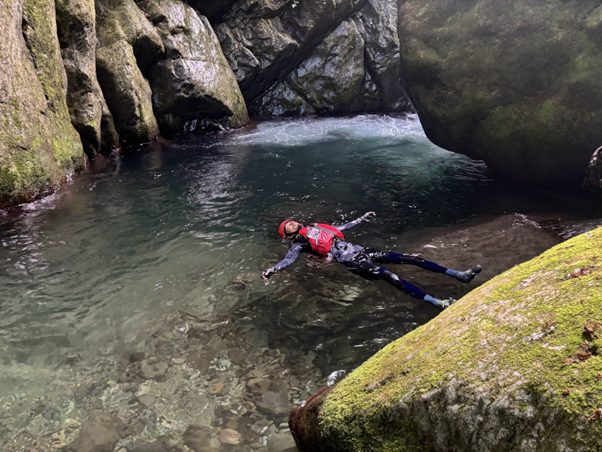
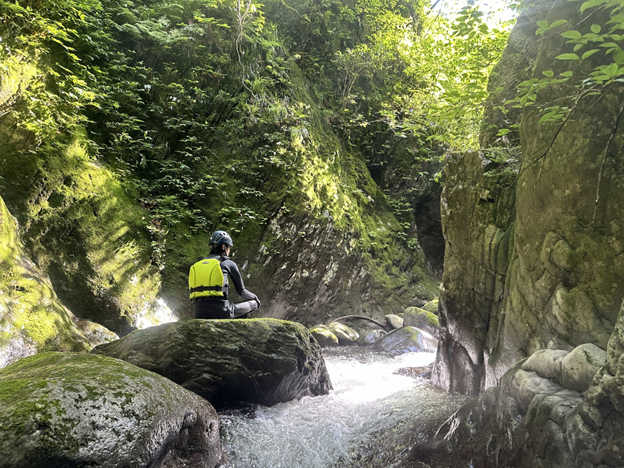
As the poetry of the Man’yoshu shows, people in Japan have long seen the movement of rivers and water flow as mirrors of the movement of the human heart.
Asukagiwa / kawayodo sarazu / tatsu kiri no / omoi sugubeki / koi ni aranaku ni
On the Asuka River
mist rises endlessly
from the quiet pools—
and this love within me
cannot simply pass away.— Man’yoshu, Book 3, Poem 325
Yamabe no Akahito
In this poem, the court poet Yamabe no Akahito overlays the lingering stillness of a river pool and the mist rising from its surface with the lingering weight of love and sorrow in the human heart. The movement of water and the movement of emotion become one.
When we begin to experience ryuiki not merely as a hydrological watershed, but as a living network of geography, climate, culture, economy, and ecology—a place where human beings and nature continuously shape one another—we may rediscover the flowing vitality of life within ourselves.
The theme of this series—Ryuiki Awareness—is precisely the capacity to sense the constantly changing, dynamic wholeness of life, and to recognize ourselves as part of the workings of all things. Going forward, as I continue to explore the Ryuiki Dynamics in regions not only across Japan but around the world, I hope to seek out the clues and practices needed to reweave our socio-economic systems—our sense of self, the fertility of the soil, our relationships with other beings, and even the ways we organize economic and corporate activities—drawing on the fluidity and joy of life.
As a first step in this endeavor, Ecological Memes, together with partners in Japan and abroad, will host the International Ryuiki Forum, along with a series of immersion programs in Daisen and Kyoto in October 2026. An online series of talks leading up to the forum has also begun, and I warmly invite those who feel called to join this shared journey of exploration.
Where do we come from, and where are we heading?
Where does the water come from, and where does it flow?
What are we, truly—and by what are we sustained?
Today, too, the water keeps flowing.
Yasuhiro Kobayashi
Tokyo
Upcoming Online Talks: Ryuiki Gatherings vol.1-5
A new online talk series on ‘Ryuiki’ is starting on April 22nd. I warmly invite those who feel called to join us in this shared journey of exploration.
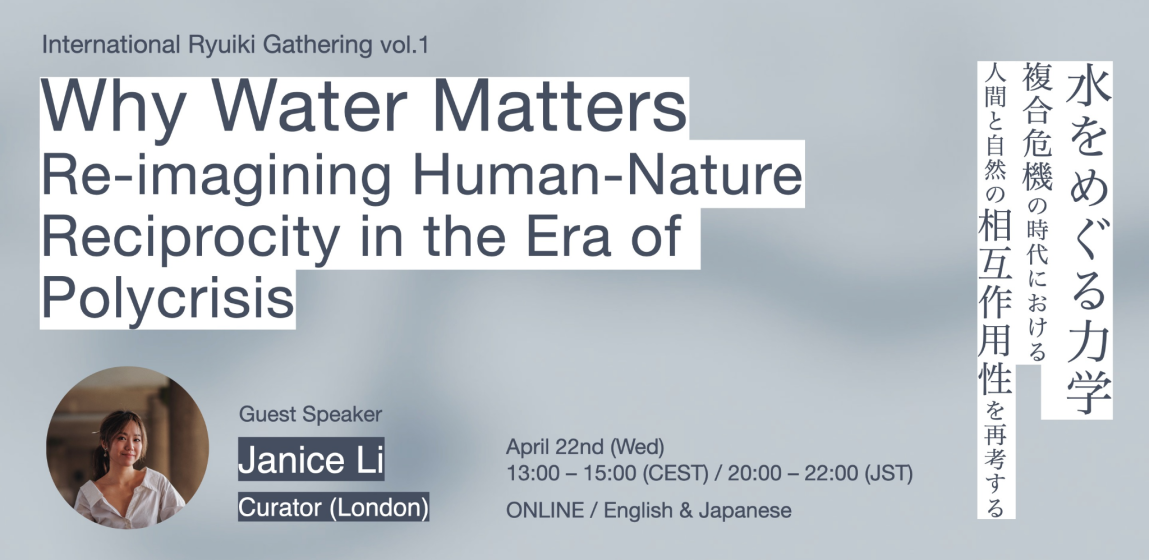
ーApril 22nd (Wed) 12:00 – 14:00 (BST) / 13:00 – 15:00 (CEST) / 20:00 – 22:00 (JST)
Why Water Matters: Re-imagining Human-Nature Reciprocity in the Era of Poly-crisis
水をめぐる力学:
Guest: Janice Li / Curator (London)
ーMay 22nd (Fri) 13:00 – 15:00 (CEST) / 20:00 – 22:00 (JST)
Caring for Watershed Ecologies: Learning from Place-based Mythologies and Landscape Regeneration Practices through Contemporary Arts
(多感覚の水辺:種を超えたケアの場としての流域と芸術)
Guest: Carmen Bouyer / Environmental Artist (Paris)
ーJune 16th (Tue) 12:00 – 14:00 (CEST) / 19:00 – 21:00 (JST)
Ancestral Flows in Japan: Re-activating Animistic Landscape and Awareness in the Layered Archipelago
日本の精神性と内なる流域:
Guest: Everett Kennedy Brown / Artist, Writer (Japan/US)
ーJuly 9th (Thu) 11:00 – 13:00 (BST) / 19:00 – 21:00 (JST)
Decolonizing Leadership: Indigenous Wisdom and Regenerative Business as a Songline of Land and Water
水と大地の記憶:先住民の知恵に学ぶビジネスとリーダーシップ
Guest: Jannine Barron / Regenerative Business Mentor (UK/Australia)
ーAugust 4th (Tue) 12:00 – 14:00 (CEST) / 18:00 – 20:00 (Bali) / 19:00 – 21:00 (JST)
Regenerating Tourism as a Ryuiki Journey: Ancient Wisdom and More-than-Human Connectivity in Bali
流域に根ざした再生型ツーリズムの可能性を探る:
Guest: Wira / Impact Entrepreneur (Bali)

