

By Amber Chandler
Every morning my co-teacher, my across-the-hall neighbor, and my next-door neighbor have breakfast in my room. Breakfast Club. Our schedules somehow converged after Covid, allowing this dedicated time to yap every day.
Sometimes the talk is lighthearted, other times it is complaining, but often, it turns to more important topics. One day, after months upon months of talking about our students’ lack of stamina, social skills, and motivation, someone blurted out, “I mean, it isn’t all our fault.”
We all took a deep breath, and our conversations shifted from shouldering all of the responsibility for the post-Covid issues we were seeing in our students. Sure, we allowed, we have a part in trying to heal this “scared new world,” but we started talking about how real growth could happen through partnership.
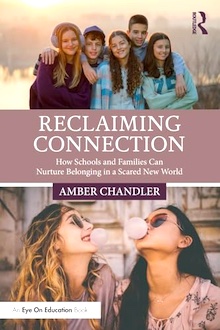
Out of these conversations, a new book emerged: Reclaiming Connection: How Schools and Families Can Nurture Belonging in a Scared New World. My four earlier books have all focused, in one way or another, on teaching practice. This one is different.
I begin with a major premise: we are all lacking community, despite our illusion of connectedness. Then, I address the people I think can help us reclaim connection: teachers, students, families, communities, and school boards.
The majority of the book is not specific to those of us who inhabit school buildings; it expands the discussion to communities and neighborhoods, city blocks, college campuses.
To begin my book project, I created a “dream team” of people I’d like to talk to. I went big, emailing people who were out of my league, and surprisingly, all but two agreed to an interview. (For the curious, Jonathan Haidt was too busy having his own moment with The Anxious Generation, and who can blame him? Mrs.Frazzled, a former teacher, with an Instagram following of 732K, may never have even noticed my message.)
Here’s how the book works
I take a problem – school attendance, for example – and examine it from five perspectives – teachers, students, families, communities, and school boards. In my search for solutions, I interviewed thought leaders like Melinda Person, President of New York State United Teachers (NYSUT), Alfie Kohn and Rick Wormeli (education authors), Tom Vander Ark (educational leader and guru), and many others outside the education sphere, including city planners, politicians, lawyers, psychologists, and parents.
The book chapters delve into our conversations, and at the end of each chapter, I write a note to each “stakeholder” group. Here’s an example of my notes to the stakeholders on the topic of attendance:
Dear Teachers,
We all know that the students need to be in school to learn. However, when they aren’t we need to make it easy for them to stay up to date. Otherwise, they will become overwhelmed, get behind, and the whole cycle of school avoidance begins.
Post your assignments in Google Classroom with the understanding that if you are absent, you need to get your work done and continue with the class. I know that there are kiddos who are not coming to school regularly who are still managing to do well in your class, if you accept their work. Some people are irked by this, but I try to imagine the harm we would do if we cut our students off completely.
Dear Students,
You need sleep. You know you need sleep. You also need screen-free time, particularly before bed, but you know that too. It’s addictive, and you didn’t buy the phones yourselves. The adults all feel badly that this is where we are, but you have a say in controlling your future too.
You are going to have to recognize that the dangerous combination of too much screen time, plus the isolation from being at home/skipping school, plus anxiety is creating a real crisis, and many of you are having mental health issues that need attention. Come to school. Just get here. Not showing up causes about 80% of the problems that are happening right now with you, so get to school. Find a teacher or counselor and touch base. We miss you.

Dear Families,
During Covid, a mom and I were having a heart-to-heart because her son would not do online school. She asked me, “What can I do?” My reply, sadly, was “Not much. Just keep asking him to join. I won’t blame you though, or think you are a bad mom.” She burst into tears because most of us did feel like bad parents, and many of us still do.
We have to take our family back, to reclaim connection, or maybe create a connection that wasn’t even there before. You need to start a weekly Game Hour at home. Hear me out. There only needs to be ONE HOUR dedicated to being together, around a game, phone free. Put on music – take turns DJing. At first, your kiddos will grumble, but trust me, when my co-teacher and I “made” our students play Uno, they ended up having a blast.
Our kids just don’t remember how to disconnect from the digital stream, and we need to take small steps to help them. What does this have to do with attendance? Everything.
Dear Communities,
Kiddos and their families need “third spaces” – a place that is not home or school or work, a place where people can meet to connect, spend time in person, and build community. Work with your schools, libraries, rec centers, churches, retirement homes – any space in your community that can be reworked into a common space to gather.
Make this happen. Incentivize it. Write grants to fund it, plan a potluck, have a contest, give free lessons, start a homework club. Anything that will bring people together, especially without costing them anything.
Dear School Boards,
Both families and educators need you to write firm, clear policies that will hold students accountable. Bell-to-bell cellphone bans are a good start so that we have students’ attention while they are in school. Consider creating a virtual academy so that students who are plagued with depression and anxiety don’t slip away.
Readjust the “college push” and focus on connecting with community partners to help students find internships and mentors. There are so many ways that you can lead the way, and it will make a difference in attendance.
I didn’t write about attendance in the book – this is just for MiddleWeb readers – but you get the idea here of the structure.
IF…
- Families helped their children disconnect and socialize
- Students got enough sleep and attended school
- Teachers encouraged students and were flexible
- Communities helped construct “third spaces”
- School boards held everyone accountable with strong policies
…then we’d be moving in the right direction.
Each of those small actions won’t do it on its own, but with a collaborative effort, we have a chance to reclaim connection.
I’d love for you to read my new book and join the conversation. You can check out my website reclaimconnection.com, follow me on Instagram and Threads @amberrainchandler, and watch for my #threeminutethoughts.
Feature image: Unsplash+
 Amber Chandler is a middle school ELA teacher in Hamburg, NY. She was the 2018 AMLE Educator of the Year and a 2022 NY State Teacher of the Year finalist. Amber is a regular contributor to AFT’s Share My Lesson and President of the Frontier Central Teachers’ Association. Visit her website.
In addition to her new book Reclaiming Connection: How Schools and Families Can Nurture Belonging in a Scared New World, Amber is the author of The Flexible ELA Classroom, The Flexible SEL Classroom, Movie Magic, and Everything New Teachers Need to Know But Are Afraid to Ask). Her books are published by Routledge/Eye on Education. Read Amber’s other MiddleWeb articles and reviews.

