

”Maybe we should acknowledge the invisible. It’s not somewhere else. It’s in the visible, right here. If this elemental air were not invisible, I wouldn’t see anything else, wouldn’t see you. And that’s the place of the spirits and the place of the ancestors—oh man, just right here! They’re right next to you, whispering in your ear.”
Atmos Magazine, 2025
Germany: Swamp, spirits, silent utterance
We gather at the edge of the Tempelhofer Feld—an airport converted into an open public park where wind moves through a vast urban prairie. We look at each other with complicity, and enter the Floating University, which was once a wastewater facility and is now an artificial wetland and a place for cultural exchange. It feels like crossing a portal.
The consequences of activism are often indirect or slow to appear; sometimes a series of events becomes a shape many years from the date of those things happening. What consequence might there be from a group of people gathering to look over a wall at a vacant lot with a spontaneous mini-forest in the middle of a city?
Artists, scientists, friends—each carrying a different way of sensing—travel inside this huge depression in the earth that now hosts a minimalistic infrastructure of docks over the water. Some move toward the old sewage structures. Others drift to the cattails rising from the mud. A few linger by the narrow gaps between wooden planks, as if something might be breathing there.
We remain quiet.
When we return together, we share what we encountered. Each person speaks of a spirit: how it appeared, what it revealed, how it altered the place. We have just played Yokai GO, a loose adaptation of Pokémon GO. Its premise is simple: to make room—for imagination, for attention, for what usually goes unnamed.
Each participant imagines a yōkai, a spirit in Japanese folklore, and anchors it to a specific site. Some of these spirits are ancient inhabitants of the place, exiled from open waterbodies into the dark sewage. Others are young spirits, fleeting and curious, living in the only place they have ever known: among frenetic humans, observing city life unfold.
From then on, something shifts. The place is no longer neutral. It holds more presences. Attention sharpens. Relations begin to form—quietly—between the seen and the unseen.
This gesture resonates with what Anna Tsing calls the “arts of noticing”: a practice of attending to the layered, entangled lives that persist within damaged landscapes. While her concept is traditionally rooted in the multispecies world and the other-than-human perspective, we expand it here to encompass a more-than-visible world—a whispering presence beyond our grasp. And it begins with a simple question:
Who else is living here? Who are we not seeing? And how do we share life together?
As human activity continues to expand across the planet, another impulse becomes necessary: not to take more space, but to give it.
To Give Space is both a material and perceptual practice. It involves restoring habitats, supporting biodiversity, and shaping resilient environments—but it also requires cultivating openness in our body, mind, and spirit: in how we perceive, imagine, and relate to others.
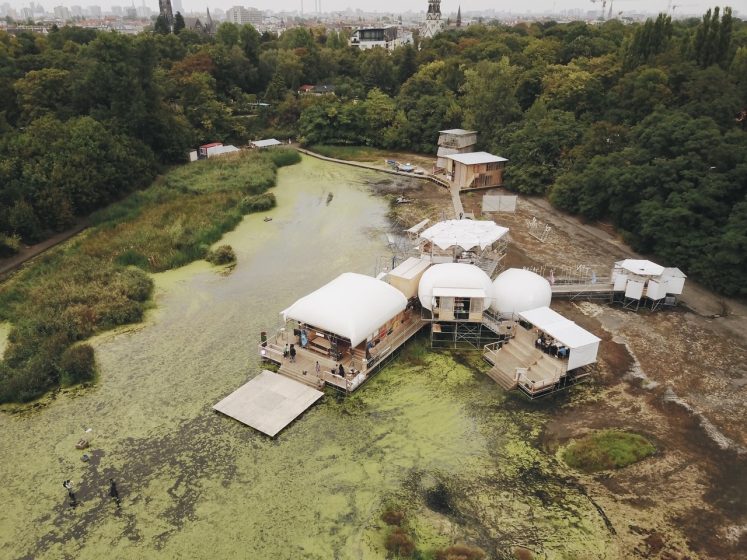
It is about awareness. From this perspective, unfiltered imagination and brave play are methods. Yokai Go is one example: a way of training our perception through fiction, allowing us to nurture new forms of attachment to (living) things.
Additionally, giving space to the unseen is an ancient practice that finds many examples in different cultures and cosmovisions.
Japan: Buddhas, gods, guardians of ecologies
We pause gently before the Torii—the shrine’s gateway defined by its striking vermilion hue—and bow our heads in reverence before stepping through into the sacred grounds. Beneath our feet, the gravel yields with a deep, rhythmic crunch. The sound of our own footsteps begins to canon with the gravel-crushing cadences of other visitors, each carrying their own hidden prayers into the precinct.
At the heart of the sanctuary sits a colossal Ginkgo tree, tenderly wrapped in a Shimenawa (sacred straw rope) and cherished by generations of the local community. Its trunk is so vast it would take five adults with arms fully outstretched just to encircle it. We stand there, utterly spellbound, held by the overwhelming strength and comforting embrace it radiates.
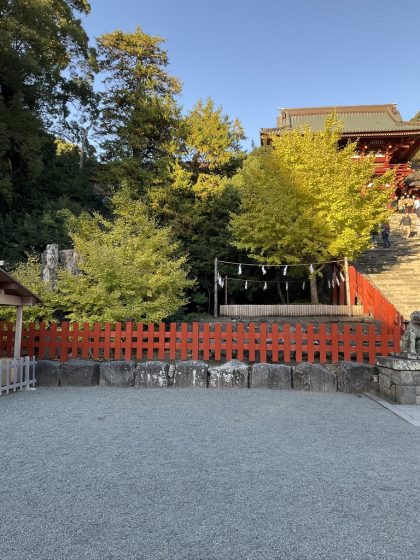
The Shimenawa marks the threshold of the divine. This tree, while rooted deeply in our earthly realm, breathes as a portal connecting us to the world of the unseen.
Through Shintoism, Japanese ancestors revered mountains, rivers, rocks, trees, and even frozen lakes. Woods and groves were also objects of worship and played a pivotal role as guardians of the sacred.
“Chinju no Mori” is such an eternal guardian grove that envelops Shinto shrines. Historically regarded as hallowed and therefore untouchable, these spaces provide a sanctuary where native plants find a place of peace. Here, the soil acts as a storyteller of ancient times, and delicate micro-ecosystems sustain a rich diversity of life.
Even today, the urban forests that remain are often found within the precincts of temples and shrines. A preeminent example is the Kasugayama Primeval Forest, the sacred domain of Kasuga Taisha Shrine. Since the year 841, under a decree that strictly prohibited hunting and logging, this forest has been tenderly protected, preserving its original majesty to this very day.
The Senso-ji Buddhist Temple in Tokyo was spared from the ferocious fires unleashed by the Great Kanto Earthquake, saving the lives of many neighboring residents. The true hero of this miracle was the Ginkgo tree. In addition to the ancient trees that had stood since the Edo period, these naturalized ginkgoes had been newly planted throughout the precincts as a firebreak, chosen for their latent water-retention capacity compared to other species.
Today, over a century later, the vivid scars from the flames remain etched upon their trunks. Yet, every autumn, they continue to flourish, blanketing the temple grounds in a brilliant radiance of their iconic, fan-shaped leaves.
Beyond ecology, these sacred spaces have long bolstered the resilience of human settlements. Japan’s indigenous science breathes quietly still throughout the cities and villages with the helping hands of gods and goddesses. Large, moist tree canopies and the forest-rimmed grounds of temples and shrines have been the saviors of countless lives from fires and natural disasters, guarding the community just as they were grown to safeguard the divine architecture within. Here, ecological knowledge transcends the boundaries of formalized expertise; it is woven into spatial norms centered on faith, and into the very fabric of rituals and prayers. Today, these elements may appear fragmented, yet they were once fused in primordial harmony—a holistic unity that embraced a diverse form of life.
Argentina: Looking, questioning, breathing together
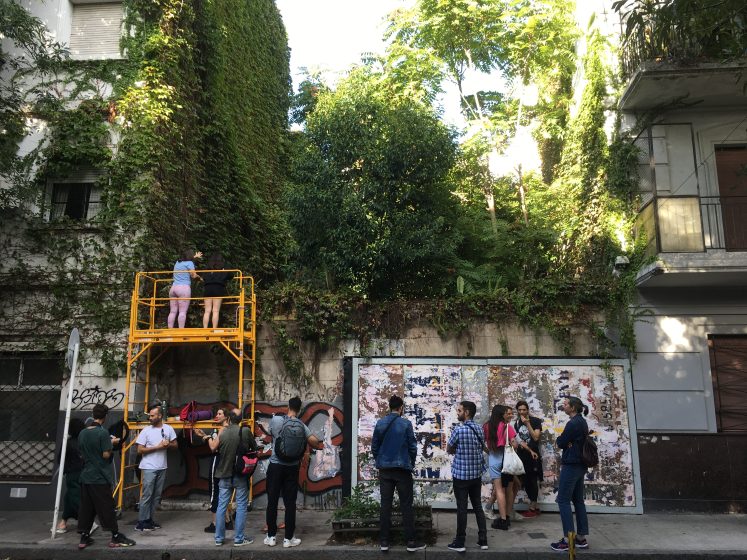
We climb the scaffolding installed on a sidewalk in the Almagro neighborhood. Before us lies a 230-square-meter vacant lot, abandoned for thirty years and transformed into a self-governing forest. High canopies, dense bushes, ferns—about twenty-four plant species and fifteen bird species have reclaimed this ground. There is a line forming on the street, not for shopping or entertainment, but to quietly observe this “spectacle of life.”
From this very observation, Relieve emerges. It is an experience with public space that is part cultural project and part citizen activism. It was born out of the observation of a vacant lot in the Almagro neighborhood of Buenos Aires City. Through “Possible Landscapes,” we map these vacant lots as green dots, weaving an urban hiking trail that treats hidden ecosystems as a form of culture.
It begins with a pair of inquisitive eyes. A neighbor observes the lot that belongs to the national government and thus to all Argentines and posts images of the place on social media. From the vibrant response to those images, a collective is appearing.
As forming Relieve, we explore the land to document its richness, organize gatherings where we share the characteristics of the plot and pose questions: What is the best use for a piece of land like this? Does it have value? Should it be opened to the public or left to other species as refuge? Should we intervene to restore a native ecosystem? How much intervention is needed?
Here, we are confronted with the same question that echoed through the marshes of Berlin, but in a more urgent form: Who else is living here?
These questions do not have fixed responses.
Then we make our second proposal: an “Invitation to Look”: scaffolding installed on the sidewalk in front of the property; letting people appreciate what is happening inside and understand why this property is of interest. That call resonates. Dozens of people show up to climb the scaffolding, sensing from their gut that this is a spectacle worthy of appreciation, or intrigued enough to wonder what it is. We are startled as a line is formed; not to buy a piece of clothing, a toy, or some trendy new food; not to access entertainment; not to seek a distraction from reality; but to observe a natural environment.
Then comes Possible Landscapes. During the Distrito Once art festival, we perform a subtle subversion of the city’s geography. We take the official map of galleries—those white cubes of curated culture—and duplicate it, but this time, we stain it with a layer of green dots. These dots mark the “voids”: the vacant lots where the city has forgotten to look. We invite the public on an urban hiking trail, a journey that weaves through the cracks of the neighborhood, blurring the lines between artist workshops and wild thickets, treating the relief of the earth as our finest gallery, and the environment itself as our living culture.
On the facade of our observed forest, we leave our mark. Through graffiti and paste-ups, we declare this space a “Natural Urban Micro-Reserve,” casting a spell of reclaiming over the concrete. We challenge the passersby to stop, to linger, and to ask themselves: What lives on this property? A new pulse is beating behind Relieve, as we push for a law to transform this accidental sanctuary into an official green lung for Buenos Aires.
All of these actions reflect a possible line of action for Giving Space: simple, naive proposals that gain strength with the echo they find; first, in a small group of people, and then in the extended collective that we all are as a society.
The consequences of activism are often indirect or slow to appear; sometimes a series of events becomes a shape many years from the date of those things happening. What consequence might there be from a group of people gathering to look over a wall at a vacant lot with a spontaneous mini-forest in the middle of a city?
We do not know yet. But we know it is a form of collective breathing—an act of conspiracy.
To conspire literally means to breathe together.
Against the suffocation of an increasingly uninhabitable world,
to conspire is to give each other what we need in order
to live, now, the life we want.
To organize is to conspire:
to be, to think, to celebrate, to cooperate, to meet.
To set in motion, in the midst of the capitalist desert, an abundance
of knowledge,
of resources,
of affections,
of stories,
of relationships. […]
Amador Fernández Savater
To organize is, finally, to “connect the dots” of resistance. But not like in that childhood game where the dots were joined according to a predetermined logic that ultimately revealed a preexisting figure. Here there are multiple lines, working in any direction. No connection is the same as another. Each one requires attentive listening and careful, hands-on work. The common figure that emerges is unrecognizable, never seen before. And it is under constant construction.
Jens Benöhr, Paula Alvarado, and Naho Iguchi
Puerto Varas, Buenos Aires, and Berlin

