

By Scott Silver-Bonito
It may seem outmoded, and it may seem like kids at a middle school level might not be interested in receiving “snail mail,” especially with their brains wired for the instant gratification of texting and social media.
However, when my students receive their first pen pal letter from their mystery pen pal, their eyes light up and their brains go into overdrive guessing with whom they might be corresponding.
“Who is writing to us? Are they in this class? Can you give me a hint?” they exclaim with magical wonder. “When do we get to write to them again? We have to wait until the end of the unit?!” “When can we FINALLY meet our partners?”
This is the excitement and intrigue that has surrounded the year-long pen pal project we engage in for 7th grade Spanish students. So, how did we decide on this particular modality of learning? What purpose does it serve? And how might this particular vehicle of learning application be adopted across different curricula?
How the Pen Pal Project Came to Be
The genesis of the pen pal project for 7th grade Spanish students began with two teachers racking their brains over the question: How can we have our students practice authentic interpersonal writing in the target language of Spanish?
My incredible colleague, Kat Mellen, and I were set to a task: create summative writing activities that invite students to apply the vocabulary and grammar of each of our units. We could have them write a presentation, a dialogue, a skit… but we wanted something fresh for the students.
We wanted something that would be sustainable, authentic, and engaging. “What about a pen pal letter?” we wondered. However, we got snarled on the fact that middle schoolers like novelty and a pen pal letter, we opined, would not grab and maintain their interest.
Then the lightbulb moment came: What if it’s a mystery pen pal and it’s a year-long correspondence where part of the fun is students guessing who is writing to them by using their increasingly scaffolded reading and writing skills in the target language?
This would also require the authors to be furtive in their own writing – “Can we switch the gender of our adjectives to throw them off the scent, Dr. Bonito?” Why, of course! And so it was: Kat and I would pair up our students, under the veil of secrecy, and begin having them write to each other.
The Logistics
So, what would our pamphlet, “So You Want to Start a Mystery Pen Pal Project,” look like? My coworker and I first listed out the rosters of each of our five classes. Then we created a Google Sheet that paired up students in each class. We gave them a code so we could keep track of the pairings. For example, A1 was the code given to the first student in my A period and his/her writing partner in my colleague’s A period class.
The students would always label their pen pal letters with their code so that we knew the recipient when we exchanged the letters. If classes had uneven numbers, we had students partner with students in different class periods. Finally, if we had uneven numbers of total students, we gave a student or students an opportunity to write to two recipients for extra credit. We even tried rotating that opportunity if there were multiple interested students.
Next Steps
With our Google Sheet filled out and the pairing complete, we needed to decide the cadence of the letter writing. We chose to position the letters as a summative assessment at the end of each unit.
Our first unit, “My Global Identity,” required students to write a letter that described their personalities and physical appearances and listed their favorite activities. They also had to write about the famous Hispanic person they researched for Hispanic Heritage Month, explain why they chose to research that person, and write two interesting facts they learned about them.
My colleague and I decided to repeat this process at the end of our other units, too: families and celebrations, the home and chores, traveling abroad, and immersing ourselves in a Spanish-speaking culture. We provided an exemplar, especially during the first one or two letters. This helped students to see effective structure and content application in a letter format.
But wait; there’s more! The benefit of writing these letters – in addition to authentic application of learned material, with the special twist of the mystery mystique of an unknown reader – was that we could collaborate with our curricular partners in the English Language Arts and Social Studies departments to bring our students through the writing process.
We started having students organize their writing in a graphic organizer, then writing a handwritten draft, peer editing and revising for multiple rounds, and writing a final draft on their computer (which we decided on so students’ handwriting wouldn’t give them away). This helped students learn to not only apply content but pick up wider scholastic skills.
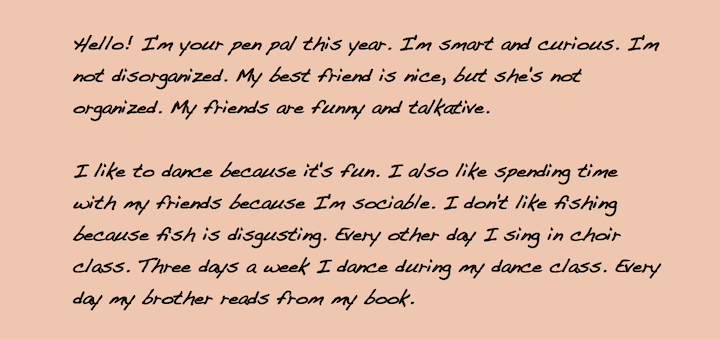 Sample pen pal letter excerpt (English). Download more samples in Spanish and English.
Stacks of Letters
Then the fateful day arrived in which my colleague and I exchanged our lovingly written stacks of pen pal letters. I would recommend this to any eager adopters of our pen pal project: make copies of all the letters. Although it seems preposterous ;-), middle schoolers COULD lose their received letters, making it near impossible to respond and keep the flow going.
The hardest part was next: the great wait. We held onto the letters until the conclusion of the next unit. If I had a counter for how many times students asked about when we would read and write our next letters, it would likely be in the double digits. Success! They were hooked.
When the end of the unit arrived, students finally received their letters. We asked students to carefully read the letters and prepare to respond with the new knowledge they had acquired throughout the unit of study.
Lather, rinse, repeat. And then the payoff.
We continued this write-submit-receive-read-write cycle until the end of the year. This led to the conundrum: What is the final payoff? How will we reveal the pen pal partners? We decided to do two different assignments across the two different years:
During year 1, we reserved our library learning commons and had students meet each other during a shared class period, complete with snacks and drinks. This meeting was also structured to be an interpersonal interview in which students had to develop and ask a last set of questions to their no-longer-mysterious pen pal partners.
However, during year 2, when this in-person meeting was not logistical, we had students create a video message for their pen pal and had them email them to him/her and to their teacher.
And thus came the conclusion of the pen pal project, to be brought back for a Season 2, 3… and currently in its 6th year and a cornerstone of our class.
Summing up
Since I’ve likely presented you with an information overload, let me summarize the recipe for our project:
- Partner up with a teacher or teachers who teach the same curriculum and grade level.
- Bring rosters, pair students, and assign them codes that will help you, the teacher, know which letter goes to whom but maintains secrecy among the students. Pair them however you’d like: alphabetically, randomly, or with a system that works for you.
- Decide on how many letters you want the students to write/exchange and the purpose that each will serve within the curriculum.
- At each writing interval, ask students to plan, draft, edit, revise, and finalize a letter. My suggestion would be a final, typed copy.
- Make a copy of all the final letters. Store them somewhere, just in case. Exchange letters with your partner teacher(s).
- At the interval you have decided on, hand out the letters to students and ask them to read the letters, then plan, write, draft, edit/revise, and finalize their next letter.
- Repeat the process, culminating in a final meet-up with students or a “payoff” wherein students are revealed to their partners.
Some Lessons We’ve Learned
No plan goes perfectly, and students are living, flexible creatures. There are many audibles that my colleague(s) and I have had to call during this process over the past six years. Allow me to share our lessons learned:
- The interval between final letter draft and exchange should be long enough that absences and disruptions are alleviated with extra time to gather all letters. This especially helps with serially late submitters. This also helps to give you time to grade and revisit with students for an additional rewrite, if necessary.
- If students leave your class or the district, be ready to re-assign their partners to other students or leverage the extra credit/extra letter opportunity I explained above.
- Middle schoolers are crafty: they may find out to whom they are writing. As the teacher and organizer, continue to encourage students to play by the rules and promote the fun of the mystery!
- Conference with students during the drafting process. You want to make sure to set them up to be as successful with written communication as possible. It is difficult to coach a student through reading a letter that is fraught with errors and missing information.
So Where Does Your Subject Fit In?
The letters are a great opportunity for students to share learning in any subject area.
- Could they offer their opinion on a book or piece of literature they just read?
- What have they learned about the water cycle and what is their opinion on the best method of water conservation?
- Is there a piece of art they created in art class that they want to describe and maybe even show off to a mystery partner?
- What do they think is a sustainable development goal worth pursuing for a Model UN project in their social studies class?
These letters could be a great source of celebration of one’s learning! The important centerpiece of this letter is that students are sharing themselves and their learning with others and learning about their peers in a mode of communication that is novel to this generation of students and promotes interconnectedness.
Truly, working within the structure and spirit of the pen pal project, I believe you can apply this across almost any curriculum area. It aids in authentic application of learned material and has the potential to engage students in exciting ways!
PS: Dear middle school educator – I hope that you found this particular pen pal project an activity you feel can fit well within your curriculum area. With a little bit of organizational work with a peer, trial and error, flexibility, and patience, I believe this activity is a great opportunity to engage our younger generations while building opportunities for content and skill application and growth. Enjoy this with your students!
Happy writing,
Your fellow middle school colleague, but not-so-mysterious pen pal,
Scott
Dr. Scott Silver-Bonito is a Technology Integration Specialist and 7th grade Spanish teacher in the Wilton (CT) Public Schools. Scott holds master’s degrees in Curriculum and Instruction and Spanish-language literature, a sixth-year degree in Educational Administration and Leadership from Southern Connecticut State University, and a doctorate from Northeastern University in curriculum, instruction, leadership, and learning with a focus on social justice. His special interests include design thinking and adult education. Read another post by Scott

