

At a time when environmental discourse is often polarized (and polarizing), overwhelming, or abstract, theatre offers something rare: a shared human experience.
Classic plays are often approached as cultural artifacts: texts to be presented, preserved, interpreted, and admired for their artistic merit or historical importance. They are staged to entertain, to educate about theatrical craft, or to fulfill curricular requirements in literature and drama. They have been seen and appreciated by countless people. They are amazing works of art.
This undervalues their potential.
Many classic and canonical plays—whether written centuries ago or in the last few decades—contain urgent questions about land use, resource exploitation, power, responsibility, and humanity’s relationship with the natural world. When connected to other streams of thought, these works can be catalysts for environmental dialogue, cross-disciplinary learning, and community conversation.
And theatre is a great vehicle for such connectivity. It conveys complexity well. It welcomes diverse voices and points of view, both on stage and in the audience. It does not demand consensus. It thrives in the dimly lit spaces between people: ambiguity, contradiction, and emotion. Discussion of environmental issues often needs such a vehicle, in that they are not only scientific or political problems. They are also cultural, ethical, and human. Classic plays, even those not explicitly “about the environment”, are fertile ground for exploring these tensions. They ask audiences to engage with both ideas and consequences — beyond choices between “this” and “that” — and to feel the weight of social decision-making.
What if we used productions of such plays as opportunities for audience talkbacks, dialogue, and education that weren’t about the plays per se, but rather about the social and environmental issues that the works imply?
Let’s expand on the notion of “environmental plays”
There are many new plays that explicitly address climate change, ecological collapse, and sustainability. To name just a few: The Contingency Plan, Greenland, Earthquakes in London, Oil, The Children, and 2071. (There is a short list at the bottom of this essay.) These plays are great. They speak directly to our current moment. They also often clear avenues for transdisciplinary post-show discussions, classroom analysis, and civic engagement.
But we rarely use them this way. And many of these modern plays are not produced as often as “the classics”.
Focusing only on explicitly environmental plays narrows the conversation. Many classic works connect with environmental themes through stories of land, labor, power, and consequence. These plays may not name climate change or biodiversity loss, but they dramatize the human patterns that drive many of the crises we face today: short-term thinking, commodification of land, subversion of knowledge, and conflicts between private gain and public good. Plus, they are terrific plays that have stood the test of time. Indeed, some theatre goers might even avoid an “environmental play”, for fear that it might be pedantic. A classic play could be an answer, and maybe even a “Trojan Horse” to discuss new ideas.
Anton Chekhov’s The Cherry Orchard is not an “environmental play”. (I spent a while writing music for and performing in, as the accordion player, a Chautauqua production.) But what is it about? A family has sold its orchard. It will be cut down to make room for rich vacation homes. The family loses its heritage. The workers lose their jobs. The landscape is subverted. The themes that drive the story are about land use, ownership, memory, and economic transformation. The orchard is both symbol and material reality—a living landscape reduced to a financial calculation. Chekhov does not frame the decision to cut it down as villainous. It is practical, logical, and perhaps inevitable. This is exactly what connects it to and potentially makes it useful for contemporary environmental challenges. The play asks: What do we lose when land is valued only for its economic potential? Who gets to decide the future of shared environments? How do we live with the consequences of choices that feel unavoidable? Through what history of additively bad decisions did these losses become unavoidable?
Wouldn’t it be interesting to stage the play and join it with audience talkbacks or student conversations about land use?
Classics and environmental behavior
Many classic plays reveal recurring human behaviors that drive environmental degradation. Bertolt Brecht’s Mother Courage and Her Children centers on war and explores systems of exploitation that treat both people and resources as expendable. War economies destroy landscapes (cultural, social, historic, economic, agricultural, natural) as relentlessly as they destroy human lives. Mother Courage is a study of how crises accelerate extraction and normalize destruction.
The characters of Chekhov’s The Seagull, Ibsen’s An Enemy of the People, and O’Neill’s The Iceman Cometh are products of societies in transition, facing industrialization, economic decline, and changing relationships to their environments. These transitions are not abstract; they reshape relationships to land, labor, and nature. New audiences can see the cultural roots of modern environmental crises and appreciate how long these tensions have existed.
Even in a play from ancient Greece is possible. In Aristophanes’ The Birds, two Athenians create a utopian city in the sky through an agreement with birds, satirizing ambition, politics, and the illusion of harmony with nature. The characters want to escape ecological limits by imagining utopian alternatives. The play’s comedy is idealizing visions of harmony with nature that collapse under the weight of human greed and ambition.
Talkbacks, communities, and living conversations
Theatre’s power does not end at the curtain call. Post-show discussions, audience talkbacks, and community forums can transform performances into shared spaces for reflection and dialogue. When environmental themes are intentionally foregrounded, classic plays can serve as entry points into engaging conversations.
Rather than asking audiences to debate climate policy directly, talkbacks can begin with the play’s human questions: Why do characters resist change? What fears drive their decisions? What losses are they unwilling—or unable—to accept or even acknowledge? These questions naturally lead to environmental parallels that might relate to people’s lived experience, without necessarily triggering defensive responses rooted in tired, stereotypical political confrontation.
In Jez Butterworth’s Jerusalem, a rebellious outsider defends his woodland home against eviction as development pressures threaten land, community, and rural identity. It could be particularly effective in community settings where land use and identity are lived issues. The post-apocalyptic work Mr. Burns, a Post-Electric Play invites audiences to consider how culture adapts when ecological systems fail, and what stories we choose to preserve. Lucy Kirkwood’s The Children and Ella Hickson’s Oil ask: Who bears responsibility for environmental damage and who must live with its consequences? These works highlight both continuity and change in how societies understand responsibility. Students are not only learning about environmental issues; they are inheritors of choices made before them.
Theatre allows these realities to be explored emotionally, not just intellectually.
Between departments and within communities, theatre can bridge disciplines and conversations
An underused opportunity in both education and cultural programming is the pairing of theatrical productions across departments. In schools, plays are often sequestered within English or drama departments, while environmental topics are confined to science or geography. Theatre can be a bridge.
How about a joint production between the drama, biology, and civics departments? What if the drama department presented Ibsen’s An Enemy of the People—in which a doctor exposes polluted baths but is ostracized (including by his own politician brother) when economic interests and public opinion reject inconvenient environmental truth—alongside biology and government lessons on water pollution, public health, and environmental whistleblowing? The play is from 1882 but presents a very contemporary problem. It is a case study in the social dynamics of environmental truth, the marginalization of scientific evidence, the pressure of economic interests, and the personal cost of speaking out.
Sound familiar? Students can examine the art of theatre and expression, the psychological and political barriers to action, and the science of contamination.
Shakespeare’s The Tempest invites discussions about control over nature, colonization, and stewardship. Prospero’s dominion over the island suggests questions about exploitation masked as civilization. Pair it with studies of colonial resource extraction or Indigenous land rights, and the play becomes a forum for examining historical patterns that still shape global ecological inequalities (Estok 2007). King Lear is a less obvious path to environmental dialogue, but storm-battered landscapes and breakdown of human order open conversations about vulnerability, exposure, and humanity’s limits in the face of natural forces (McMullen 2015). Over my years as a theatre artist, I created music for four different productions of King Lear and didn’t realize this interpretive angle until writing this essay.
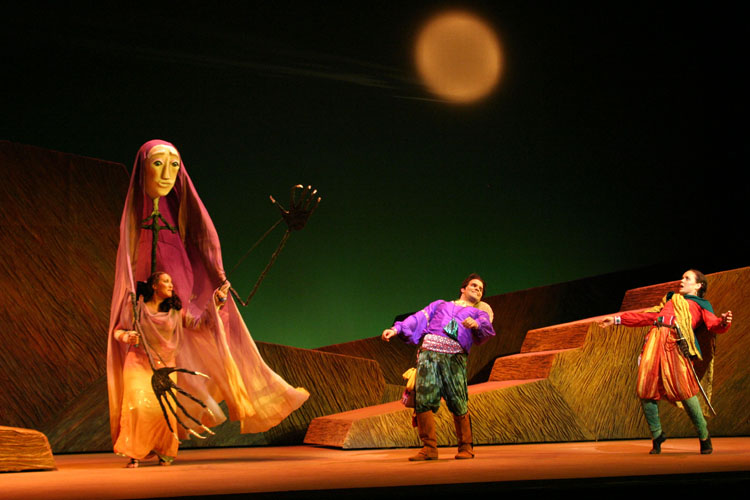
Play productions could become shared projects: theatre students staging the work, environmental and civics students contributing research and context, art departments designing lobby exhibits, and all segments shaping audience engagement. Pre-show materials, lobby installations, and short presentations could situate the play within current debates, while post-show discussions co-led across disciplines model the kind of integrated thinking environmental challenges demand. The benefits are mutual. Theatre and art students gain a stronger sense of contemporary policy relevance; science and policy students learn to communicate complex ideas in human, narrative terms; and audiences encounter environmental issues not as abstractions, but as lived dilemmas embodied on stage.
Knowledge out of silos
It is quietly radical. It breaks down the assumption that knowledge lives in silos, art in one corner, science in another, social policy in a third. It suggests instead that understanding the world—especially something as complex as socio-environmental change—requires multiple ways of seeing, thinking, and expressing.
Community theatre offers another important opportunity. (See Cohen-Cruz 2005.) Unlike schools or universities, community theatre is typically deeply embedded in local contexts. It draws audiences who may not otherwise attend academic lectures or policy discussions. That makes it an ideal platform for grounded, place-based environmental conversation.
Imagine a community production of The Children, set in an area considering nuclear power and grappling with questions of sustainability, risk, wars over petroleum, and long-term responsibility. Or Oil, tracing generations shaped by fossil fuels, staged in a place economically tied to extraction industries. The Contingency Plan is about rising sea levels and could resonate deeply in coastal or flood-prone communities.
Or, if these feel too “on the nose” for communities exhausted by polarized debates, then classic plays can work powerfully. Chekhov’s The Seagull can prompt reflection on changing landscapes, artistic responsibility, and people unable to change. There is an actual seagull in the play that is both a literal and a symbolic presence. A seagull is shot and presented to Nina, an action that foreshadows her own loss of illusion.
The plays become a way in, not by presenting conclusions but by opening space for dialogue. People see their own tensions reflected: between livelihood and sustainability, present needs versus future consequences, consumption and its relationship to sustainability. This can make for meaningful dialogue. Talkbacks don’t have to be abstract or generic. They can be rooted in local realities: What’s happening here? Who is making those decisions? What are the trade-offs? What feels inevitable—and is it really so?
Community partners such as local environmental groups, planners, historians, activists can be brought into the process, not as add-ons but as collaborators. They might help shape discussion questions, contribute to program materials, or participate in post-show conversations. In some cases, the production itself might include documentary or locally relevant elements layered alongside the text. For example, produce the play, but also project local reality and policy on the wall behind or in the lobby
So what?
What matters is not that theatre provides answers. It doesn’t. What it can do is create a shared space where people are willing to sit with difficult questions together. In a time when environmental issues are often polarized or overwhelming, that kind of space is rare—and valuable.
In both university and community settings, the goal is similar: to use theatre not just as performance, but as a meeting ground. A place where different kinds of knowledge come together, where stories connect to lived experience, and where conversation—thoughtful, open-ended, and sometimes uncomfortable—can begin.
At a time when environmental discourse is often polarized (and polarizing), overwhelming, or abstract, theatre offers something rare: a shared human experience. Using classic or modern plays as starting points for environmental dialogue does not require rewriting them or imposing contemporary messages. It requires listening carefully to what they already contain. Land disputes, industrial change, moral compromise, denial, hope—these themes are woven through dramatic literature across centuries. Classic plays carry authority and familiarity, which can disarm resistance. They remind us that environmental crises are not only about carbon levels, +2° worlds, or policy frameworks, but about values, futures, memory, loss, imagination; that is, about lived experience.
By intentionally pairing productions with environmental study, community dialogue, and cross-disciplinary learning, theatres and schools can transform familiar works into living laboratories for reflection and action. In doing so, we honor both the enduring power of theatre and the urgency of the environmental challenges we face. Classic plays are not just the province of art. They are in social dialogue.
David Maddox
New York City
Selected References:
Arons, Wendy, and Theresa J. May, eds. Readings in Performance and Ecology. London: Palgrave Macmillan, 2012.
Barone, Tom, and Elliot W. Eisner. Arts Based Research. Sage Publications, 2012.
Boal, Augusto. Theatre of the Oppressed. New York: Theatre Communications Group, 1979.
Chaudhuri, Una. “There Must Be a Lot of Fish in That Lake: Toward an Ecological Theater.” Theater 25, no. 1 (1994): 23–31.
Cohen-Cruz, Jan. 2005. Local Acts: Community-Based Performance in the United States. Rutgers University Press.
Estok, Simon C. “Ecocriticism and Shakespeare: Reading Ecophobia.” Shakespeare Bulletin 25, no. 2 (2007): 61–77.
Freestone, Elizabeth, and Jeanie O’Hare, editors. 100 Plays to Save the World. Nick Hern Books, 2021.
Jackson, Shannon. Social Works: Performing Art, Supporting Publics. Routledge, 2011.
McMullan, Gordon. “The Uses of History: King Lear and the Environment.” In Shakespeare and Ecology, edited by Randall Martin. Oxford University Press, 2015.
Nicholson, Helen. Applied Drama: The Gift of Theatre. Palgrave Macmillan, 2005.
Selected Examples of Plays: Here are 10 classic plays and 19 modern plays (post-1970) that fit the themes of this essay. This is an idiosyncratic, not comprehensive list. What unites these plays is not that they are all “about the environment” in any narrow sense, but that they all explore how humans live within—and often mismanage—larger systems: land, resources, power, and time. This is what makes them so useful for interdisciplinary collaboration and discussion—they open space where science, ethics, economics, and culture can meet, not as separate subjects, but as parts of the same stories.
Classics / Canonical Plays
An Enemy of the People (1882) Henrik Ibsen – A doctor exposes polluted baths but is ostracized, including by his politician brother, when economic interests and public opinion reject inconvenient environmental truth
The Birds (414 BCE) by Aristophanes – A satirical comedy about humans building a utopian city with birds, exposing ambition, power, and flawed visions of harmony with nature.
The Tempest (1611) by William Shakespeare – Prospero exerts control over an island’s natural forces, raising questions about power, colonization, and humanity’s relationship with nature.
The Skin of Our Teeth (1939) by Thornton Wilder – A family survives an Ice Age, a biblical flood, and a devastating war, blending environmental catastrophe with human resilience.
Mother Courage and Her Children (1941) by Bertolt Brecht – A war profiteer survives by selling goods to soldiers, revealing how systems of conflict exploit both people and resources.
The Iceman Cometh (1946) by Eugene O’Neill – Set amid social and industrial decline, the play explores illusion, despair, and the psychological toll of a collapsing world.
The Arsonists (1958) by Max Frisch – A dark allegory about people enabling their own destruction, often read as a warning about inaction in the face of looming catastrophe.
The End of the Golden Weather (1959) by Bruce Mason – A coming-of-age story reflecting on landscape, memory, and changing relationships to place.
The Seagull (1896) by Anton Chekhov – Artists and lovers struggle with ambition and dissatisfaction in a rural setting shaped by nature and change.
The Cherry Orchard (1904) by Anton Chekhov – A family estate is sold and its orchard destroyed, symbolizing land use change, economic transition, and ecological loss.
Modern Plays (Post-1970)
2071 (2014) by Duncan Macmillan and Chris Rapley – A lecture-performance blending climate science and storytelling, presenting the realities of climate change through a personal and accessible lens.
Big Love (2000) by Charles L. Mee – A stylized reworking of myth that examines power, violence, and human excess, often interpreted through ecological and social lenses.
Chimerica (2013) by Lucy Kirkwood – Although primarily political, this play explores pollution, media, and global capitalism, raising questions about environmental consequence and social accountability.
Earthquakes in London (2010) by Mike Bartlett – A sweeping, multi-generational play that links personal lives to climate crisis, examining denial, anxiety, and the psychological weight of environmental collapse.
Falling (2016) by Deirdre Kinahan – A family drama that explores care, responsibility, and the pressures shaping human relationships with place, with subtle environmental undertones.
Greenland (2011) by Moira Buffini, Matt Charman, Penelope Skinner, and Jack Thorne – A multi-authored play weaving together scientists, politicians, and citizens, capturing the complexity and urgency of climate change.
Harvest (1997) by Manjula Padmanabhan – Set in a dystopian future where the poor sell their organs to the rich, this play serves as a metaphor for exploitation, inequality, and the extraction of bodies and resources.
Hibernation (2021) by Finegan Kruckemeyer – It’s the year 2030 and there is an immediate climate crisis. With little choice remaining, world leaders make a collective, pragmatic decision to save the planet. For an entire year, all 8.5 billion humans on Earth will hibernate.
If There Is I Haven’t Found It Yet (2009) by Nick Payne – A family drama that touches on climate change, anxiety, and disconnection, exploring how large-scale environmental fears seep into everyday life.
Jerusalem (2009) by Jez Butterworth – A rebellious outsider fights eviction from his woodland home as development pressures threaten land, community, and rural identity, raising questions about belonging, stewardship, and resistance.
Lungs (2011) by Duncan Macmillan – A two-person play that confronts the ethics of having children in a climate-changed world, balancing intimacy with global responsibility.
Marisol (1992) by José Rivera – A surreal and apocalyptic play set in a collapsing urban world, reflecting environmental breakdown and the fragility of social systems.
Mr. Burns, a Post-Electric Play (2012) by Anne Washburn – Set in a post-apocalyptic world, this play examines how storytelling and culture evolve as society adapts to life without modern energy systems.
Oil (2016) by Ella Hickson – This play explores the human cost of fossil fuels, following a mother and daughter across generations impacted by oil, asking how our dependency on fossil fuels shapes our world and future.
The Children (2016) by Lucy Kirkwood – Set after a nuclear disaster, this play raises ethical questions around environmental responsibility, generational legacy, and the sacrifices older generations may have to make for the future of the planet.
The Contingency Plan (2009) by Steve Waters – A pair of plays about climate science and rising sea levels, exploring the tension between scientific warning, political inertia, and personal relationships.
The Heretic (2011) by Richard Bean – A provocative play about climate science, skepticism, and academic politics, raising questions about evidence, belief, and public discourse.
The Wilderness (2014) by Seth Bockley – This multimedia play explores competing ideas of wilderness and conservation, examining how humans define, value, and interact with nature.
This Is What We Do in Winter (2014) by William Eno – Focused on human behavior in seasonal cycles, this play quietly reflects on time, survival, and humanity’s relationship to natural rhythms.
Wastwater (2011) by Simon Stephens – A triptych of dark, interconnected stories set in a remote landscape, reflecting environmental unease, moral ambiguity, and hidden violence.

