

Voices of trees on burial grounds and funeral pyres, those overhearing decisions of village governing bodies and educational institutions, or the ones silently witnessing rituals at religious sites ― A council of shrinking greenery on pockets and clusters of urban conglomerates.
Trees as lived memories serve us citizens and residents, a culinary or recreational experience of engaging with them at regular intervals in our lives. A mango or jackfruit tree may bring back past relationships with our forefathers, and their ritualistic pickling processes or preservation through frying of chips. A banyan or peepal tree of the Focus genera may help recollect a vivid memory of the demise of a loved and dear one, through rituals associated with bringing the dead to their final resting place. Ceremonies and festivals, especially in India ― are always associated with using parts of a tree other than the fruit and seed, its leaves or roots, and floral extracts ― in cooking to mark death anniversaries of those deceased. Medicinal properties of flora further bring in relationality during sickness and attempts at natural cure.
Photo: Hussain Ebrahim
All these collated memoirs serve the breadth and depth of how civilizations have continued to preserve local knowledge and practices on the use of plant-derived food as curative or energetic on varied occasions. Burning of twigs, essential oils derived from bark or leaf, etc., adds to the expanse of how we source tree products even while living across urban conglomerates. Here, it is even more predominant as to how people purchase and consume the essence of nature within their homes.
Apart from this, there also exists the mere aesthetic presence of natural patches undisturbed by development. These pockets create breathing spaces for the mind of feeling to reconnect with nature in its pristine form. Within our backyards, we aspire to stay within reach of shrinking clusters of natural greenery. While they hold testimony to the unfulfilled promises of local government bodies under their shade, their presence near panchayat offices offers solace to the elderly, to women, and to children ― in diverse ways. Often proximal to a temple or place of worship ― they serve as spaces for festive rituals, ordinary day socializing, and recreation through board and card games, or mere relaxation, avoiding the scorching heat during summer. They also offer respite during heavy pours in the monsoon season for passersby.
Graveyards, village councils, and sites of worship ― as fundamental to the conservation of suburban, township, and city ― tree covers
Funeral sites are often silent spaces that stand against the forces of urbanization and development. They offer solace to nestling tiny mammals and avian species ― both migratory as well as local, to the biome that they create as silos of refugees for the biodiversity in any city. While tree relics and understories are rarely cleared, especially in larger grave lands, they are reshaped with seasons around the newly buried, offering space for regeneration of saplings and seed dispersal.
Panchayat houses in the suburbs are also trapped in the expansion of urban conglomerates and widening of highways ― both state and national. While underpasses and bridges are constructed, tree relics stand their ground firm beside a flyover, their roots protruding through the walls of an underbridge. Besides temples, they take refuge in the religious sentiments of humans and are even spared the axe by the most powerful politicians and financial powers who dictate development agendas in the city.
Newer townships, too, save a sacred grove from the ruins of a bulldozer. Fearing superstitious repercussions ― birds, insects, and rodents are spared from the loss of a micro-habitat, while the anthropocene attempts to reshape the landscape foreign to the local flora and fauna. Being more diverse than exotic species shipped across nations, these sacred spaces of pristine nature represent the health of the local ecology and offer a learning to landscape artists ― on natural synergies that exist in the local biome.
Tree memoirs ― a diverse perspective account of how humans navigate relationships with flora in their lived environments
Be it the choice of wood used at funeral pyres, during fire rituals for a housewarming or marriage ceremony ― Hindus have scientifically chosen medicinal trees like neem or auspicious ones such as mango, to initiate their fueling rituals with camphor. Essential oils and hot brews from barks, flowers, and herbs, or even resin smoke, purify and energize the body and spaces that are meant to be welcoming to the realms of the spiritual world, during certain occasions. This is the lived experience of humans, at least within the Indian subcontinent.
But there is a greater existential value that local flora offer, apart from such enlisted use values. Linked to customary beliefs and ritualistic practices ― they shape the day of some religious folks by their mere presence. Especially those of sentimental significance pertaining to symbolic superstitions ― they become places of worship by growing over generations at prominent landmarks of once rural regions. With the expansion of a city, they are preserved from felling ― while roads and other developmental activities bend around their canopies. Villages turn peri-urban, yet the essence of what twin Ficus trees stand for, or those ageing with prolonged roots ― remains in essence in the hearts of the residents witnessing the growth of a metropolitan into their farms and meadows.
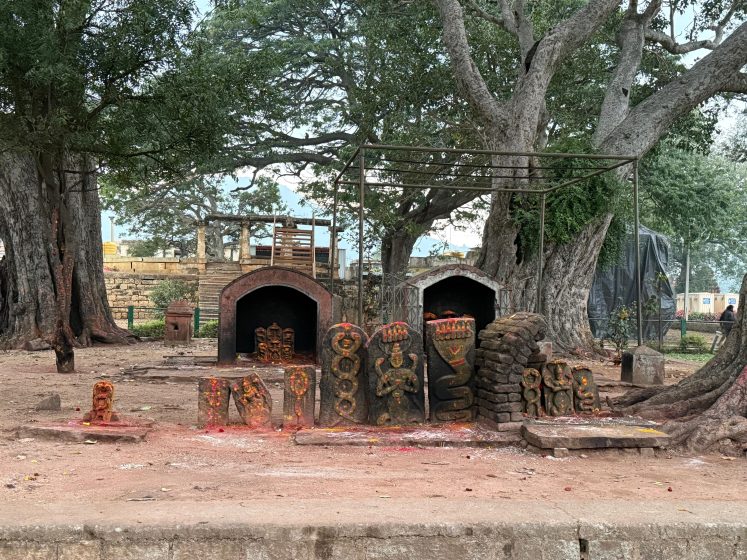
Photo: @tilottamaham
Temple trees
Ancient tree relics marking prominent meeting points within suburban villages still stand strong against the will of urbanisation and development. Their canopies bend the construction of flyovers or highways, their roots uprooting roads and pipelines, they stand testimonial to the dynamic politics around nature. They serve as refuge to dwindling urban biodiversity and are homes to local flora and fauna in their understories.
Most have a space of worship connecting Hindu mythology to the sacredness of shade under which spiritual aspirants found liberation, or how local healers healed societies with their medicinal properties ― their divine presence earmarks eons of historical narratives. Serving as grounds for dialogue ― lovers, friends, politicians, and businessmen seek respite from the scorching afternoon sun, or from a sudden heavy downpour. They overheat our conversations and know when it’s their time to meet the axe. They shape local climates around shifting seasons, and their leaves, fruits, and seeds provide ritualistic symbolism to those who believe in their divine healing energies.
Wood and ashes at funeral pyres
Oftentimes, the only wish of the one departed, or of their family members ― is to cremate them in vibrant energies ― sourcing wood from medicinal trees. Both ritualistic and spiritual, the embodied energy in dry wood from certain species helps the spirit in its final ascent into the meta-universe. Leaving the earth plane and detaching oneself from earthly desires, their ashes constitute earthy minerals that are either released into flowing waters of religious significance, kept in urns, or transformed into pendants that hold remnant memories for dear and loved ones.
Trees at burial grounds
Giant relics with unfelled branches stand wide and tall, offering shade to graves, as their roots suck vital energies from the dead. They offer a space for local flora and fauna to thrive undisturbed, in pockets around urban roads with traffic and noise. They offer nesting sites for insects, small mammals, migratory and resident birds ― as niche biomes with unique biodiversity or regenerating saplings, herbaceous plants, and understory shrubs and thickets. These cemeteries aren’t like the lawn-mowed, well-kept ones in developed nations ― but are mere micro forest habitats within bustling city conglomerates. Their natural growth and untamed progression from a patch of grassland to a young forest is testimony to the peace that each death and burial brings to that land. Some have great terrains with rivulets of storm water drains that keep soil from eroding, maintaining a unique topography across parts of the city, and open out at multiple gates on various sections of the urban spaces.
Trees in sacred groves
Some sites are human-influenced and intended plantations of medicinal herbs and trees. These dedicated spaces are considered sacred to the deities of the land, nature, and universal balance. They are often used during rituals and religious ceremonies to harvest plant-derived medicine of symbolic importance to certain faith practices. They also have nestled within their shades ― rocks of divine significance, idols carved out of wood or stone ― representative of forms of divinity, and boulders that earmark spots of grounded energies channeled from mother earth. Temple graves and wells with holy water, Sufi shrines and trees that symbolize nationhood or transcending borders of politics and faiths, streams of purity that channel wellness within them all encompass the embodiment and surge of energies in such sacred spaces. Their existence is symbolic of grounding negativity and spreading positive vibes into the surroundings. Many visitors come to clear their auras and free their karmic debts.
Trees around peri-urban local bodies of governance and learning
Rural areas around city limits are slowly being urbanised. Yet eons and eras of tree plantation designs to mark village entryways, highway road-widths, or spots where people gather for recreation or official purposes ― are retained as robust and hardy species ― against such rampant developmental activities. Most panchayat houses still have tree relics that overhear discussions of local governing bodies. They are aware of the aspects of ruling parties dictating if they stand a chance at survival for the next political term. They also stand within village-based schools funded by local agencies of political rule, often offering a play area and sit out to children, parents, and teachers.
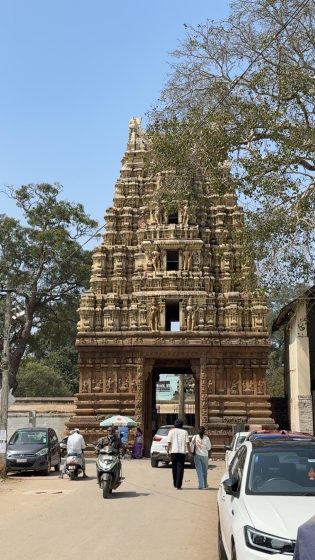
Photo: @tilottamaham
This essay addresses the emotional connection that humans have with trees, in their continued efforts to preserve patches of greenery within growing and overpopulating cities. The use of religion, governance, and death as a reason to conserve tree relics and urbanscapes in their pristine forms vis-à-vis urbanising gardening design is discussed here. The services that trees and greenscapes as urban commons provide to the soul at a level of mental health and emotional appeal cannot be matched with landscape architecture and anthropologenic aesthetics of any sort. The choice of natural processes in shaping a particular biome is unique to a site ― be it a burial plot, a sacred grove, or an urban forest park; and can’t be replaced by plantations of vegetation in the anthropocene.
Hussain Ebrahim
Bengaluru
References
Baker, Harriet. “Tree-hugging: A scientist’s engaging memoir and paean to plants.” TLS. Times Literary Supplement 5908 (2016): 27-28.
Bobier, Michelle. “MEMOIR: The White Woods.” The American Scholar 65.2 (1996): 279-283.
Chan, David Marshall. “Memoirs of a Boy Detective.” Conjunctions 45 (2005): 265-275.
Deleuze. “Memoirs of the Life and Botanical Travels of Andre Michaux (Continued).” The Belfast Monthly Magazine (1810): 117-127.
Dunphy, Maureen. Divining, a Memoir in Trees. Wayne State University Press, 2023.
Durand, Elias. “Biographical memoir of the late François André Michaux.” (1860): xvii-xxviii.
Hillman, James. “In the Gardens—A Psychological Memoir.” Consciousness & Reality. Brill, 2000. 175-182.
Hillman, Laura. I will plant you a lilac tree: A memoir of a Schindler’s list survivor. Simon and Schuster, 2005.
Hinds, Richard Brinsley. “XI.—Memoirs on geographic Botany.” Journal of Natural History 15.96 (1845): 89-104.
Irving, Apricot. The Gospel of Trees: A Memoir. Simon and Schuster, 2018.
Jaffrey, Madhur. Climbing the mango trees: a memoir of a childhood in India. Knopf, 2006.
Le Goux de Flaix, M. “XVI. Memoir on the natural history of the coco-nut tree and the areca-nut tree; the cultivation of them according to the methods of the Hindoos; their productions, and their utility in the arts and for the purposes of domestic economy.” The Philosophical Magazine 21.82 (1805): 110-116.
Mason, David T., and Elwood R. Maunder. “Memoirs of a Forester Part II: Oral History Excerpts.” Forest History Newsletter 13.1-2 (1969): 28-39.
McGowin, Floyd. Forest and the Trees: A Memoir of a Man, a Family, and a Company. NewSouth Books, 2015.
Nathorst, Alfred Gabriel. “Notices of Memoirs.” Geological Magazine 8.5 (1911): 217-225.
Rice-Oxley, Mark. Underneath the lemon tree: A memoir of depression and recovery. Hachette UK, 2012.
Simard, Suzanne. Finding the mother tree: Uncovering the wisdom and intelligence of the forest. Penguin UK, 2021.
Simon, Carly. Boys in the Trees: A Memoir. Flatiron Books, 2015.
TREES, VIGOROUS. “GEOPHYSICAL MEMOIRS.” Nature (1915).
White, Jessica. “Wilding, Eco-Memoir and Biodiversity.” The Poetics and Politics of Gardening in Hard Times (2019): 71.
Withers, William. A Memoir, Addressed to the Society for the Encouragement of Arts, Manufactures, and Commerce, on the Planting and Rearing of Forest-trees. James Shalders, 1827.

